War-weary Yemenis fell trees for fuel, cash / Photo: © AFP

 Mancini brings nine newcomers into the first squad of his Italy comeback

 Czechs level Davis Cup tie against USA as South Korea eye Finals

 New France boss Zidane confirms Mbappe as captain after naming first squad

 California governor signs order to explore AI 'kill switch'

 Head leads run spree as Australia win Zimbabwe ODI series

 In-form Raphinha wants to finish career at Barcelona

 Warren Buffett steps down as Berkshire Hathaway chairman

 Carrick confident Man Utd can 'work through' tough time

 Mbappe ends Nike partnership to join Swiss brand On

 Liverpool boss Iraola puts Bournemouth love affair on hold

 'A disaster' if Man City do not win says Maresca after flawless start

 Kerry James Marshall: American 'blackness' painter celebrated in Europe

 Spain coach De la Fuente offers 'full support' to people of Ceuta

 Russia seizes assets of Nestle, French firms over West's Ukraine support

 England can build on World Cup 'spirit', says Tuchel

 UNESCO can be 'moderator' in AI debate: chief to AFP

 Infantino 'must go', says German FA vice-president

 Russia seizes assets of Nestle, French firms

 Japan's busiest rail station tests robot bins

 Anthropic says AI systems moving towards building themselves

 Asian stocks boosted by falling oil, yen weakens after BoJ rate hike

 Pakistan court blocks expulsion of Afghan medical college students

 Athletes 'can't take it any more' as Asian Games issues mount

 Allen lights up Bills' new stadium with 41-31 win over Lions

 Afghan medical students in Pakistan hope court stops college expulsions

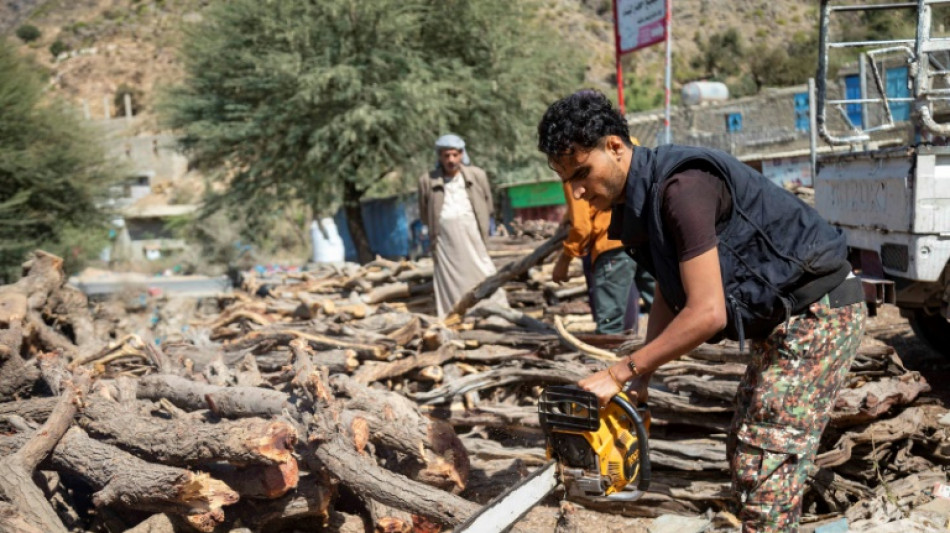
The sound of an electric saw rips through a lush mountain landscape in southern Yemen, where years of conflict and soaring prices have left people desperate for fuel and income.
"We started cutting trees and selling them because we have no other way of making a living," said Hussein Abdulqawi from a thinning forest on the outskirts of Taez.
He and other workers lugged freshly cut wood into the back of a van near the city, which is besieged by rebels but still under government control.
A more than eight-year-long war between Saudi-backed government forces and pro-Iran Huthi rebels has devastated Yemen, the poorest country on the Arabian Peninsula.
Following Russia's invasion of Ukraine a year ago, rises in global food and fuel prices have piled on further suffering.
Abdulqawi acknowledged he was contributing to an environmental "catastrophe" but said he lacked options in a nation where many cannot afford fuel for heating and cooking.
"We have no choice" but to sell the wood, just as people "have no choice but to buy" it, he said.
Huthi rebels seized the capital Sanaa in 2014, prompting a Saudi-led coalition to intervene the following year to prop up the internationally recognised government.
Since then, the war has caused hundreds of thousands of deaths both directly and indirectly, and pushed the nation to the brink of famine.
An estimated 21.6 million people –- two-thirds of Yemen's population –- will require humanitarian assistance and protection services in 2023, according to the United Nations.
- 'Anarchic' -
At a Taez bakery, tree trunks and branches are cut into pieces and piled into bread ovens.
The wood crackles as it catches fire while employees shovel out loaves at a frantic pace.
Standing in front of the oven, bakery owner Abdelsalam Dabwan complained of an "incredible increase" in gas costs.
He said he used wood as a cheaper alternative and to avoid compounding his people's "suffering" by putting up bread prices.
"We use wood to give people what they need," the baker told AFP, urging authorities to intervene to stem inflation.
Fuel costs in government-held parts of Yemen peaked early last year in the immediate aftermath of Russia's invasion of Ukraine.
They then spiked again mid-year before steadily declining, but still remain high.
Environmental expert Anwar al-Shazli said more than six million trees had been felled since the start of Yemen's war, including around the capital Sanaa, where the wood is often used in restaurants and bakeries.
Especially in Taez, trees are cut "at ground level, which affects groundwater, agricultural systems and biodiversity while contributing to soil erosion", he added.
Shazli called on authorities to prevent "anarchic" felling and to train amateur loggers on how to avoid serious damage to the environment.
"A natural disaster will befall the country" if no steps are taken, he warned.
H.Seidel--BTB