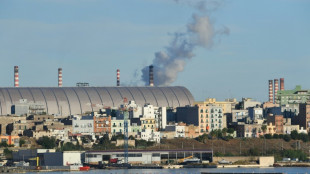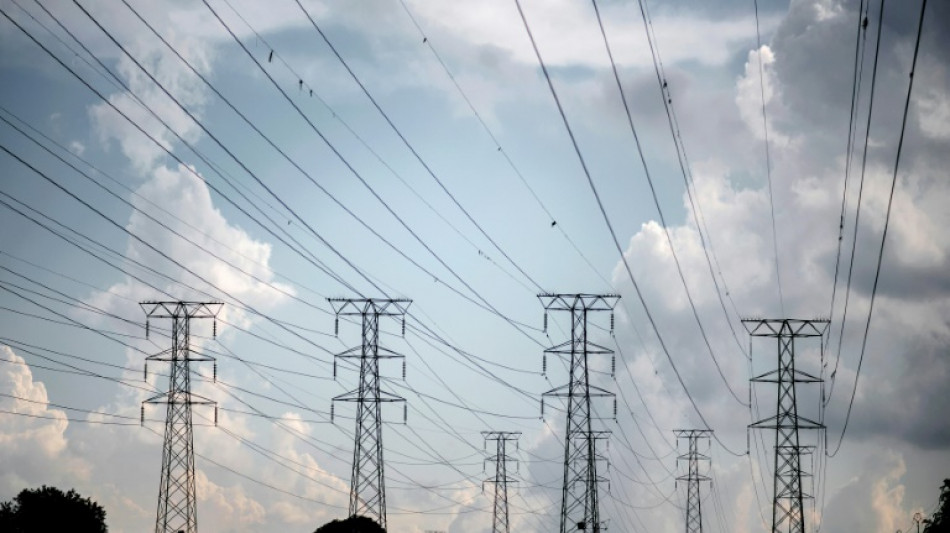
Energy-starved S.Africa offers tax breaks to boost green power / Photo: © AFP/File

 Mancini brings nine newcomers into the first squad of his Italy comeback

 Czechs level Davis Cup tie against USA as South Korea eye Finals
 New France boss Zidane confirms Mbappe as captain after naming first squad
 California governor signs order to explore AI 'kill switch'
 Head leads run spree as Australia win Zimbabwe ODI series
 In-form Raphinha wants to finish career at Barcelona
 Warren Buffett steps down as Berkshire Hathaway chairman
 Carrick confident Man Utd can 'work through' tough time

 Mbappe ends Nike partnership to join Swiss brand On

 Liverpool boss Iraola puts Bournemouth love affair on hold
 'A disaster' if Man City do not win says Maresca after flawless start
 Kerry James Marshall: American 'blackness' painter celebrated in Europe

 Spain coach De la Fuente offers 'full support' to people of Ceuta
 Russia seizes assets of Nestle, French firms over West's Ukraine support
 England can build on World Cup 'spirit', says Tuchel

 UNESCO can be 'moderator' in AI debate: chief to AFP

 Infantino 'must go', says German FA vice-president
 Russia seizes assets of Nestle, French firms

 Japan's busiest rail station tests robot bins
 Anthropic says AI systems moving towards building themselves

 Asian stocks boosted by falling oil, yen weakens after BoJ rate hike
 Pakistan court blocks expulsion of Afghan medical college students

 Athletes 'can't take it any more' as Asian Games issues mount
 Allen lights up Bills' new stadium with 41-31 win over Lions
 Afghan medical students in Pakistan hope court stops college expulsions
South Africa unveiled Wednesday new tax incentives to encourage investment in the production of clean power to help the country battle an energy crisis that has sparked worsening blackouts.
Starting March 1, "businesses will be able to reduce their taxable income by 125 percent of the cost of an investment in renewables," Finance Minister Enoch Godongwana said as he presented his annual budget to parliament.
"We will also introduce a new tax incentive for individuals to install rooftop solar panels to reduce pressure on the grid and help ease" the scheduled blackouts, also known as load-shedding, he said.
The continent's most industrialised country has been labouring under a devastating energy shortfall for months, largely due to under-investment in power utility Eskom's ageing and poorly maintained plants.
Earlier this month, President Cyril Ramaphosa announced a national state of disaster and the appointment of an electricity minister to help intensify the response to the crisis.
South Africa has suffered blackouts over the past decade but more recently they have become "more persistent and prolonged" and are wreaking havoc on the economy, in particular the country's freight and logistics network, Godongwana said.
The government had already said last year that it was taking over half of Eskom's debt pile of 400 billion rand ($22 billion).
The bailout for the firm that provides almost all of South Africa's electricity will send national debt soaring to 5.84 trillion rand, or 73.6 percent of GDP in the next three years, according to the treasury.
Servicing this debt will cost around 336 billion rand this year, Godongwana said, meaning the country now spends more money on debt than it does on healthcare, peace and security or social development.
But the government has little room to manoeuvre. The power outages have weighed heavily on South Africa's growth prospects.
- 'Irresponsible' -
The minister said growth was expected to reach just 0.9 percent this year after 2.5 percent in 2022 -- but the country's central bank had last month estimated growth to be as low as 0.3 percent due to the electricity supply crisis.
The country experienced a record 207 days of power outages last year alone, compared to 75 days in 2021, said Godongwana.
"Our economy is facing significant risks," he said.
"The minister sent a strong message that the government is failing to produce energy so it would rather incentivise people to produce their own and welcome more private investment," said political economist Lumkile Mondi.
The largest opposition party, the Democratic Alliance (DA), criticised the Eskom bailout as "irresponsible".
In additional to rolling blackouts, further shocks have threatened the continental heavyweight's prospects of cleaning up its economy such as crime and natural disasters.
Godongwana also announced beefed-up budgets to fight graft and crime in a country ranked among some of the most violent in the world outside war zones.
He set aside funds for the appointment of 5,000 new police trainees per year over the next several years.
The prosecution agency will receive extra funding to start prosecuting individuals implicated in the sweeping investigation that revealed a web of well-orchestrated state graft under former president Jacob Zuma.
G.Schulte--BTB