Foot-and-mouth variant hits Iraq buffaloes, threatening livelihoods / Photo: © AFP

 Mancini brings nine newcomers into the first squad of his Italy comeback

 Czechs level Davis Cup tie against USA as South Korea eye Finals

 New France boss Zidane confirms Mbappe as captain after naming first squad
 California governor signs order to explore AI 'kill switch'

 Head leads run spree as Australia win Zimbabwe ODI series

 In-form Raphinha wants to finish career at Barcelona

 Warren Buffett steps down as Berkshire Hathaway chairman
 Carrick confident Man Utd can 'work through' tough time

 Mbappe ends Nike partnership to join Swiss brand On

 Liverpool boss Iraola puts Bournemouth love affair on hold
 'A disaster' if Man City do not win says Maresca after flawless start
 Kerry James Marshall: American 'blackness' painter celebrated in Europe

 Spain coach De la Fuente offers 'full support' to people of Ceuta

 Russia seizes assets of Nestle, French firms over West's Ukraine support

 England can build on World Cup 'spirit', says Tuchel

 UNESCO can be 'moderator' in AI debate: chief to AFP

 Infantino 'must go', says German FA vice-president

 Russia seizes assets of Nestle, French firms

 Japan's busiest rail station tests robot bins
 Anthropic says AI systems moving towards building themselves

 Asian stocks boosted by falling oil, yen weakens after BoJ rate hike

 Pakistan court blocks expulsion of Afghan medical college students

 Athletes 'can't take it any more' as Asian Games issues mount

 Allen lights up Bills' new stadium with 41-31 win over Lions

 Afghan medical students in Pakistan hope court stops college expulsions

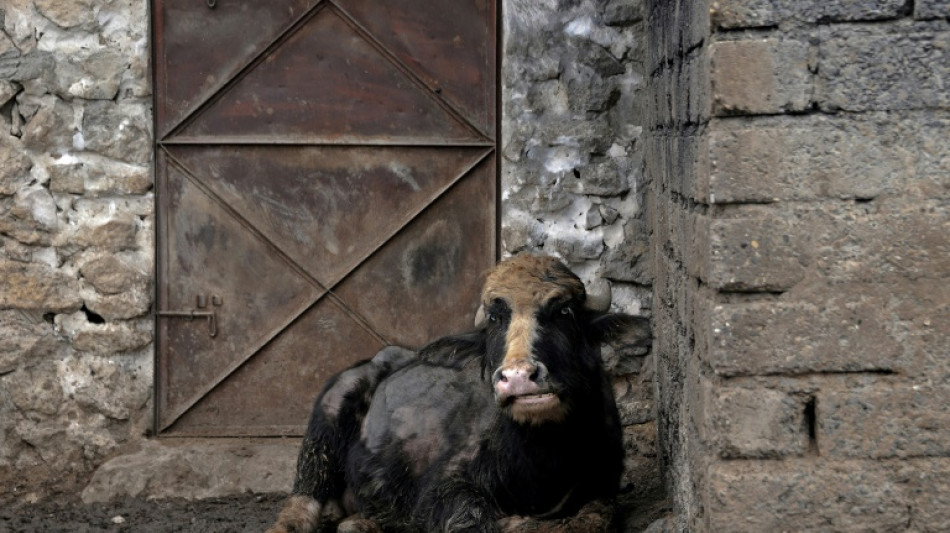
Despite vaccinating his entire herd against foot-and-mouth disease, Iraqi farmer Saadoun Roumi has lost five of his 15 buffaloes to a variant never before seen in the country.
The severe, highly contagious livestock disease has plagued Iraq for decades, but this year's outbreak has already had a devastating impact described as unprecedented by veterinarians in Nineveh province.
Laboratory tests have identified the SAT2 variant of the viral disease, the United Nations' Food and Agriculture Organization (FAO) said.
This strain -- never before recorded in Iraq -- is resistant to the vaccines normally used in the country, leaving authorities scrambling to obtain the right doses to inoculate livestock and prevent further spread.
"The infections are much higher," lamented 26-year-old Roumi from his farm in the village of Badush near Mosul, the capital of Nineveh. "Every day, there are between 20 and 25 cases in the village."
In his yard, he tends to one of his ailing animals, chewing on some fodder in a basin. Along with the five he has already lost, all his buffaloes were vaccinated against the disease as part of a campaign by authorities in 2021.
"The administered vaccines aren't effective," Roumi said. "Foot-and-mouth disease has ravaged the herd."
Between the outbreak and the exorbitant prices of fodder, Roumi like other farmers has seen his only source of livelihood pushed to the brink.
"Before, I used to produce a barrel of 50 kilogrammes (110 pounds) of milk per day -- now, it's less than 25 kilogrammes."
- High mortality -
Though the disease does not pose a threat to humans, it is highly contagious among "cattle, buffaloes, sheep, goats, swine and other cloven-hoofed", according to FAO.
The disease causes potentially lethal fevers and blisters resulting in "high mortality in newborn and young animals, weight loss, reduced milk yields and lower fertility", the UN agency said.
"Affected animals become too weak to be used to plough the soil or reap harvests, and farmers cannot sell the milk they produce, which can severely impact household food security."
Udai al-Abadi, the director of a veterinary hospital in Nineveh, noted that the disease "resurges in intermittent waves", with the last peak in 1998.
But this year, "infections are high and can be counted in the hundreds" in the province, compared with the dozens usually recorded, he said.
"More than a hundred cattle have died."
Urgent requests for vaccines have been sent to the government in Baghdad, he said, but the province did not receive its allocation of shots in 2022, though they can be purchased locally from private sellers.
- Preventing epidemic -
Saadoun Roumi's 90-year-old father Balou said he lost a calf from his herd of 20 buffaloes.
"When foot-and-mouth disease hits the animal, its milk is unusable and its legs can barely carry it," he said.
Khalid Shlash, assistant to the FAO representative in Iraq, explained that analysis of 12 samples in Nineveh, Baghdad and Diyala provinces identified the responsible strain -- SAT2, which stands for "Southern African Territories" where it originated.
He said the strain was not previously present in Iraq and therefore the corresponding vaccine had never been used there.
In a bid to curb the outbreak, authorities have launched disinfection campaigns and imposed restrictions on the movement of livestock, Shlash said.
He noted that the FAO is offering its expertise to support the government's efforts, noting that the priority now is for a specialised lab to identify the right vaccine.
Baghdad must then find a producer to supply nine million doses of the vaccine, he added.
"From where and how did this virus come to Iraq?" he said. "This is the question veterinarian services are now trying to answer."
L.Dubois--BTB