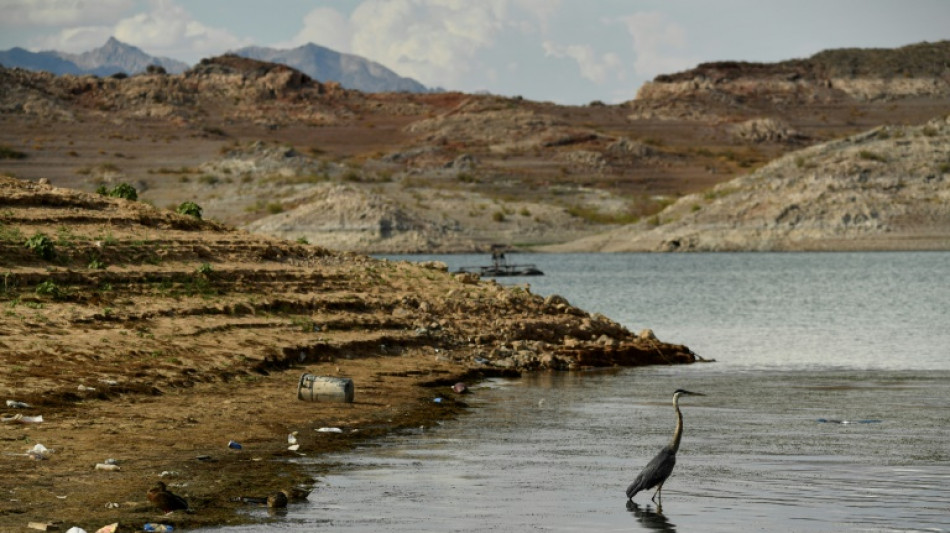
California submits rival Colorado River water plan / Photo: © AFP/File

 Galloway accuser could not foresee publishing-sector fallout, lawyer argues

 New York City Center revives In the Heights as a timely community story

 Godzilla Minus Zero shifts focus toward postwar human drama
 Mehbooba Mufti urges dialogue and renewed Central Asia links for Kashmir

 Seacliff Healthcare Seeks Specialist GP in Thirroul

 US stocks fall before midterm Election Day as technology shares weaken

 BLS Polymers makes strong market debut at ₹248 per share

 Petrol and diesel prices remain broadly steady across major Indian cities

 Reliance shares remain in focus after near-12% surge

 2026 Arizona Midterms: Key Races, Ballot Measures, and Voter Deadlines

 Coal India prepares possible $1 billion Mahanadi Coalfields listing

 Julia Stiles and Ezra Sosa Share Emotional Farewell After 'DWTS' Elimination

 US Buildings Threatened by Wildfires Could Triple by 2060

 Why Pregnancy Cost Estimates Fail: A Family’s $9,000 Surprise

 US Strikes Iranian Targets in Strait of Hormuz Ahead of Midterms

 Brodeur’s Overtime Goal Secures Bethlehem’s Second Consecutive Sectional Title

 Rare 1970 Plymouth ‘Cuda 426 Hemi Listed for $400,000

 The Digital Burden: Why Instant Messaging Feels Like a Full-Time Job

 Alberta Tabled Controversial Riding Boundary Maps Amid Gerrymandering Accusations

 Hong Kong court set to sentence activist Joshua Wong in security case

 Australia raises benchmark rate to highest level in 18 years

 'The Remarried Empress' Cast Discusses Bringing Fantasy Royal Drama to Life

 Asian stocks retreat as AI worries outweigh steep oil-price drop

 Hamad International Airport stages emergency drills during WATAN 2026

 Global failure to punish attacks leaves journalists at continuing risk

California has submitted a rival plan for use of the Colorado River, after six other states accused it of refusing to cooperate in the battle over usage of a dwindling major US watercourse.
Arizona, California, Colorado, Nevada, New Mexico, Utah and Wyoming were given until January 31 to come up with a plan to slash the amount of water they take from the river -- or face a solution imposed by Washington.
Everyone apart from California agreed on a proposal that would see a reduction in the amount of water that makes it as far as the most populous state in the country, where critics say farmers use too much to grow crops for export.
On Tuesday, California offered its own solution, and offered to trim its own use, but in the meantime to revert to the over-subscribed status quo.
"In the absence of a seven-state consensus proposal (we) should maintain existing protections to California’s senior entitlements," the Colorado River Board of California said in its submission to the Bureau of Reclamation, the federal government department with responsibility for water.
That came after a behind-closed-doors proposal last week from the state's representatives to model what would happen if big cities like Phoenix and Las Vegas were cut off from the water supply, CNN reported.
The suggestion was met with strong pushback from other negotiators, the broadcaster said, citing people familiar with the matter.
Eventually, the other six states huddled, and submitted a framework of water consumption ceilings, with the bulk of the cuts falling on California to "mitigate the risk of either Lake Powell or Lake Mead reaching dead pool."
Both reservoirs, fed by the Colorado River, have seen their levels plunge over the past two decades as a punishing drought grips the western United States.
Adel Hagekhalil, general manager of Metropolitan Water District of Southern California, said the state's proposal followed two decades of reductions from the region.
"We are committed to doing more now. But we must do it in a way that does not harm half of the people who rely on the river - the 19 million people of Southern California," he said.
"We must do it in a way that does not devastate our $1.6 trillion economy, an economic engine for the entire United States.
"The proposal presented today by California does all of this by equitably sharing the risk among Basin states without adversely affecting any one agency or state. The plan presented yesterday, which shut out California, does not."
The Colorado River rises in the Rocky Mountains and flows through Colorado, Utah, Arizona, Nevada, California and northern Mexico, where it empties into the Gulf of California.
It is fed primarily by snow accumulated at high altitude that gradually melts during the warmer months.
But declining precipitation and rising temperatures caused by humanity's unchecked burning of fossil fuels means less snow falls, and what does fall, melts faster.
That means less water reaches a river that is crucial to the great cities of the west like Las Vegas and Los Angeles, as well as to tens of thousands of acres (hectares) of farmland.
K.Brown--BTB