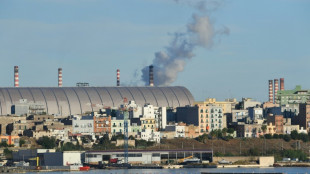
Business and consumers hamper climate fight: report / Photo: © AFP

 Mancini brings nine newcomers into the first squad of his Italy comeback

 Czechs level Davis Cup tie against USA as South Korea eye Finals
 New France boss Zidane confirms Mbappe as captain after naming first squad

 California governor signs order to explore AI 'kill switch'

 Head leads run spree as Australia win Zimbabwe ODI series

 In-form Raphinha wants to finish career at Barcelona
 Warren Buffett steps down as Berkshire Hathaway chairman

 Carrick confident Man Utd can 'work through' tough time

 Mbappe ends Nike partnership to join Swiss brand On

 Liverpool boss Iraola puts Bournemouth love affair on hold

 'A disaster' if Man City do not win says Maresca after flawless start

 Kerry James Marshall: American 'blackness' painter celebrated in Europe

 Spain coach De la Fuente offers 'full support' to people of Ceuta

 Russia seizes assets of Nestle, French firms over West's Ukraine support

 England can build on World Cup 'spirit', says Tuchel

 UNESCO can be 'moderator' in AI debate: chief to AFP

 Infantino 'must go', says German FA vice-president

 Russia seizes assets of Nestle, French firms

 Japan's busiest rail station tests robot bins
 Anthropic says AI systems moving towards building themselves

 Asian stocks boosted by falling oil, yen weakens after BoJ rate hike

 Pakistan court blocks expulsion of Afghan medical college students
 Athletes 'can't take it any more' as Asian Games issues mount
 Allen lights up Bills' new stadium with 41-31 win over Lions

 Afghan medical students in Pakistan hope court stops college expulsions

Corporations and consumers are the main obstacle to the emissions cuts needed to keep global warming to the 1.5-degree Celsius limit, researchers said Wednesday, adding that "positive signs" in other areas are not yet enough to meet climate goals.
The report by a multidisciplinary team of researchers warned that staying within the 1.5C goal was "not plausible", but that this could change if societies stepped up their efforts to cut emissions.
"We see all kinds of positive signs, for example, the political protests, divestment decisions, climate litigation cases, transnational initiatives, this is all on the rise," said one of the study authors Anita Engels. "So you could think that we are really on a good track."
But she added: "We need to do so much more".
The report, the Hamburg Climate Futures Outlook, assessed the plausibility of achieving the emissions reductions necessary to limit temperatures in line with the Paris Agreement.
That 2015 deal saw nations agree to limit global warming to well below two degrees Celsius since pre-industrial times, preferably 1.5C.
Researchers looked at 10 societal factors that they considered to be the most important drivers of decarbonisation and found that currently none are yet at a level that would lead to the dramatic emissions reductions needed by 2050.
- Media 'ambivalent' -
Using global databases and computer modelling, the authors found that seven social trends were moving tentatively in the right direction -- including United Nations climate governance, regulation, litigation, and divestment from fossil fuels.
One -- the media -- was seen as "ambivalent".
But the two heading in the wrong direction were corporate responses and consumption patterns, which the researchers said "continue to undermine the pathways to decarbonisation".
The two are closely interlinked, said Engels.
"It would be so much easier if the way the products are produced is regulated in a way that (consumers) are not forced to buy climate destructive products," she told AFP.
The report said it was still too early to assess the potential impact of recent events such as Russia's invasion on Ukraine.
Researchers also looked at six physical processes around the planet, from the melting of ice sheets to fears that a deforested Amazon rainforest will transform into savannah.
Jochem Marotzke from the Max Planck Institute for Meteorology said that these and other physical processes were important, but that "we're not on a slippery slope".
It was human agency that would prove most decisive, he said.
P.Anderson--BTB