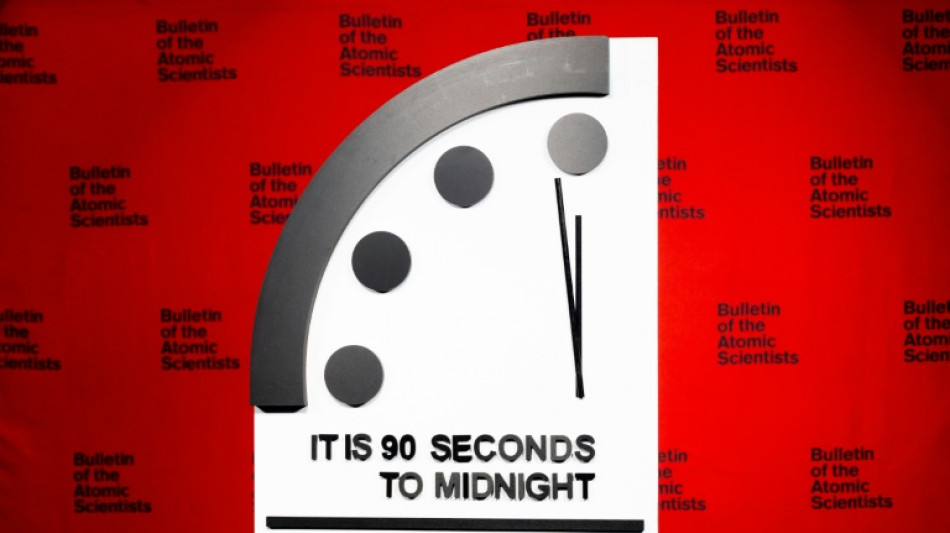
'Doomsday Clock' moves closest ever to midnight / Photo: © Hastings Group Media/AFP

 Mancini brings nine newcomers into the first squad of his Italy comeback

 Czechs level Davis Cup tie against USA as South Korea eye Finals

 New France boss Zidane confirms Mbappe as captain after naming first squad

 California governor signs order to explore AI 'kill switch'
 Head leads run spree as Australia win Zimbabwe ODI series
 In-form Raphinha wants to finish career at Barcelona
 Warren Buffett steps down as Berkshire Hathaway chairman

 Carrick confident Man Utd can 'work through' tough time

 Mbappe ends Nike partnership to join Swiss brand On

 Liverpool boss Iraola puts Bournemouth love affair on hold

 'A disaster' if Man City do not win says Maresca after flawless start

 Kerry James Marshall: American 'blackness' painter celebrated in Europe

 Spain coach De la Fuente offers 'full support' to people of Ceuta

 Russia seizes assets of Nestle, French firms over West's Ukraine support
 England can build on World Cup 'spirit', says Tuchel

 UNESCO can be 'moderator' in AI debate: chief to AFP
 Infantino 'must go', says German FA vice-president

 Russia seizes assets of Nestle, French firms

 Japan's busiest rail station tests robot bins
 Anthropic says AI systems moving towards building themselves

 Asian stocks boosted by falling oil, yen weakens after BoJ rate hike
 Pakistan court blocks expulsion of Afghan medical college students

 Athletes 'can't take it any more' as Asian Games issues mount
 Allen lights up Bills' new stadium with 41-31 win over Lions

 Afghan medical students in Pakistan hope court stops college expulsions

The "Doomsday Clock" symbolizing the perils to humanity moved Tuesday to its closest ever to midnight amid the Ukraine war, nuclear tensions and the climate crisis.
The Bulletin of the Atomic Scientists, which describes the clock as a "metaphor for how close humanity is to self-annihilation," edged its hands from 100 seconds to midnight to 90 seconds to midnight.
A decision to reset the hands of the symbolic timepiece is taken each year by the Bulletin's science and security board and its board of sponsors, which includes 10 Nobel laureates.
The hands of the clock moved to 100 seconds to midnight in January 2020 -- the closest to midnight it had been in its history -- and remained there for the next two years.
In a statement, the Bulletin said it was advancing the hands of the clock by 10 seconds this year "due largely but not exclusively to Russia's invasion of Ukraine and the increased risk of nuclear escalation."
"Russia's thinly veiled threats to use nuclear weapons remind the world that escalation of the conflict -- by accident, intention, or miscalculation -- is a terrible risk," it said. "The possibility that the conflict could spin out of anyone's control remains high."
The Bulletin said the new clock time "was also influenced by continuing threats posed by the climate crisis and the breakdown of global norms and institutions needed to mitigate risks associated with advancing technologies and biological threats such as Covid-19."
"We are living in a time of unprecedented danger, and the Doomsday Clock time reflects that reality," said Rachel Bronson, president and CEO of the Bulletin of the Atomic Scientists.
"90 seconds to midnight is the closest the clock has ever been set to midnight, and it's a decision our experts do not take lightly," Bronson said.
"The US government, its NATO allies and Ukraine have a multitude of channels for dialogue," she said. "We urge leaders to explore all of them to their fullest ability to turn back the clock."
Former UN secretary-general Ban Ki-moon also called for world leaders to take action in a world that has become more dangerous because of Covid-19, extreme weather events and "Russia's outrageous war on Ukraine."
"Leaders did not heed the Doomsday Clock’s warnings in 2020," Ban said. "We all continue to pay the price. In 2023 it is vital for all our sakes that they act."
The clock was originally set at seven minutes to midnight.
The furthest from midnight it has ever been is 17 minutes, following the end of the Cold War in 1991.
The Bulletin was founded in 1945 by Albert Einstein, J. Robert Oppenheimer and other scientists who worked on the Manhattan Project which produced the first nuclear weapons.
The idea of the clock symbolizing global vulnerability to catastrophe followed in 1947.
C.Kovalenko--BTB