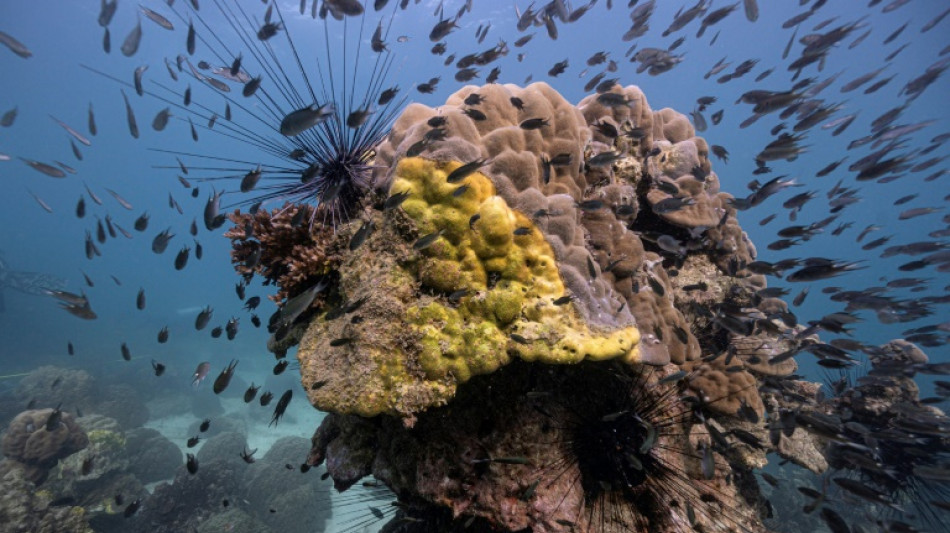
'It just dies': Yellow-band disease ravages Thailand's coral reefs / Photo: © AFP

 Stock markets retreat after central bank rate hikes

 Russia labels director of Cannes Grand Prix winner a 'foreign agent'

 Macron warns of Russian 'hybrid' threat after meeting presidential hopefuls

 UN holds third informal poll for new chief

 Kulusevski return can spark Spurs: De Zerbi

 Shakira to cap off world tour with Madrid 12-gig run

 Isolated Syrian-Druze city blames Damascus for shortages

 Isolated Syrian-Druze city shortages

 Dutch drop Depay for Germany match in Xavi's first pick

 Ronaldo named in Portugal squad for Nations League

 Stock markets diverge after central bank rate hikes

 Anti-Assad music star makes triumphant return to Syria

 In-form Fernandez included in Spain Nations League squad

 Arteta buries hatchet with Hurzeler ahead of Brighton clash

 Alexander-Arnold and Palmer return to England squad for Nations League

 Russians vote as Ukraine war drags on for fifth year

 Backpackers fret over Australian visa crackdown

 Most Asian stocks track Wall St rally, yen drops after BoJ rate hike
 Russians begin voting in controlled election as war drags on

 Trump 'clearly' wants dialogue with Pyongyang: South Korean President

 Bank of Japan hikes rates to 31-year high to battle inflation
 Thailand's Muslim separatists vow to fight to the end

 Mideast turmoil, AI set to dominate UN gathering of world leaders

 Australia to detain tourists who overstay visa, minister says

 Championship rivals brace for renewal of bitter feuds

Underneath the calm turquoise waters off eastern Thailand, a rapidly spreading disease is killing corals over vast stretches of the sea floor, and scientists fear it may be getting worse because of climate change.
Yellow-band disease -- named for the colour it turns corals before destroying them -- was first spotted decades ago and has caused widespread damage to reefs in the Caribbean. There is no known cure.
But it was detected for the first time off Thailand's eastern coast just last year, near the popular tourist city of Pattaya, and has already spread over roughly 600 acres (240 hectares) of the sea.
"I haven't seen anything like this before," said marine scientist Lalita Putchim, of Thailand's Department of Marine and Coastal Resources.
"Everywhere we went we saw it, and we expect to see more of it as we go."
Scientists believe overfishing, pollution and rising water temperatures because of climate change may be making the reefs more vulnerable to yellow-band disease.
The disease's impact cannot be reversed, unlike the effects of coral bleaching.
"When the coral is infected with this disease, it just dies," Lalita said.
The loss of corals could have a devastating impact on the ecosystem -- the reef is "like a forest", sustaining massive amounts of life, and its death could eventually impact humans too, she added.
Thai scientists are hoping their investigation into this outbreak will help find a way to stop or cure yellow-band disease.
On one research trip near Samaesan island in Chonburi district, Lalita and her team donned diving gear on a boat before heading underwater.
They photographed infected corals, taking measurements and photographs while harvesting samples to study later.
Thai marine authorities are using social media to track reports of infected reefs, and have also asked the public to report any sightings of affected corals.
Thai researchers have also been aided by local volunteers, as well as business owner Thanapon Chaivanichakul, who collected underwater photographic evidence.
"I was shocked when I first saw it," Thanapon told AFP, using a series of expletives to describe the disease.
The disease is also a threat to the livelihoods of many in the area.
Choopan Sudjai, the owner of a sightseeing boat, relies on the income from tourists who come to see the area's natural beauty -- especially the coral reefs.
"Now that the coral has been infected and will be destroyed, what will we do in five years?" said the 55-year-old.
"It feels as if our own home has been destroyed."
A.Gasser--BTB