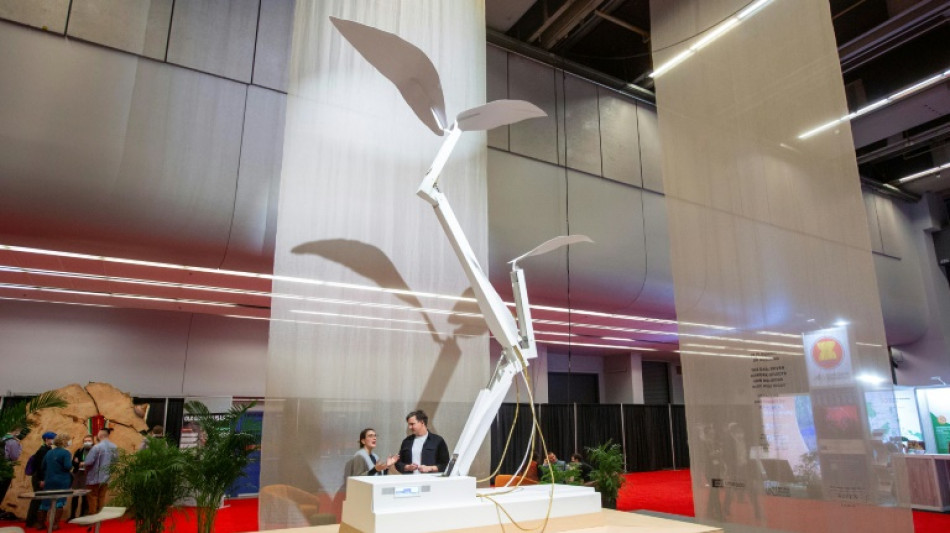
Robot plant grows, wilts on fate of UN nature talks / Photo: © AFP

 Stock markets retreat after central bank rate hikes

 Russia labels director of Cannes Grand Prix winner a 'foreign agent'

 Macron warns of Russian 'hybrid' threat after meeting presidential hopefuls
 UN holds third informal poll for new chief
 Kulusevski return can spark Spurs: De Zerbi

 Shakira to cap off world tour with Madrid 12-gig run

 Isolated Syrian-Druze city blames Damascus for shortages
 Isolated Syrian-Druze city shortages
 Dutch drop Depay for Germany match in Xavi's first pick

 Ronaldo named in Portugal squad for Nations League
 Stock markets diverge after central bank rate hikes
 Anti-Assad music star makes triumphant return to Syria
 In-form Fernandez included in Spain Nations League squad
 Arteta buries hatchet with Hurzeler ahead of Brighton clash
 Alexander-Arnold and Palmer return to England squad for Nations League

 Russians vote as Ukraine war drags on for fifth year

 Backpackers fret over Australian visa crackdown
 Most Asian stocks track Wall St rally, yen drops after BoJ rate hike
 Russians begin voting in controlled election as war drags on

 Trump 'clearly' wants dialogue with Pyongyang: South Korean President

 Bank of Japan hikes rates to 31-year high to battle inflation
 Thailand's Muslim separatists vow to fight to the end

 Mideast turmoil, AI set to dominate UN gathering of world leaders
 Australia to detain tourists who overstay visa, minister says

 Championship rivals brace for renewal of bitter feuds
It's not always easy to make sense of the complex environmental diplomacy taking place at a UN summit billed as humanity's last hope to save nature.
That's why a scientist and artist have teamed up to build a large, data-driven robotic plant that withers or flourishes depending on countries' policy commitments: a tangible demonstration of how human actions will impact the world's threatened species.
Called "ECONARIO," the 5.5-meter (18-foot) tall artwork took a year to build from recycled steel and is currently on display in Montreal Convention Centre, keeping policymakers at the COP15 meeting on their toes as they attempt to hammer out a deal to protect ecosystems.
Its creator, Dutch artist Thijs Biersteker, told AFP the idea behind it is simple: "If the research does not reach us, then how can the research teach us?"
"Art reflects the time we're in, and it should reflect these important issues."
The plant feeds on data from the Biodiversity Intactness Index (BII) -- an estimated percentage of the original number of species that remain, and their abundance in any given area, despite human impacts.
Data scientist Adriana De Palma of London's Natural History Museum, who serves as research lead for the BII, told AFP it is based on a robust, peer-reviewed and open access methodology.
As negotiations happen, the team behind BII input, for example, how many countries have committed to implement a cornerstone pledge of protecting 30 percent of lands and oceans by 2030.
"We can then predict what that is going to mean for biodiversity in 20, 50 or 100 years," she said.
- Rooting for success -
New funding pledges by wealthy countries to assist lower income nations in protecting their biodiversity have helped to nudge up slightly the predicted global average of BII to 70.7 percent by 2050 -- meaning the average ecosystem will have that percentage of its natural ecological community left.
The current figure is 68.5 percent, set to drop to 66.4 percent if "business as usual" continues but rise to 76.4 percent in case of "real action" which the UN summit was meant to deliver.
For now, ECONARIO is cycling between the pessimistic and optimistic scenarios in order to show what could be possible -- but if policymakers fail to achieve an ambitious target, that will be reflected in a very sorry looking robotic plant.
"We shouldn't shy away from the hard numbers, it's not time to sugarcoat anymore," said Biersteker.
De Palma added they were in talks with North American museums to loan the artwork out after the UN summit concludes, and it will eventually return to Europe.
"Using a piece of art like this to really connect with people so they see the damage that individual choices, company choices and government choices are having on the world, is incredibly valuable," she said.
M.Odermatt--BTB