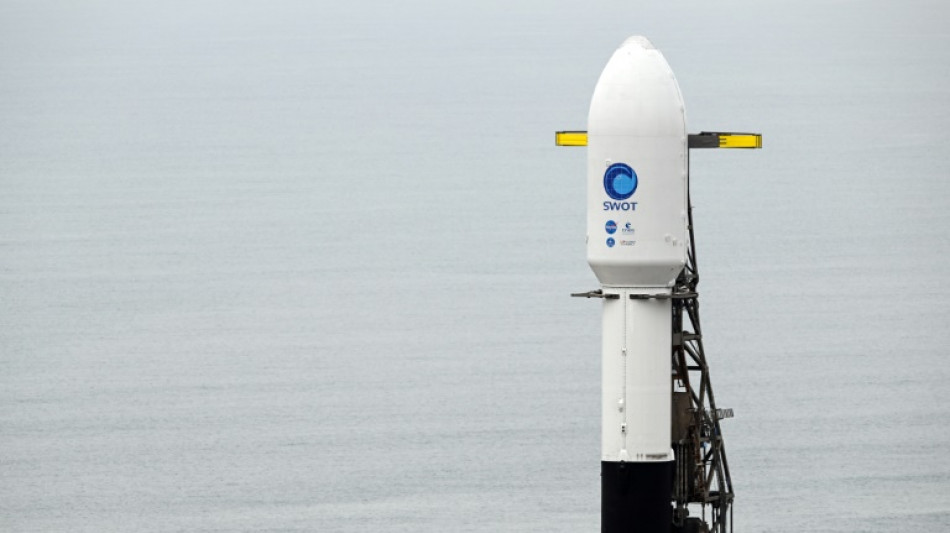
NASA launches satellite for landmark study of Earth's water / Photo: © AFP

 Stock markets retreat after central bank rate hikes

 Russia labels director of Cannes Grand Prix winner a 'foreign agent'

 Macron warns of Russian 'hybrid' threat after meeting presidential hopefuls

 UN holds third informal poll for new chief

 Kulusevski return can spark Spurs: De Zerbi

 Shakira to cap off world tour with Madrid 12-gig run

 Isolated Syrian-Druze city blames Damascus for shortages

 Isolated Syrian-Druze city shortages

 Dutch drop Depay for Germany match in Xavi's first pick

 Ronaldo named in Portugal squad for Nations League

 Stock markets diverge after central bank rate hikes

 Anti-Assad music star makes triumphant return to Syria

 In-form Fernandez included in Spain Nations League squad

 Arteta buries hatchet with Hurzeler ahead of Brighton clash

 Alexander-Arnold and Palmer return to England squad for Nations League

 Russians vote as Ukraine war drags on for fifth year

 Backpackers fret over Australian visa crackdown

 Most Asian stocks track Wall St rally, yen drops after BoJ rate hike

 Russians begin voting in controlled election as war drags on

 Trump 'clearly' wants dialogue with Pyongyang: South Korean President

 Bank of Japan hikes rates to 31-year high to battle inflation

 Thailand's Muslim separatists vow to fight to the end

 Mideast turmoil, AI set to dominate UN gathering of world leaders

 Australia to detain tourists who overstay visa, minister says

 Championship rivals brace for renewal of bitter feuds

A satellite lifted off Friday from California on a mission to survey nearly all bodies of water on Earth, offering key insights on how they influence or are impacted by climate change.
The Surface Water and Ocean Topography (SWOT) satellite, a billion-dollar project jointly developed by NASA and France's space agency CNES, took off at 1146 GMT atop a SpaceX rocket from the Vandenberg Space Force Base.
According to a statement from NASA, it will start collecting scientific data in about six months after undergoing checks and calibrations.
"SWOT will bring us a revolutionary advance in our understanding of how water moves around our planet," said Karen St. Germain, NASA's Earth Science Division director, ahead of the launch.
"We will be able to see detail in eddies and currents and circulation in the oceans that we have never been able to see before."
She said this would help predict floods in areas with too much water, and manage water in regions prone to drought.
Selma Cherchali, of the French space agency CNES, told a press conference on Tuesday that the satellite represents a "revolution in hydrology. We are aiming to provide fine-scale observations ten times better than the current technology."
From a height of 890 kilometers (550 miles), SWOT will have the clearest view yet of the world's oceans, allowing it to track the rise in sea levels, as well as rivers and lakes.
Researchers will be able to get data on millions of lakes, rather than the few thousands currently visible from space.
"We know with climate change that Earth's water cycle is accelerating. What this means is that some locations have too much water, others don't have enough," said Benjamin Hamlington, a NASA research scientist.
"We're seeing more extreme droughts, more extreme floods, precipitation patterns are changing, becoming more volatile. So it's really important that we try to understand exactly what is happening."
The mission is meant to last for three and a half years, but could be extended until five years, or even more, said SWOT's project head at CNES, Thierry Lafon.
The US and French space agencies have worked together in the field for more than 30 years. A previous satellite developed by the partners, TOPEX/Poseidon, improved understanding of ocean circulation and its effect on global climate.
G.Schulte--BTB