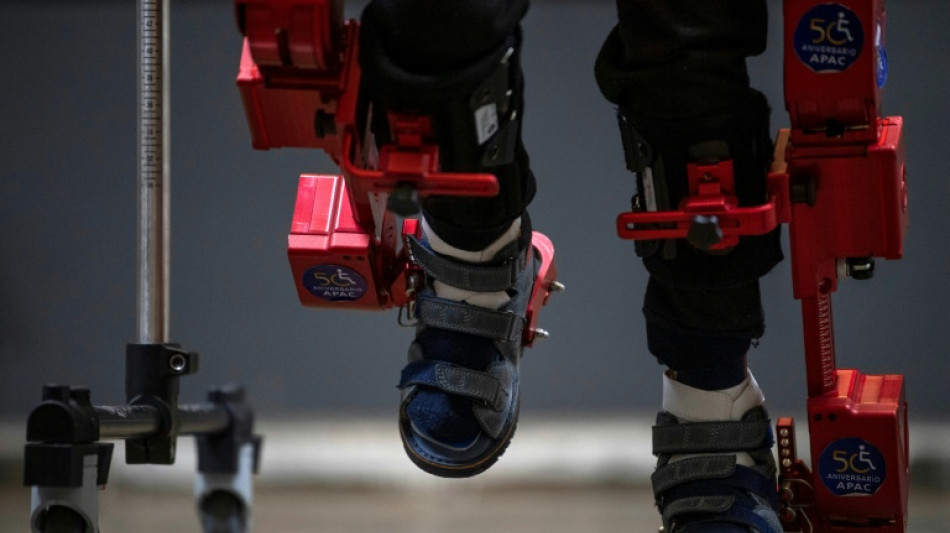
Robotic suit gives paralyzed children gift of walking / Photo: © AFP

 Typhoon Dujuan leaves four dead in Japan, 45,000 houses without power

 G7 leaders condemn Houthi strikes on Saudi Arabia

 Google data centre sparks protests in Austria

 Shin Ohashi: Junk food-loving teen and Japan's next big swimming hope

 Stocks rise on AI buzz, drop in oil prices

 China's robot dancers limber up for America's Got Talent final

 Despite military might, Saudi struggles to crush the Houthis

 Trump to tout deals, defend Iran war in UN speech
 Sri Lanka to issue verdict in landmark Easter attack trial

 Macron says talks with Trump on Red Sea, Ukraine 'constructive'

 Green policies just good politics, says UK minister

 Bardot auction in Paris fetches nearly one million euros

 No timeline on Daniels injury return, says Commanders coach

 British Columbia sues OpenAI in US court over Canada school shooting

 French star Batum retires after 18-year NBA career

 Zidane leads first France training session
 Man shot by ICE agent in Texas detained with bullet inside him: lawyer

 California declares state of emergency ahead of El Nino

 South Africa arrests three more suspects, after nine women murdered

 Carse needs time away from England, says captain Brook

 NOWPayments Releases Cross-Chain Payout Data Revealing Key Performance Benchmarks Across TRON, BNB Chain, and Solana

 British Museum bans photos of Bayeux Tapestry as crowds linger
 COP31 host says AI climate footprint to be a summit priority

 Berlin's far-left vote winners reject anti-semitism charges

 Mancini eager for 'new adventure' on Italy return

Wearing a robotic exoskeleton designed specially for children, an eight-year-old boy with cerebral palsy walked through a therapy room in Mexico City, smiling triumphantly at the once-unthinkable feat.
David Zabala uses a wheelchair due to his neurological condition, which also left him deaf and reliant on sign language.
But thanks to the Atlas 2030 exoskeleton, which won its creator a European Inventor Award this year, he was able to walk and stand in front of a mirror where he drew smiling faces with colored marker pens.
"He's taking his first steps. That's a joy for him," said the boy's mother, Guadalupe Cardoso, 41.
"At first it scared him and his hands were very tense, and now I see that he's already holding the marker pen and starting to draw or (play with) the ball," Cardoso added.
It makes the exhausting, near two-hour journey from their home in the south of Mexico City to the therapy center totally worth it, she said.
The exoskeleton was designed by Spanish professor Elena Garcia Armada to enable children who use wheelchairs to walk during muscle rehabilitation therapy.
The mechanical joints of the battery-powered titanium suit adapt intelligently to the motion of each child, according to the European Patent Office, which presented Garcia with the European Inventor Award.
Giving paralyzed children the opportunity to walk "not only extends their life expectancy and enhances their physical well-being, but also improves their self-esteem," it said.
- 'Changing lives' -
Mexico is the third country, after Spain and France, where the Atlas 2030 has been used to treat children.
The suit helps "to achieve in record time rehabilitation goals" that would take months to achieve with conventional therapies, said Guadalupe Maldonado, director of Mexico's Association for People with Cerebral Palsy.
The benefits include muscle strengthening, improvement of the digestive and respiratory systems and -- above all -- a major mood boost, Maldonado said.
The private organization, founded in 1970, has already seen positive results two weeks after acquiring its first exoskeleton, she said.
A second device, worth around $250,000, is due to arrive in Mexico City next month.
The association's initial goal is to offer rehabilitation to about 200 children with cerebral palsy.
"We want to continue working and empowering, so that more children in the city and the country have access to this type of rehabilitation... that radically changes their lives," Maldonado said.
The sessions also give joy to the therapists, who carefully fit the exoskeleton using its special corset, cuff and shoes and celebrate the children's progress with smiles and applause.
"It motivates us a lot as therapists that we will be able to achieve many things in the future," said Arturo Palafox, 28.
G.Schulte--BTB