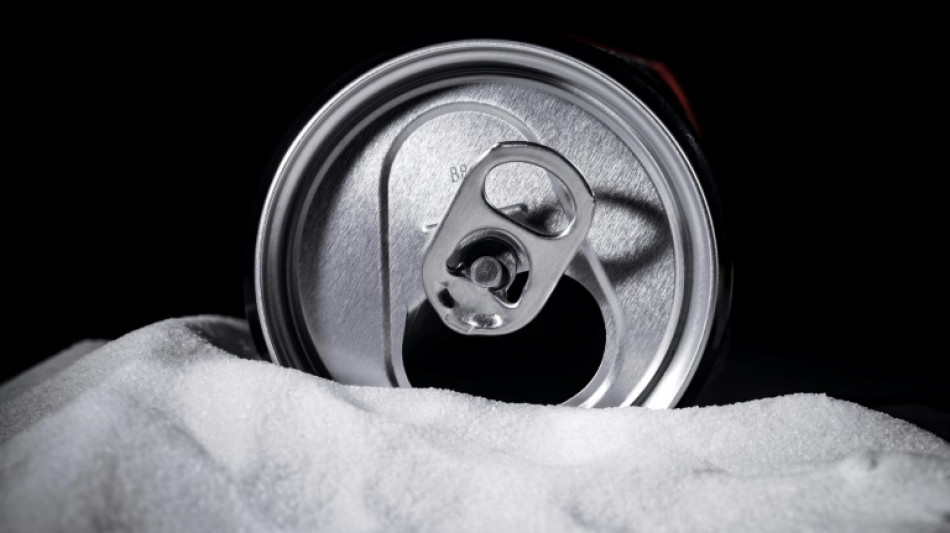
Sweeteners may be linked to heart disease risk, study suggests / Photo: © AFP/File

 Google data centre sparks protests in Austria

 Shin Ohashi: Junk food-loving teen and Japan's next big swimming hope

 Stocks rise on AI buzz, drop in oil prices

 China's robot dancers limber up for America's Got Talent final

 Despite military might, Saudi struggles to crush the Houthis

 Trump to tout deals, defend Iran war in UN speech

 Sri Lanka to issue verdict in landmark Easter attack trial

 Macron says talks with Trump on Red Sea, Ukraine 'constructive'

 Green policies just good politics, says UK minister

 Bardot auction in Paris fetches nearly one million euros

 No timeline on Daniels injury return, says Commanders coach

 British Columbia sues OpenAI in US court over Canada school shooting

 French star Batum retires after 18-year NBA career

 Zidane leads first France training session

 Man shot by ICE agent in Texas detained with bullet inside him: lawyer

 California declares state of emergency ahead of El Nino

 South Africa arrests three more suspects, after nine women murdered

 Carse needs time away from England, says captain Brook

 NOWPayments Releases Cross-Chain Payout Data Revealing Key Performance Benchmarks Across TRON, BNB Chain, and Solana

 British Museum bans photos of Bayeux Tapestry as crowds linger

 COP31 host says AI climate footprint to be a summit priority

 Berlin's far-left vote winners reject anti-semitism charges

 Mancini eager for 'new adventure' on Italy return

 Mbappe says having Zidane as France coach 'like a film'

 Palmer, Rice out of England Nations League squad

A large study suggested Thursday that artificial sweetener could be associated with a higher risk of heart disease, however experts urged caution about the findings.
Sweeteners are consumed by millions every day in products like diet soda, partly as a way to avoid weight gain from sugar -- but the healthiness of these substitutes has long been a matter of controversy.
Aiming to assess the heart disease risk of sweeteners, researchers at the French INSERM institute analysed the data of more than 100,000 adults in France who self-reported their diet, lifestyle and medical history between 2009-2021 as part of the NutriNet-Sante study.
Thirty-seven percent of the participants consumed artificial sweeteners, with an average intake of 42 milligrams a day -- the equivalent of one packet of sweetener or about a third of a can of diet soda.
During the nine-year follow-up period, 1,502 heart problems were recorded, including heart attack, angina and stroke.
The research, published in the journal BMJ, indicated that heart disease occurred in 346 out of 100,000 people who consume a high level of sweetener, compared to 314 per 100,000 for non-consumers.
"These results, in line with the latest WHO report published this year, do not support the use of sweeteners as a safe alternative to sugar," said INSERM's Mathilde Touvier, who coordinated the study.
An April report from the World Health Organization said that "there is no clear consensus on whether non-sugar sweeteners are effective for long-term weight loss or maintenance, or if they are linked to other long-term health effects".
Another study published earlier this year using Nutri-Net data found a correlation between cancer and sweeteners such as aspartame, acesulfame potassium and sucralose.
However such observational studies have come under increased criticism because they cannot establish the cause of the differences they find, which could come from other sources.
Naveed Sattar, a professor of metabolic medicine at Glasgow University not involved in the sweetener study, said that it "cannot answer the question posed".
"This is because there are clearly major differences in many characteristics of people who consume artificial sweeteners compared to those who do not consume any," he said.
He called for governments to fund long-term, randomised trials "to get closer to the truth".
H.Seidel--BTB