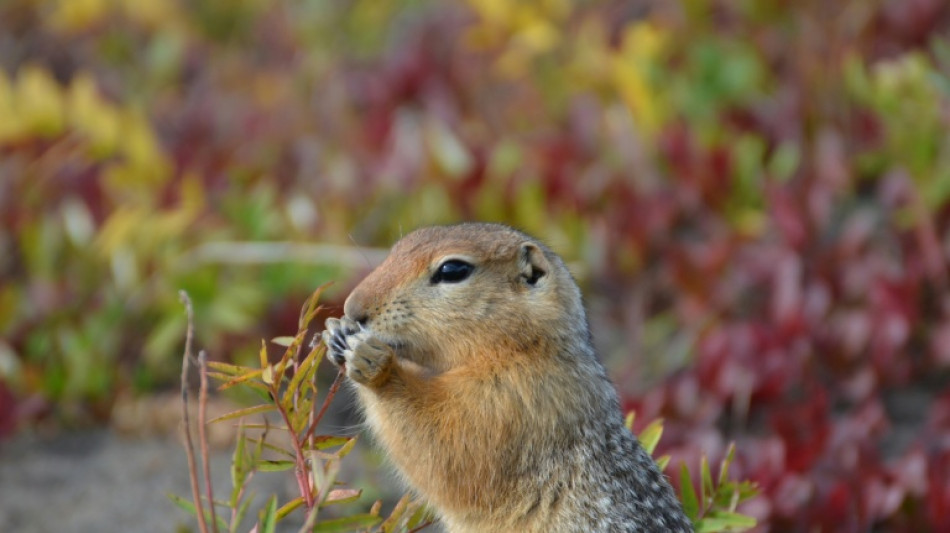
Woolly mammoth among trove of ancient DNA found in squirrel poo / Photo: © Colorado State University/AFP/File

 Global stocks rally on lower oil prices, US-China hopes

 EU proposes energy rating for data centres

 Schoolgirl Yu scorches to second gold as doping case rocks Games

 Putin's party secures record score in Russia election

 Haupt Koleksiyonu: Paranın Biz İnsanlar Hakkında Anlattıkları

 Spanish PM says unregulated AI could be 'devastating'

 Yu, 13, smashes record again with second Asian Games gold

 Switzerland to play without Xhaka over fake Covid certificate

 From Korean Chipmakers to Leveraged Semiconductor ETFs: STARTRADER Launches 49 New 24/7 Stock and ETF CFDs

 Thai badminton player first doping case at Asian Games: testers

 Колекція Гаупта: Що гроші розповідають про нас, людей

 German far-right AfD poll winner says Merz 'twilight' has begun

 Flights scrapped, evacuations urged as Typhoon Dujuan nears Japan

 China confirms Xi to visit US this week for Trump talks

 مجموعة هاوبت: ما يكشفه المال عنا نحن البشر

 Colecția Haupt: Ce ne dezvăluie banii despre noi, oamenii

 Sisters of jailed Pakistan ex-PM Imran Khan arrested

 African players in Europe: Semenyo brace helps City top table

 'For my family': India boxer beats hardship, injury to go for Games gold

 Indonesia doing 'everything' but still struggling to curb fires

 Once decried as 'human cockfighting', MMA wants Olympic spot
 China's Yu, 13, great for swimming says multiple Olympic medallist

 Putin's party set to retain power after Russia vote hit by cyberattacks, drones
 Germany's Merz under pressure after bruising state election losses

 Messi, Miami frustrated in 2-2 draw with San Diego

A huge treasure trove of ancient DNA from animals including extinct woolly mammoths has been discovered in frozen squirrel faeces in Canada's remote Yukon territory, scientists said Tuesday.
The DNA found deep inside sealed-off burrows is between 3,000 and 700,000 years old, offering a rare window into how life has changed over the millennia.
As well as DNA from woolly mammoths -- which the US company Colossal claims it is trying to "de-extinct" -- genetic material was also found from wolves, bison, horses, a cheetah and hundreds of plants.
Tyler Murchie, a paleogenomics researcher at Canada's McMaster University and lead author of a new study, admitted that digging through squirrel poop might sound "less appealing" than discovering, say, a mammoth tusk.
However the "spectacular" amount of information they uncovered suggests that faeces is an overlooked way to see into our planet's distant past, he added.
The scientists had just been expecting to study the squirrel's microbiome before coming across the "really surprising biodiversity of organisms", Murchie said.
It turned out that arctic ground squirrels were ideal subjects for this research because of their "natural archivist behaviour", he explained.
The squirrels are only conscious for around four months a year, spending the rest of their life in hibernation.
So when they are awake, "they've got to get out there and eat as much as they can of everything," Murchie said.
The squirrels pack their burrows with nuts, seeds, leaves, bones, fur and anything else they can find.
But over time, rising permafrost permanently sealed off some of the burrows in the Yukon, creating a perfectly preserved time capsule.
Murchie said they even found a "super cute little guy" frozen in time.
"He just went to sleep one season, then he never woke up... it wasn't until some palaeontologist came by investigating that they found him in there."
- Back from the dead? -
The scientists used the DNA to reconstruct 18 mitochondrial genomes, including for six woolly mammoths that lived in different eras.
This involves using computers to stitch together DNA fragments, like puzzle pieces, Murchie explained.
Colossal has declared its intention to resurrect the woolly mammoth, which went extinct around 4,000 years ago.
However experts have expressed scepticism about the claim, saying the resulting animal would be more like an Asian elephant with some genetic tweaks to make it resemble a mammoth.
Murchie, who does not work for Colossal, said the genetic data they found would be made publicly available, so the company could use it.
"But they already have so much DNA to go off of -- whole genomes from different organisms -- so I'm sure ours is a drop in the bucket," he added.
The team behind the latest research, which was published in the journal Nature Communications, is working on another study describing what the DNA reveals about the woolly mammoth's evolution.
Murchie could not speak about that future research, other than to say it was "super cool".
"I can't believe that we were able to get these insights from squirrel faeces," he added.
C.Bruderer--VB