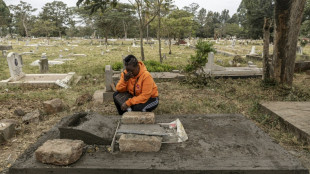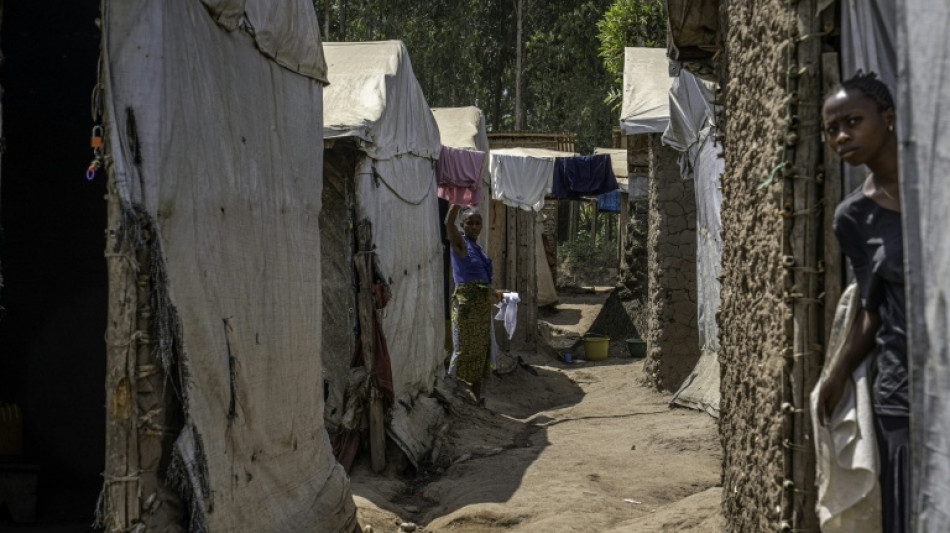
'If Ebola comes, we'll be wiped out': DR Congo conflict-displaced / Photo: © AFP

 Global stocks rally on lower oil prices, US-China hopes

 EU proposes energy rating for data centres

 Schoolgirl Yu scorches to second gold as doping case rocks Games

 Putin's party secures record score in Russia election

 Haupt Koleksiyonu: Paranın Biz İnsanlar Hakkında Anlattıkları

 Spanish PM says unregulated AI could be 'devastating'

 Yu, 13, smashes record again with second Asian Games gold

 Switzerland to play without Xhaka over fake Covid certificate

 From Korean Chipmakers to Leveraged Semiconductor ETFs: STARTRADER Launches 49 New 24/7 Stock and ETF CFDs

 Thai badminton player first doping case at Asian Games: testers

 Колекція Гаупта: Що гроші розповідають про нас, людей
 German far-right AfD poll winner says Merz 'twilight' has begun

 Flights scrapped, evacuations urged as Typhoon Dujuan nears Japan
 China confirms Xi to visit US this week for Trump talks
 مجموعة هاوبت: ما يكشفه المال عنا نحن البشر

 Colecția Haupt: Ce ne dezvăluie banii despre noi, oamenii

 Sisters of jailed Pakistan ex-PM Imran Khan arrested

 African players in Europe: Semenyo brace helps City top table

 'For my family': India boxer beats hardship, injury to go for Games gold

 Indonesia doing 'everything' but still struggling to curb fires
 Once decried as 'human cockfighting', MMA wants Olympic spot

 China's Yu, 13, great for swimming says multiple Olympic medallist

 Putin's party set to retain power after Russia vote hit by cyberattacks, drones
 Germany's Merz under pressure after bruising state election losses

 Messi, Miami frustrated in 2-2 draw with San Diego

Dorcas Mapenzi fears the worst if Ebola comes to the Kingonze camp, where she lives alongside more than 25,000 other displaced people in the conflict-hit eastern Democratic Republic of Congo.
"If Ebola comes, we'll be wiped out as we're packed like sardines," the displaced woman told AFP at the sprawl of tarpaulin and tents on the outskirts of Bunia, the capital of the northeastern Ituri province, the epicentre of the latest outbreak.
Spread by close contact, the deadly viral disease has spread like wildfire in the vast central African country's east, where decades of armed conflicts have forced millions of people from their homes and into camps where they live cheek-by-jowl.
Nearly a million of those displaced are in Ituri -- among the provinces of the desperately impoverished DRC most prey to the east's litany of armed groups -- where the prospect of the epidemic spreading throughout the refugee camps has sparked alarm.
The World Health Organization's chief Tedros Adhanom Ghebreyesus -- who is expected in Bunia on Friday -- has warned that the eastern DRC "faces a catastrophic collision of disease and conflict", with the fighting hampering efforts to tackle the epidemic.
Since an Ebola outbreak was declared in the DRC on May 15, the WHO has recorded 10 confirmed and 223 suspected Ebola deaths in the DRC, out of more than 1,000 confirmed and suspected cases, according to its latest figures up to May 24.
- 'Everyone will die' -
No infection has yet been recorded at the Kingonze displaced persons' camp, which was built in 2018.
But conditions in the camp are ripe for a disease passed on through close physical contact and bodily fluids.
"I've already heard of Ebola and it's a disease that scares me a lot," Mapenzi said as she washed her laundry in a basin on the ground.
"We displaced people here have no hygiene. Our children play next to filthy toilets and even relieve themselves on the ground, in the middle of the tarpaulins that serve as our homes," the young woman said.
Deborah Nzale, a widow and head of the family, lives with nine people in a small tarpaulin shelter of barely three square metres (32 square feet).
"Given these conditions, how are we going to protect ourselves against this disease, when everyone tells us we need to distance ourselves to fight Ebola?" she asked.
No vaccine or treatment exists for the Bundibugyo strain of Ebola responsible for the latest outbreak.
So attempts to contain the virus's spread have had to rely mainly on protective measures and rapid contact tracing.
"We sleep piled on top of each other, with everyone's sweat," Nzale said.
"If a single person gets infected here in this camp, everyone will die."
- 'Ebola really kills' -
So far, Kingonze's displaced residents have not received any protective gear.
"Ebola really kills," a poster at the entrance warns.
"People looking to raise awareness come through here with messages but, surprisingly, we don't have the kit we need to protect ourselves," Budjo Amos complained.
"I don't even have soap to wash my hands," added the displaced man, who fled the province's common communal violence.
"The most urgent thing is to give us clean water."
There is just a single borehole in Kigonze. Empty jerrycans pile up in front. Water flows from the tap for just a few hours a day.
"The state has to intervene urgently," Amos pleaded.
Already long absent from swathes of Ituri, the Congolese state has been criticised for its delayed response to the outbreak, which was declared several weeks after the first cases emerged.
Many hospitals in the region still lack essential equipment, especially isolation tents for patients.
According to Ituri's military governor, the province counts around 61 displaced persons camps housing nearly 970,000 people.
"We need to deploy equipment and qualified, specialist medical staff as quickly as possible," Lieutenant General Johnny Luboya Nkashama told AFP on Friday, "to spare this province from disaster".
S.Gantenbein--VB