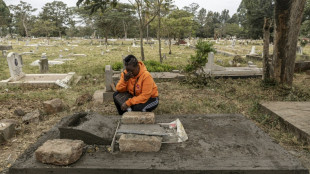
In Tierra del Fuego, a hunt for the rodent carrier of hantavirus / Photo: © AFP

 Global stocks rally on lower oil prices, US-China hopes

 EU proposes energy rating for data centres

 Schoolgirl Yu scorches to second gold as doping case rocks Games

 Putin's party secures record score in Russia election

 Haupt Koleksiyonu: Paranın Biz İnsanlar Hakkında Anlattıkları

 Spanish PM says unregulated AI could be 'devastating'

 Yu, 13, smashes record again with second Asian Games gold

 Switzerland to play without Xhaka over fake Covid certificate

 From Korean Chipmakers to Leveraged Semiconductor ETFs: STARTRADER Launches 49 New 24/7 Stock and ETF CFDs

 Thai badminton player first doping case at Asian Games: testers

 Колекція Гаупта: Що гроші розповідають про нас, людей
 German far-right AfD poll winner says Merz 'twilight' has begun

 Flights scrapped, evacuations urged as Typhoon Dujuan nears Japan

 China confirms Xi to visit US this week for Trump talks

 مجموعة هاوبت: ما يكشفه المال عنا نحن البشر

 Colecția Haupt: Ce ne dezvăluie banii despre noi, oamenii

 Sisters of jailed Pakistan ex-PM Imran Khan arrested

 African players in Europe: Semenyo brace helps City top table

 'For my family': India boxer beats hardship, injury to go for Games gold

 Indonesia doing 'everything' but still struggling to curb fires
 Once decried as 'human cockfighting', MMA wants Olympic spot
 China's Yu, 13, great for swimming says multiple Olympic medallist

 Putin's party set to retain power after Russia vote hit by cyberattacks, drones
 Germany's Merz under pressure after bruising state election losses

 Messi, Miami frustrated in 2-2 draw with San Diego

A scientific mission was set to kick off the search Monday for rodents that may be hantavirus carriers after an outbreak on a cruise ship departed this region at the southern tip of Argentina on April 1.
For several days, biologists from Buenos Aires will set traps at various locations on the southern island of Tierra del Fuego to analyze whether the captured rodents carry the Andes strain of the virus, the only one known to spread between people.
The mission is critical since the outbreak aboard the Hondius led to three deaths and triggered global alarm.
The first person to die from the disease, a Dutchman, had spent 48 hours in the picturesque city of Ushuaia with his wife -- who died two weeks later -- before embarking on the cruise, raising suspicions that they had contracted the virus in Argentina.
Provincial officials vehemently deny this hypothesis.
They insist that Tierra del Fuego province has not had a case of hantavirus since its reporting became mandatory 30 years ago, unlike in provinces to the north, such as Rio Negro and Chubut.
"There's no precedent," said Sebastian Poljak, an expert in local mammals.
- Night Traps -
Local scientists debate about whether the noteworthy rodent in Tierra del Fuego is the long-tailed rat (Oligoryzomys longicaudatus) or a subspecies, the Magellanic long-tailed rat (Oligoryzomys magellanicus).
"For some, it's the same species, for others, a subspecies, but the important thing is to analyze whether one of them is infected with hantavirus," said Juan Petrina, the province's director of epidemiology.
The woodland rodent that lives here is a small species measuring 6-8 centimeters (2.4-3.1 inches), but with a tail that can reach 15 cm.
The rodent is nocturnal and feeds on fruits and seeds. It lives in wooded and shrubby areas, nesting, for example, in tree cavities.
It is in these areas that scientists from Malbran, Argentina's leading institute for infectious diseases, will set trap cages in the evening and retrieve them in the morning, local health sources said.
A prime target is Tierra del Fuego National Park, 70,000 hectares (173,000 acres) of forests, lakes and mountains 15 kilometers (9 miles) from Ushuaia.
Another wooded area, not far from a landfill, will also be targeted, though the landfill itself will be excluded, they said.
Unconfirmed reports suggested that the Dutch person who died, a bird enthusiast, had visited the site to observe local scavengers, prompting speculation that his case involved contact with rodents there.
Capturing rats in the landfill itself would "make no sense, (because) the rodents found there are urban rodents, not susceptible to hantavirus," Petrina said.
Analysis results of the captured rats should be available within four weeks, he added.
- Isolated Rodents -
Local scientists welcome the mission, which will allow them to "assess with greater certainty the potential danger posed by the local rodents," said Guillermo Deferrari, a biologist at the Southern Center for Scientific Investigation (CADIC).
That should allow them to "definitively eradicate the idea that there is hantavirus here," said Poljak.
He points out that Tierra del Fuego is an archipelago separated from the mainland by the Strait of Magellan, a major geographical barrier for species.
The rodent population there is significantly isolated, he said.
Local scientists suspect that it is more likely that the infection happened in another region.
The Dutch couple had traveled extensively in Argentina for four months, with forays into Chile -- where hantavirus is also present -- and Uruguay.
Local authorities hope the Malbran mission will rule out the hypothesis of a local infection so as not to hurt the tourism business.
While Ushuaia is experiencing a slowdown at the start of winter, cruises that run from September to April attract up to 200,000 visitors annually.
"We don't want this situation to escalate any further," said Juan Manuel Pavlov, secretary of the Tierra del Fuego Tourism Institute.
K.Sutter--VB