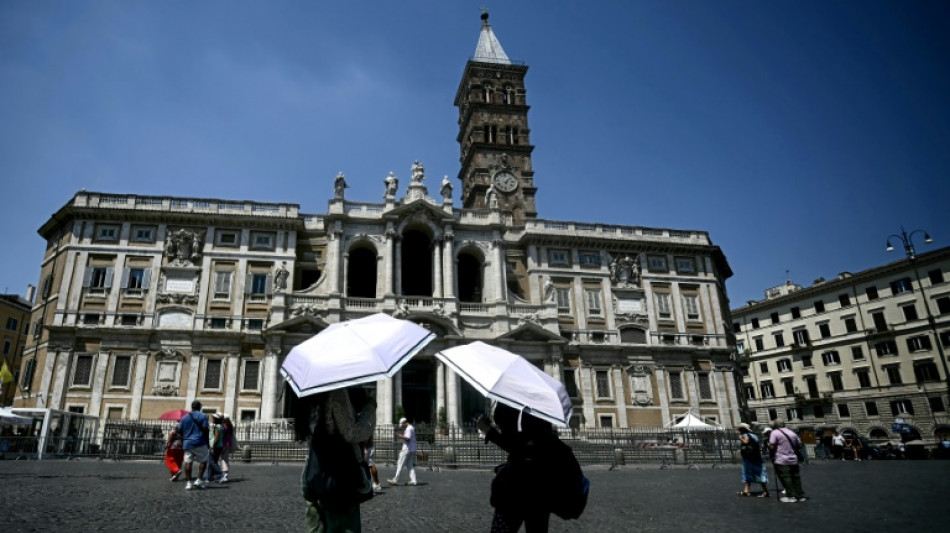
Estimated 16,500 climate change deaths during Europe summer: study / Photo: © AFP/File

 South Africa arrests three more suspects, after nine women murdered

 Carse needs time away from England, says captain Brook

 NOWPayments Releases Cross-Chain Payout Data Revealing Key Performance Benchmarks Across TRON, BNB Chain, and Solana

 British Museum bans photos of Bayeux Tapestry as crowds linger

 COP31 host says AI climate footprint to be a summit priority

 Berlin's far-left vote winners reject anti-semitism charges

 Mancini eager for 'new adventure' on Italy return

 Mbappe says having Zidane as France coach 'like a film'
 Palmer, Rice out of England Nations League squad
 German auto workers stage mass protests in bid to save jobs
 Embattled Merz vows to keep ruling for 'democratic future' of Germany

 Merz vows to keep ruling coalition together for 'democratic future' of Germany

 Spain coach De la Fuente gets new deal after World Cup success

 Pressure grows on Germany's Merz after election defeats

 China's Zhang beats Japan rivals to Asian Games gymnastics gold

 Samlingen Haupt: Vad pengar avslöjar om oss människor

 Tens of thousands of German auto workers protest to save jobs

 हॉप्त् कलेक्शन: पैसा हमारे बारे में एक इंसान के रूप में क्या प्रकट करता है

 Συλλογή Haupt: Τι αποκαλύπτει το χρήμα για εμάς τους ανθρώπους

 TradersYard Shifts Focus to Futures Trading

 ハウプト・コレクション:お金が人間について明かすこと

 하우프트 컬렉션: 돈이 우리 인간에 대해 드러내는 것

 Indonesia doing 'everything' but struggling to curb fires

 Sbírka Haupt: Co o nás lidech prozrazují peníze
 North and South Korea fight out draw in niggly Asian Games clash

Scientists estimated Wednesday that rising temperatures from human-caused climate change were responsible for roughly 16,500 deaths in European cities this summer, using modelling to project the toll before official data is released.
The rapidly-produced study is the latest effort by climate and health researchers to quickly link the death toll during heatwaves to global warming -- without waiting months or years to be published in a peer-reviewed journal.
The estimated deaths were not actually recorded in the European cities, but instead were a projection based on methods such as modelling used in previously peer-reviewed studies.
Death tolls during heatwaves are thought to be vastly underestimated because the causes of death recorded in hospitals are normally heart, breathing or other health problems that particularly affect the elderly when the mercury soars.
To get a snapshot of this summer, a UK-based team of researchers used climate modelling to estimate that global warming made temperatures an average of 2.2 degrees Celsius hotter in 854 European cities between June and August.
Using historical data indicating how such soaring temperatures drive up mortality rates, the team estimated there were around 24,400 excess deaths in those cities during that time.
They then compared this number to how many people would have died in a world that was not 1.3C warmer due to climate change caused by humans burning fossil fuels.
Nearly 70 percent -- 16,500 -- of the estimated excess deaths were due to global warming, according to the rapid attribution study.
This means climate change could have tripled the number of heat deaths this summer, said the study from scientists at Imperial College London and epidemiologists at the London School of Hygiene & Tropical Medicine.
The team had previously used similar methods to find a similar result for a single European heatwave that started in late June.
The researchers said they were not able to compare their estimates to actual excess deaths recorded in European cities this summer because most countries take a long time to publish that data.
"It's impossible to get real-time statistics right now," however the estimates are "in the right ballpark," study co-author Friederike Otto told a press conference.
- 'Even more alarming' -
The estimates did reflect previous peer-reviewed research, such as a Nature Medicine study which determined there were more than 47,000 heat-related deaths during the European summer of 2023.
Numerous prominent climate and health researchers also backed the study.
"What makes this finding even more alarming is that the methods used in these attribution studies are scientifically robust, yet conservative," said atmospheric science researcher Akshay Deoras at the UK's University of Reading.
"The actual death toll could be even higher."
The study said that Rome had the most estimated deaths attributed to climate change with 835, followed by Athens with 630 and Paris with 409.
More than 85 percent of the estimated excess deaths were among people aged 65 or over.
The researchers emphasised the study did not represent Europe as a whole because some areas -- such as the Balkans -- were not included.
"An increase in heatwave temperature of just 2-4C can be the difference between life and death for thousands of people -- this is why heatwaves are known as silent killers," study co-author Garyfallos Konstantinoudis said.
This year was Europe's fourth-hottest summer on record.
G.Schmid--VB