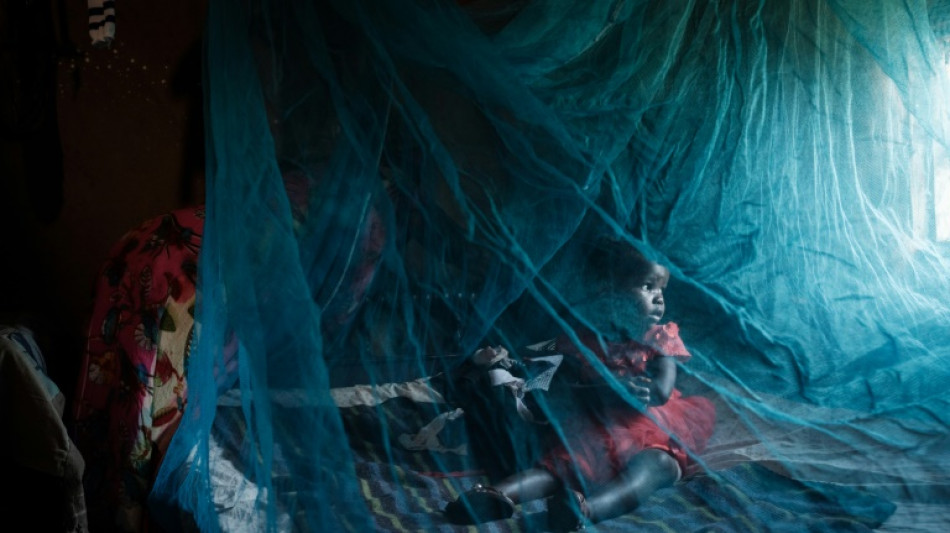
Malaria mortality returns to pre-Covid levels: WHO / Photo: © AFP

 Yemen's Houthis seize key city on Red Sea: military source

 Oil prices extend gains as markets await ECB rate outlook

 Wars pose a test as India hosts BRICS summit with China, Russia, Iran leaders

 Messi to buy second Spanish lower league club

 Pochettino calls for Chelsea to lose 2016-17 Premier League title

 North Korea leader's daughter believed to have younger sibling: Seoul

 Wars pose a test as India hosts BRICS summit with Russia, Iran leaders

 Alessio Vinassa Unveils an Emerging Technology Investment Approach Shaped by Financial Challenges

 Stocks drop as oil spike fans inflation and interest rate fears

 Portugal harvests grapes at night to beat the heat
 Philippine ferry fire kills 5, dozens missing

 Oil prices flare as Iran tightens grip on Hormuz

 Japan gymnasts under injury cloud for home Asian Games

 India trailblazer won't 'let go' of chance for Asian weightlifting glory

 Zverev cruises past van de Zandschulp into US Open semis

 Myanmar tin mega-mine restarts operations: think tank

 Online and undercover: saving trafficked wildlife in Thailand

 Antonelli faces new challenge after stirring triumph in Monza

 Korda leads US bid to win first away Solheim Cup since 2015
 Eurozone rate-setters to hike borrowing costs as energy prices jump

 As oceans warm, Florida scientists hunt for heat-resistant coral

 Trump takes center stage as Republicans fight midterm tide

 Gauff takes inspiration from Tiafoe in US Open fightback win

 Ralph Lauren opens fur-free New York Fashion Week

 Arteta lauds in-form Odegaard as 'remarkable' Arsenal edge Napoli

Malaria mortality has fallen back to levels seen before the Covid-19 crisis, the WHO said Wednesday, but called for faster progress against the disease that killed nearly some 597,000 people last year.
In a new report, the World Health Organization estimated that there were 263 million cases of malaria worldwide in 2023 -- 11 million more than a year earlier -- while the death toll remained relatively stable.
But in terms of the mortality rate, "we have come back to pre-pandemic numbers", Arnaud Le Menach, of the WHO's Global Malaria Programme, told reporters.
In 2020, disruptions caused by the Covid-19 pandemic led to a sharp increase in malaria-related mortality, with an additional 55,000 deaths counted that year.
Since then the total number of deaths from malaria, which is caused by a mosquito-borne parasite, has gradually shrunk, as has the mortality rate.
The estimated 2023 mortality rate in Africa of 52.4 deaths per 100,000 population at risk meanwhile still remains more than double the target level set by a global strategy for combatting malaria through 2030, WHO said, insisting "progress must be accelerated".
- Vaccine promise -
WHO pointed to the wider rollout of malaria vaccines as a promising development, expected to save tens of thousands of young lives each year.
The two jabs currently in use, RTS,S and R21/Matrix-M, hold the promise of significantly easing the burden in Africa, which accounts for up to 95 percent of all malaria deaths.
Malaria vaccines were first introduced in April 2019, first in Malawi, with Kenya and Ghana following suit.
Through the end of 2023, nearly two million children in those three countries received jabs of the RTS,S vaccine, WHO said.
"We saw in those three pilot countries... a 13-percent drop in mortality during the four years of the pilot programme," said Mary Hamel, who heads WHO's malaria vaccine team.
The WHO now looked forward to seeing a similar drop in other countries introducing the vaccines, she told reporters, pointing out that countries that began introducing the jabs early this year were "following a similar trajectory".
So far, 17 nations across sub-Saharan Africa have included the jabs in their routine immunisation programmes, she said
Another eight countries had been approved to receive funding towards introducing the vaccines through the vaccine alliance GAVI, WHO said.
- 'Curb the threat' -
In another promising development, new-generation dual-insecticide nets nets are becoming more widely available.
These nets, which are coated in a new generation pyrrole insecticide in combination with the standard pyrethroid insecticide, have been shown to offer far better protection against malaria.
The WHO estimated earlier this year that such nets had averted 13 million malaria cases and nearly 25,000 deaths over three years.
Despite the successes, the WHO highlighted a number of factors slowing the battle against malaria, including a lack of funds and insufficient stocks of vaccines, as well as climate change, which is allowing a greater spread of the mosquitos that carry the parasite that causes malaria.
"Stepped-up investments and action in high-burden African countries are needed to curb the threat," WHO chief Tedros Adhanom Ghebreyesus said in a statement.
The Global Fund, a partnership set up to battle AIDS, tuberculosis and malaria, agreed.
"Progress has stagnated for several years," its executive director Peter Sands warned in a statement.
"To overcome this, we must accelerate our efforts through a dual approach: investing in new technologies while simultaneously easing the strain that climate change places on healthcare systems," he said.
R.Fischer--VB