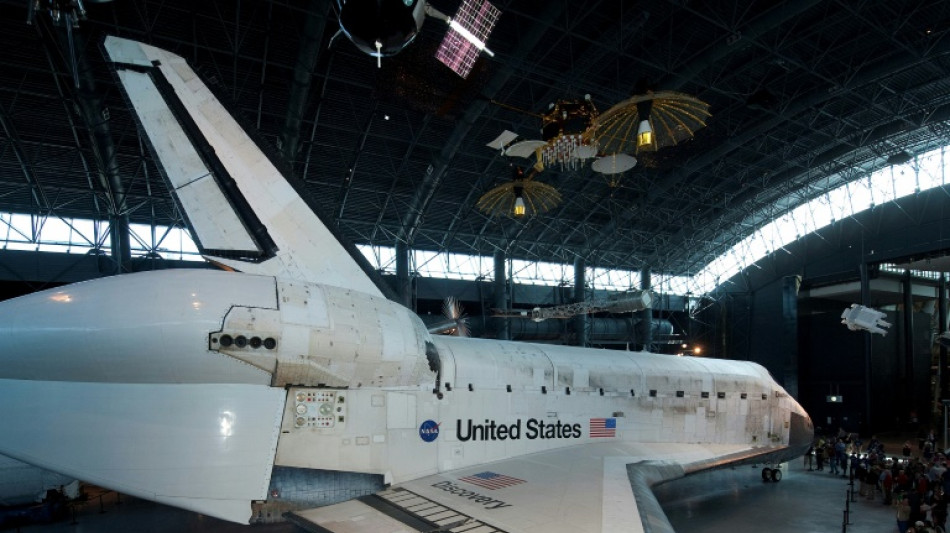
Bid to relocate US Space Shuttle Discovery faces museum pushback / Photo: © Smithsonian National Air and Space Museum/AFP

 Repsol says profit more than triples on higher oil prices

 TotalEnergies says profit doubled on Mideast war

 Giant swing on Swiss peak aims to boost summer tourism as Alps warm

 ASEAN to call for open straits as US-Iran war casts shadow

 AI catches up with humans to score 100% at top maths contest

 South Korea election office raided in fake turnout figures probe: investigators

 Killer whales: orcas blow fish to bits 'for fun', study finds

 Deadly wildfires force thousands from homes in parts of Europe

 Tech bounce lifts Asia stocks, oil extends gains on US-Iran fears

 Surrounded by militias, Sudanese fear endless cycle of war

 Commonwealth Games 'where champions are made' despite slimmed down model, argues president

 Trump family project in Albania has already caused 'irreparable' damage: NGOs
 Bollywood blast master keeps it real with fire and fury

 Tearful fights, edible offerings: A glimpse into the Maradona trial

 What's the deal with peptides? The hyped market under US review

 Tesla shares fall as Musk touts ambitious -- and costly -- plans

 Houthis claim Red Sea tanker strikes as US hits Iran again

 Wildfires ravage parts of southern France, Italy and Spain
 Alphabet beats expectations in second quarter, cloud revenue nearly doubles
 Trump threatens Iran infrastructure, Tehran vows 'eye for eye'

 US teen withdraws lawsuit against Meta over social media addiction
 Lebanon PM says Beirut working for 'complete Israeli withdrawal'
 EU conditionally clears Paramount bid for Warner Bros.

 Philipsen snaps 'horrible' drought with Tour de France stage 17 victory

 US trial of Venezuela's Maduro set for June 2027

Tucked inside President Donald Trump's flagship tax and spending bill last month was a little-noticed provision to relocate the iconic Space Shuttle Discovery from a museum outside Washington to Houston.
The plan now faces legal uncertainty, with the Smithsonian Institution arguing Congress had no authority to give away what it considers private property -- even before accounting for the steep logistical and financial challenges.
"The Smithsonian Institution owns the Discovery and holds it in trust for the American public," the museum network, which receives substantial federal funding yet remains an independent entity, said in a statement to AFP on Friday.
"In 2012, NASA transferred 'all rights, title, interest and ownership' of the shuttle to the Smithsonian," the statement continued, calling Discovery one of the museum's "centerpieces" that welcomes millions of visitors a year.
The push to move Discovery from the Air and Space Museum's site in northern Virginia began in April, when Texas Senator John Cornyn, a Republican who faces a tough primary challenge next year by state attorney general Ken Paxton, introduced the "Bring the Space Shuttle Home Act," naming Discovery.
The legislation stalled until it was folded into the mammoth "Big Beautiful Bill," signed into law on July 4.
Its passage allocated $85 million for the move, though the nonpartisan Congressional Research Service has projected a far higher cost of $325 million, adding that the NASA administrator's power over non-NASA entities is "unclear."
To comply with Senate rules, the bill's language was modified such that Discovery is no longer named directly. Instead, the bill refers to a "space vehicle," though there is little doubt as to the target.
NASA's administrator -- currently Transportation Secretary Sean Duffy, serving in an acting capacity -- was given 30 days to identify which spacecraft is to be relocated, a deadline coming up on Sunday.
- End of an era -
NASA's Space Shuttle program ended in 2011, after a 30-year run that carried America's post-Apollo space ambitions.
The four surviving orbiters -- Atlantis, Endeavour, prototype Enterprise, and Discovery -- were awarded to Florida, California, New York, and Virginia through a ranked selection process.
Discovery, the most flown, was chosen as a vehicle-of-record in a near-complete state, intended for study by future generations.
"There was not a lot of support within Houston to want a shuttle," space historian Robert Pearlman told AFP, adding that a proposal to house it at Space Center Houston was relatively weak.
But after the announcement, Texas -- home to the Johnson Space Center, which oversees NASA's human spaceflight -- felt snubbed, and allegations of political interference by then-president Barack Obama swirled.
A NASA inspector general probe found no evidence of foul play.
- Enormous challenges -
Relocating Discovery now would pose major technical hurdles. NASA had modified two Boeing 747s to ferry retired shuttles -- one is now a museum piece, and the other is out of service.
That leaves land and water transport. "The nearest water entrance to the Potomac River is about 30 miles away," Pearlman said -- but it may be too shallow for the orbiter and required barge, requiring a 100-mile journey instead.
A water transport would require a massive enclosed barge, he added.
The US government owns only one such vessel, controlled by the military. Loaning it to a civilian agency would require another act of Congress, and the alternative would involve building one from scratch.
Dennis Jenkins, a former shuttle engineer who oversaw the delivery of retired orbiters to their new homes, told the Collect Space outlet he could see costs reach a billion dollars.
Nicholas O'Donnell, an attorney at Sullivan & Worcester with expertise in art and museum law, told AFP that assuming Smithsonian has valid paperwork, "I don't think Secretary Duffy or anyone in the federal government has any more authority to order the move of Discovery than you or I do."
The government could invoke eminent domain -- seizing private property for public use -- but it would have to pay fair market value or try to sue.
The Smithsonian is unlikely to want a court battle, and while it's legally independent, its financial reliance on federal funds leaves it politically vulnerable, said O'Donnell.
E.Burkhard--VB