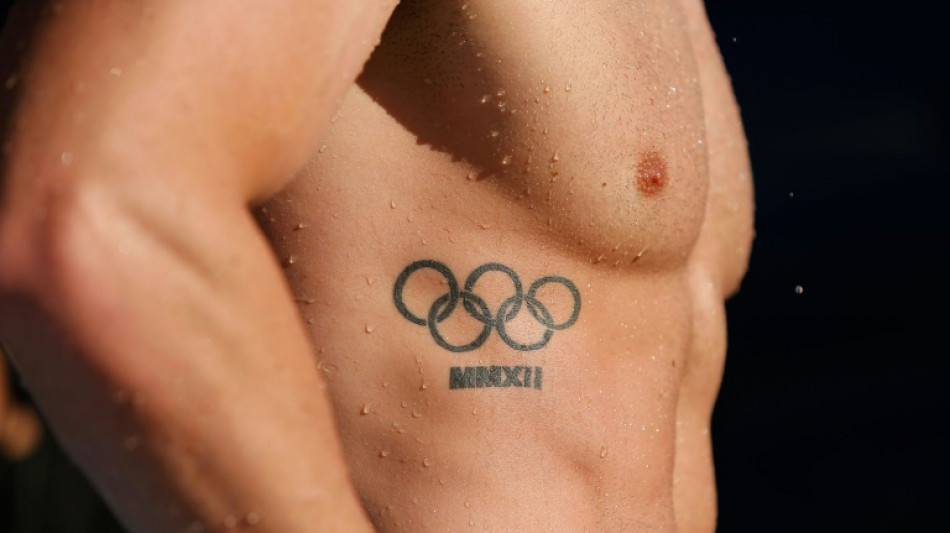
'Extremely dangerous': Health experts slam doping-friendly Enhanced Games / Photo: © GETTY IMAGES NORTH AMERICA/AFP/File

 Typhoon Dujuan leaves four dead in Japan, 45,000 houses without power
 G7 leaders condemn Houthi strikes on Saudi Arabia

 Google data centre sparks protests in Austria

 Shin Ohashi: Junk food-loving teen and Japan's next big swimming hope

 Stocks rise on AI buzz, drop in oil prices

 China's robot dancers limber up for America's Got Talent final

 Despite military might, Saudi struggles to crush the Houthis

 Trump to tout deals, defend Iran war in UN speech

 Sri Lanka to issue verdict in landmark Easter attack trial

 Macron says talks with Trump on Red Sea, Ukraine 'constructive'

 Green policies just good politics, says UK minister

 Bardot auction in Paris fetches nearly one million euros

 No timeline on Daniels injury return, says Commanders coach

 British Columbia sues OpenAI in US court over Canada school shooting

 French star Batum retires after 18-year NBA career

 Zidane leads first France training session

 Man shot by ICE agent in Texas detained with bullet inside him: lawyer

 California declares state of emergency ahead of El Nino

 South Africa arrests three more suspects, after nine women murdered

 Carse needs time away from England, says captain Brook

 NOWPayments Releases Cross-Chain Payout Data Revealing Key Performance Benchmarks Across TRON, BNB Chain, and Solana

 British Museum bans photos of Bayeux Tapestry as crowds linger

 COP31 host says AI climate footprint to be a summit priority

 Berlin's far-left vote winners reject anti-semitism charges

 Mancini eager for 'new adventure' on Italy return

Athletes at the Paris Olympics later this month will be tested for performance-enhancing drugs, but at a competition plotting to rival the Games, doping will be the point.
The Enhanced Games, currently planned for late next year, will not test competitors for drugs but instead encourage them to take advantage of medical advancements to break world records.
The organisers say that by freeing athletes from the tyranny of anti-doping agencies and embracing technology, the Enhanced Games aim "to safely evolve mankind into a new superhumanity".
But researchers who have studied the effects of performance-enhancing drugs told AFP they fear the Games will push athletes to dope at such extreme levels they could risk heart attack, stroke or even death.
It remains unclear if the Enhanced Games will actually be held at all. World Athletics president Sebastian Coe has dismissed the whole idea as "bollocks".
But momentum seems to be building after retired Australian Olympic swimmer James Magnussen signed up earlier this year and the competition announced millions of dollars in funding from investors including US libertarian billionaire Peter Thiel.
Astrid Kristine Bjornebekk, a researcher at Oslo University Hospital, said she was shocked to find out there was a even a chance this "extremely dangerous" idea could become reality.
- 'Juice to the gills ' -
Bjornebekk, who has studied how anabolic steroids damage the brains of weightlifters, warned that the Games would "trigger use with no boundaries".
Illustrating how the concept could incentivise such use, Magnussen told a podcast he will "juice to the gills" to get the $1 million (920,000 euros) on offer for breaking the 50-metre freestyle world record.
As well as swimming, the Games also plan to host track and field events, gymnastics, weightlifting and combat sports.
Bjornebekk warned that mixing steroids and combat sports such as mixed martial arts "significantly escalates" the risk of someone dying during the competition.
To avoid such risks, a spokesman for the Enhanced Games told AFP that all athletes will be "continually supervised" once they sign up.
This will include health checks, psychological screening and monitoring using new tech such as a "real-time portable echocardiogram," the spokesman said.
However Dominic Sagoe of Norway's University of Bergen, who has led research finding that one in three steroid users become addicted, warned the consequences of a successful Enhanced Games "could spill into society".
He feared that children inspired by their sporting heroes could seek out steroids, or that 'roid rage-induced violence by aspiring athletes could be pushed into the streets.
"We cannot even fathom the consequences," he said. "It's not something to laugh at."
Anabolic steroids would likely be the most commonly used drug at the Games, the experts said.
Excessive use of these steroids has been found to cause liver or kidney damage, high blood pressure and cholesterol, infertility, mental health problems, and a higher risk of cancer.
But athletes would likely take a cocktail of drugs potentially including growth hormones, blood doping using erythropoietin (EPO), insulin and more, including some treatments to offset the side effects of others, Sagoe said.
The most "dangerous combinations of drugs likely will land the best performances," Bjornebekk warned.
- 'Tool for coercion' -
The Enhanced Games spokesman said that "side effects and adverse events" from performance-enhancing drugs "could arguably be avoided with proper clinical supervision and expert guidance".
A new medical commission and scientific advisory board are still hammering out exactly how the competition will monitor athlete safety, he added.
John William Devine, an expert in sports ethics at UK's Swansea University, said that -- despite billing itself as increasing athlete freedom -- the Games could turn into a "tool for coercion".
"If you remove the limit on performance-enhancing drugs, will athletes be pressured by coaches, by teammates, by governments or even by sponsors to take risks that they otherwise wouldn't have taken?" he asked.
Matthew Dunn, a steroid researcher at Australia's Deakin University, was concerned about athletes getting drugs on the black market and using them without supervision.
But he acknowledged that despite best efforts, competitions like the Olympics "are not 100 percent clean".
"It would also be interesting to see what the human body can achieve when it is 'enhanced'," he added.
So could the Enhanced Games one day overtake the Olympics?
"I think the general public still likes the idea of achievements occurring through ability, hard work and dedication -- and not through a syringe," Dunn said.
L.Meier--VB