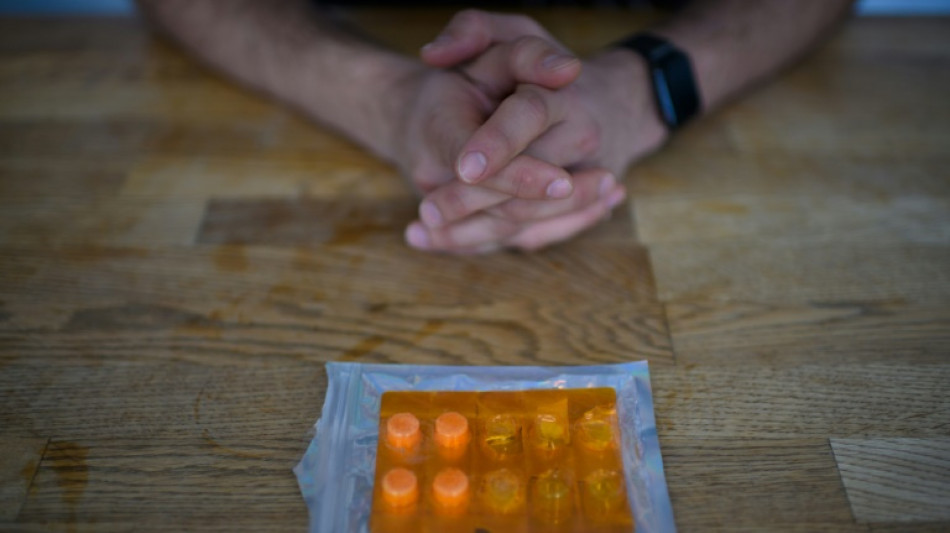
Ketamine pill treats depression without psychedelic effects: study / Photo: © AFP/File

 Typhoon Dujuan leaves four dead in Japan, 45,000 houses without power

 G7 leaders condemn Houthi strikes on Saudi Arabia

 Google data centre sparks protests in Austria

 Shin Ohashi: Junk food-loving teen and Japan's next big swimming hope

 Stocks rise on AI buzz, drop in oil prices

 China's robot dancers limber up for America's Got Talent final

 Despite military might, Saudi struggles to crush the Houthis

 Trump to tout deals, defend Iran war in UN speech
 Sri Lanka to issue verdict in landmark Easter attack trial

 Macron says talks with Trump on Red Sea, Ukraine 'constructive'

 Green policies just good politics, says UK minister

 Bardot auction in Paris fetches nearly one million euros

 No timeline on Daniels injury return, says Commanders coach

 British Columbia sues OpenAI in US court over Canada school shooting

 French star Batum retires after 18-year NBA career

 Zidane leads first France training session

 Man shot by ICE agent in Texas detained with bullet inside him: lawyer

 California declares state of emergency ahead of El Nino

 South Africa arrests three more suspects, after nine women murdered

 Carse needs time away from England, says captain Brook

 NOWPayments Releases Cross-Chain Payout Data Revealing Key Performance Benchmarks Across TRON, BNB Chain, and Solana

 British Museum bans photos of Bayeux Tapestry as crowds linger

 COP31 host says AI climate footprint to be a summit priority

 Berlin's far-left vote winners reject anti-semitism charges

 Mancini eager for 'new adventure' on Italy return

A new pill that slowly releases ketamine could treat people with severe depression without giving them the psychedelic side effects of the often-misused drug, early trial results suggested on Monday.
First developed in the 1960s as an anaesthetic, ketamine's hallucinogenic and dissociative effects led to it becoming a party drug dubbed "Special K".
However, mounting research has demonstrated that ketamine is effective for the roughly quarter of people suffering from depression who see little benefit from common anti-depressant drugs.
In many countries, ketamine has been prescribed for depression for years.
US billionaire Elon Musk told CNN in March that he regularly uses a small amount of prescribed ketamine because it is "helpful for getting one out of the negative frame of mind".
The drug has long been administered intravenously in clinics, but more recently a nasal spray using a derivative called esketamine has increased in popularity.
Both can cause patients to have side effects such as dissociation, high blood pressure and an elevated heart rate.
There are also fears that medical use of the drug could slide into abuse.
The pill described in the journal Nature Medicine on Monday takes more than 10 hours to break down in the liver, lead study author Paul Glue told AFP.
"The really interesting feedback from patients is the lack of side effects -- no euphoria, no dissociation," said the researcher at New Zealand's University of Otago.
"I don't think these tablets would appeal to people who are abusing ketamine."
- Electro-shock alternative -
The phase 2 trial involved more than 270 people with depression who had previously tried an average of four different anti-depressant drugs.
More than half taking the ketamine pill went into remission for their depression, while 70 percent of the placebo group relapsed after 13 weeks, the study said.
Julaine Allan, an expert on mental health and addiction at Australia's Charles Sturt University who was not involved in the study, praised the trial while emphasising that more research is needed.
Ketamine does not work for everyone, and the "positive effects may wear off over time," she told AFP.
Michel Hoffmann, a psychiatrist at Geneva University Hospitals, said there is "real enthusiasm" in the medical community for ketamine's potential for treating depression.
"For patients who don't respond to conventional drugs, ketamine offers a way to avoid electro-shock therapy," he told AFP.
This last-resort treatment, which involves sending electric currents through the brain, has been proven to be effective.
But it can cause memory loss -- and some patients fear the procedure after seeing depictions of it in films such as "One Flew Over the Cuckoo's Nest".
- Fears of 'opioid style crisis' -
Some psychiatrists remain hesitant to prescribe ketamine for depression, fearing their patients could end up misusing the drug.
Last year, "Friends" actor Matthew Perry became the latest high-profile death from a ketamine overdose.
US police are investigating how Perry obtained the doses that caused his death -- he had reportedly not had a supervised infusion session for several days.
One potential benefit of quick-acting ketamine seen in previous research is that it could help patients considering suicide.
But there is "the plausible concern that the widespread use of ketamine might trigger a new opioid style crisis," Oxford researcher Riccardo De Giorgi said in a 2022 BMJ editorial.
By ridding ketamine of the side effects sought by some partygoers, the slow-release pill could alleviate some of these concerns.
There were still some side effects from the pill, the most common being headaches, dizziness and anxiety.
More research including phase 3 trials is needed before the drug can be reviewed by national medicine agencies, meaning it will be at least two or three years before patients could potentially access the pills, Glue said.
D.Schlegel--VB