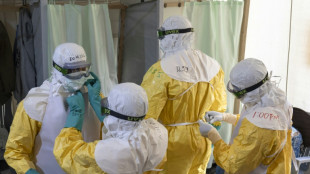
Macron assisted-dying plan riles opponents / Photo: © AFP/File

 Newcomers South Korea face holders Italy in Davis Cup finals

 Japan's Kojima sounds Marchand warning with Asian Games gold

 England rugby star Pollock signs new Northampton deal

 STARTRADER Expands Its Chinese Equity CFD Range with CXMT and Unitree Robotics

 MEXC Expands Opportunity Compass with Stock Trading Handbook to Help Crypto Users Build Investment Knowledge

 England paceman Wood retires from international cricket

 Magnificent Mandhana's 79 helps India to Asian Games cricket gold

 Marchand 'stressed' about racing Japanese rivals at LA Olympics

 Mobile boat clinics bring healthcare to India's remote islands

 Former India paceman Zaheer Khan named Chennai coach in IPL

 Six-year-old Chinese girl sets world record with Rubik's Cube

 Swimming prodigy Yu, 13, says 'interviews way harder than racing'

 Star coaches make their bows as Nations League returns

 Rams bounce back as Giants reel from Dart injury

 In Bangladesh, Pakistan's Jinnah photo stirs anger

 Two New Zealand naval ships transit Taiwan Strait

 Zidane gets down to work as France start new era

 Inside the Venezuelan prison meant to 'drive you insane'

 UK king braces as memoir by Diana's brother goes on sale

 No green light to lift EU sanctions on Russian oligarchs, talks to resume

 UK agrees support for Saudi in struggle with Houthis: reports
 EU foreign policy chief calls for continued sanctions on Russia

 Flights scrapped, evacuations urged as Typhoon Dujuan wallops Japan

 Fonseca to take break from tennis

 A Cuban zoo, and its animals, in epic battle for survival

President Emmanuel Macron on Monday faced criticism from French medical workers, political opponents and the Catholic Church over a draft bill, slated for debate in May, that would allow assisted dying for certain terminally-ill patients.
He told newspapers Sunday the bill would include "strict conditions" on allowing people to self-administer a lethal substance, or call on a relative or medical worker if they are incapable.
The move comes after France's parliament last week enshrined the right to abortion in the constitution, a widely-popular move championed by the president and a world first.
"There are cases we can't humanly accept," Macron told Catholic newspaper La Croix and left-wing Liberation, saying the "brotherly" law "looks death in the face".
Prime Minister Gabriel Attal wrote on X that the bill would be presented to the French parliament from May 27. "Death can no longer be a taboo issue and subject to silence," he added.
But several health workers' groups declared their "consternation, anger and sadness" at the plan.
Macron "has with great violence announced a system far removed from patients' needs and health workers' daily reality, which could have grave consequences on the care relationship," the associations for palliative care, cancer support and specialist nurses said in a joint statement.
Accusing the government of aiming to save money with the plan, they said that greater resources for palliative care, rather than assisted dying, would fulfil patients' demands to "die with dignity".
Political opponents accused Macron of hijacking the abortion and assisted dying debates as a diversion in his party's campaign for June 9 European Parliament elections.
"Purchasing power, security and immigration are the concerns of the French public," said Laurent Jacobelli, spokesman for the far-right National Rally (RN) currently leading the polls.
- Campaign promise -
The bill is unlikely to become law before 2025 after two readings in each of parliament's two houses.
At present, French law allows for "deep and continuous sedation" of patients who would otherwise endure great suffering and with a short life expectancy.
But updating the rules was one of Macron's presidential campaign promises, and he gathered an assembly of randomly-selected citizens to deliberate.
They issued a non-binding decision in 2023 that assisted dying should be allowed under certain conditions.
The draft law he has now proposed would open assisted dying to adults "fully capable of discernment" -- ruling out psychiatric and Alzheimer's patients, for example.
They would have to be suffering from an "incurable" condition likely to be fatal in the "short or medium term", causing suffering that is "resistant to treatment".
Patients' request for assisted dying would be ruled on by their medical team within two weeks. If approved, they would get a prescription for a lethal substance that could be self-administered.
People suffering from certain conditions, such as motor neurone disease, would be able to nominate someone to administer the lethal dose or get help from a health worker.
Beyond assisted dying, the law would also pump a billion euros ($1.1 billion) into palliative care over 10 years, Macron told the newspapers, also vowing to open 21 new centres in under-served areas.
- 'Towards death' -
"France is finally emerging from the dilly-dallying of the last few months," the Association for the Right to Die in Dignity (ADMD) said in a statement.
The group hailed the "relatively precise timetable" for the law to come before parliament.
But ADMD also objected to some provisions, such as the choice to rule out requests in advance from Alzheimer's sufferers.
"I hope (the law) will allow us to find what we wish for when we're close to the end, which is calm," assisted dying campaigner Loic Resibois, who suffers from motor neurone disease, told broadcaster France Inter.
"Knowing that French law will finally allow us to avoid a situation where we're not yet dead, but not really alive any more, is very important," he added.
Meanwhile France's Catholic bishops categorically rejected the bill.
"A law like this, whatever its aim, will bend our whole health system towards death as a solution," bishops' conference chief Eric de Moulins-Beaufort told La Croix.
"What helps people die in a fully human way is not a lethal drug, it's affection, esteem and attention," he added.
D.Schaer--VB