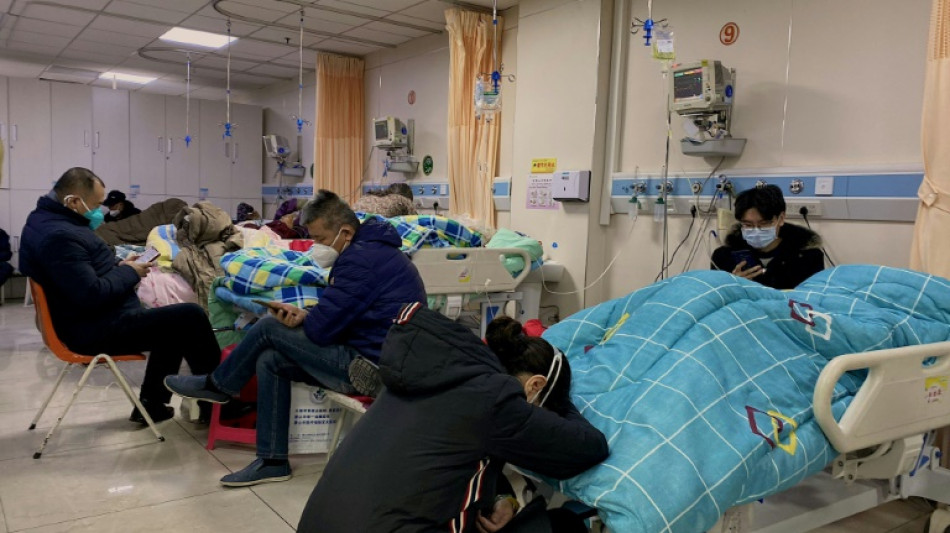
Soaring Covid cases shine light on China's healthcare gap / Photo: © AFP

 Stocks rise on AI buzz, oil prices cool

 India narrowly survive huge scare against minnows Japan

 Missing F-35 fighter parts 'not sensitive', says Australia minister
 Cambodia showcases scams crackdown with global conference

 Afghan cyclist who disguised herself as man wins Asian Games silver

 Typhoon Dujuan leaves four dead in Japan, 45,000 houses without power

 G7 leaders condemn Houthi strikes on Saudi Arabia

 Google data centre sparks protests in Austria

 Shin Ohashi: Junk food-loving teen and Japan's next big swimming hope

 Stocks rise on AI buzz, drop in oil prices

 China's robot dancers limber up for America's Got Talent final

 Despite military might, Saudi struggles to crush the Houthis
 Trump to tout deals, defend Iran war in UN speech

 Sri Lanka to issue verdict in landmark Easter attack trial

 Macron says talks with Trump on Red Sea, Ukraine 'constructive'

 Green policies just good politics, says UK minister

 Bardot auction in Paris fetches nearly one million euros

 No timeline on Daniels injury return, says Commanders coach

 British Columbia sues OpenAI in US court over Canada school shooting

 French star Batum retires after 18-year NBA career

 Zidane leads first France training session
 Man shot by ICE agent in Texas detained with bullet inside him: lawyer

 California declares state of emergency ahead of El Nino

 South Africa arrests three more suspects, after nine women murdered

 Carse needs time away from England, says captain Brook

Understaffed and underfunded clinics stand half-empty in parts of the Chinese countryside even as hospitals in major cities heave under an unprecedented Covid wave -- an illustration of the stark disparities in the country's healthcare system.
Visits by AFP journalists in the past two weeks have revealed sharp differences in demand for urban and rural hospitals in parts of northern China as many in the countryside head to big cities for a quality of care they simply can't get closer to home.
In one of the world's most unequal economies, China's centralised healthcare system drives money and resources towards urban hospitals at the expense of rural ones, a disparity that has become all the more intense as cases surge.
In the capital Beijing and the northern megacity of Tianjin, emergency wards have been so overwhelmed that dozens of mostly elderly patients have been accommodated on gurneys in public areas.
Crammed shoulder to shoulder and gasping for breath, many were hooked up to intravenous drips or oxygen tanks while machines monitored their vital signs. A few appeared unconscious or unresponsive.
Yet in the neglected rural town of Xin'an, the sparsely equipped local hospital was operating at well below full capacity.
In a poorly heated room near reception, around half a dozen elderly people huddled in thick overcoats, drips protruding from their arms.
But most of the seats were unoccupied, and the pressure on staff appeared far lower than their municipal counterparts.
- 'Lack of progress' -
"What we are seeing in rural China epitomises the lack of progress in China's healthcare reform," said Yanzhong Huang, senior fellow for global health at the Council of Foreign Relations, a nonpartisan US think tank.
"People dissatisfied with the poor quality of rural healthcare will bypass (local providers) to seek care in urban hospitals."
As the initial wave starts to ebb, the pressure on some facilities may be receding -- even as the seriously sick continue to flock to municipal institutions.
Many rural residents, meanwhile, struggle for nearby access to doctors and medicines, and public health literacy is often patchy.
A local shopkeeper in Xin'an said a Covid outbreak had swept through the settlement of around 30,000 people in December, but "the worst of it has passed".
And hospital staff and local residents there said those requiring treatment for severe illness usually made the 90-minute journey up the highway to Tianjin or pushed on to Baoding, a city some 200 kilometres away where a recent outbreak overwhelmed hospitals.
Medical services in mid-size municipalities also appear to be less stretched than in China's megacities.
In Tangshan -- a smaller industrial city of 7.7 million people -- the scene was calmer than that in Tianjin about two hours away.
Around two dozen patients of advanced age filled the resuscitation ward of a central hospital, with one nurse saying they had "all tested positive" for Covid.
Only three or four patients occupied makeshift beds in the corridors outside.
- Far from over -
Chinese authorities have said in recent days that the first wave of infections has hit a peak in cities including Beijing and Tianjin.
But the end is far from near, with officials warning of a multi-pronged outbreak in the coming weeks as city workers return to their rural hometowns during the winter travel season.
"To some extent, rural patients may have put extra strains on urban healthcare institutes," said Xi Chen, an associate professor at the Yale School of Public Health.
"However, unlike in urban areas, this wave of the Omicron outbreak has not reached its peak in rural China," he added
"Things may get significantly worse as migrants start to return to rural communities."
M.Furrer--BTB