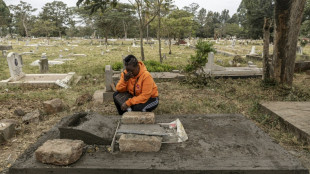
Covid's true death toll still elusive, three years in / Photo: © AFP/File

 Stocks rise on AI buzz, oil prices cool

 India narrowly survive huge scare against minnows Japan

 Missing F-35 fighter parts 'not sensitive', says Australia minister
 Cambodia showcases scams crackdown with global conference

 Afghan cyclist who disguised herself as man wins Asian Games silver

 Typhoon Dujuan leaves four dead in Japan, 45,000 houses without power

 G7 leaders condemn Houthi strikes on Saudi Arabia

 Google data centre sparks protests in Austria

 Shin Ohashi: Junk food-loving teen and Japan's next big swimming hope

 Stocks rise on AI buzz, drop in oil prices

 China's robot dancers limber up for America's Got Talent final

 Despite military might, Saudi struggles to crush the Houthis
 Trump to tout deals, defend Iran war in UN speech
 Sri Lanka to issue verdict in landmark Easter attack trial

 Macron says talks with Trump on Red Sea, Ukraine 'constructive'

 Green policies just good politics, says UK minister
 Bardot auction in Paris fetches nearly one million euros
 No timeline on Daniels injury return, says Commanders coach

 British Columbia sues OpenAI in US court over Canada school shooting

 French star Batum retires after 18-year NBA career

 Zidane leads first France training session
 Man shot by ICE agent in Texas detained with bullet inside him: lawyer

 California declares state of emergency ahead of El Nino

 South Africa arrests three more suspects, after nine women murdered

 Carse needs time away from England, says captain Brook

The true global death toll of Covid-19 remains difficult to nail down three years after the first case was detected, though experts agree there have been far more fatalities than officially reported.
The difference between the official and real figures could diverge even further next year, with modelling predicting more than a million deaths in post-zero-Covid China, which recently narrowed how it counts fatalities.
There have been more than 6.65 million officially reported Covid deaths since the virus was first identified in China in December 2019, according to the World Health Organization.
However countries count Covid deaths differently and methods have changed throughout the pandemic.
Attributing deaths to Covid can be a very difficult exercise, said Antoine Flahault, director of the Institute of Global Health at the University of Geneva.
The death of a patient in a hospital in a developed country who had already been diagnosed with Covid could be straightforward but that is often not the case and doctors "usually do no have much information" to guide them, Flahault told AFP.
Instead researchers have sought to compare the total number of deaths from all causes recorded since 2020 to what would have been expected if there had been no pandemic.
Using these figures, researchers from the WHO reported in the journal Nature earlier this month that there were 14.83 million excess deaths from Covid in 2020 and 2021, updating a figure first released in May.
That is nearly three times higher than the 5.4 million officially reported Covid deaths over those two years.
Research from the US-based Institute for Health Metrics and Evaluation estimated in March that the number was an even higher 18.2 million.
But Flahault said that even these figures could "perhaps still be an underestimate".
The toll has risen more slowly this year. A regularly updated tally from The Economist estimates that there have been 21 million excess deaths since the pandemic's start -- 3.1 times higher than the official number.
- Lacking data -
According to the WHO figures, India had by far the most excess deaths linked to Covid in 2020-2021 with 4.74 million, a figure the Indian government has sharply disputed.
Russia came next with a little over one million. However the biggest disparities between the expected number of deaths and the actual figure were in South America.
Peru, for example, recorded around twice as many total deaths in 2020-2021 as it had in normal times.
However Hanno Ulmer of Austria's Medical University of Innsbruck pointed out that there were "also strong dengue fever outbreaks during the pandemic years in Peru", which could have increased the number of excess deaths without being linked to Covid.
Another problem is that many nations have little or no data in the first place.
"For almost half the countries of the world, tracking excess mortality is not possible using the data that are available and for these we must rely on statistical models," the WHO researchers wrote in this month's study.
In Africa, monthly data on deaths was only available for six out of 47 countries.
- A million deaths in China -
Looking forward to 2023, China's lifting of its zero-Covid measures loom large as a possible source of new deaths.
With the first easing of strict measures in place the start of the pandemic, few of China's 1.4 billion population have immunity from previous Covid infection, and vaccination rates have lagged, particularly among the at-risk elderly.
Modelling by the IHME predicts more than 300,000 Covid deaths in China by April 1 -- and a total of over a million across 2023.
Last week China reclassified what it considers to be Covid deaths, which will now only count if they come directly from respiratory failure, in a move that analysts say will dramatically the number of officially recognised deaths.
Hospitals across China have been overwhelmed by an explosion of infections in recent weeks but just one new death was added on Thursday to a tally by a national disease control body.
Ali Mokdad, a professor of health metrics sciences at IHME, told AFP that good data was the only way "we can manage to stay ahead of the virus".
K.Brown--BTB