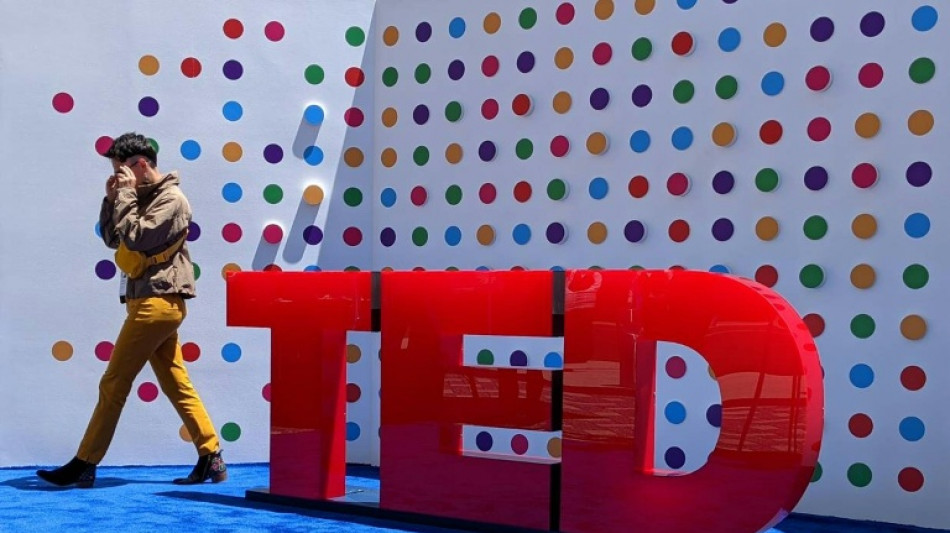
Exiting TED leader clings to tech optimism / Photo: © AFP/File

 Colombian judge bans strikes on guerrillas if minors are present

 Khachanov shocks ailing Auger-Aliassime, Swiatek and Osaka advance at US Open

 Lone juror blocking verdict in US mother's child murder trial: defense
 'Kinda chic' - Williams sisters set to launch US Open doubles bid

 Volkswagen says cutting 100,000 jobs by end of decade

 Russia slaps curfew on charity director over army criticism

 Ailing Auger-Aliassime upset by Khachanov at US Open
 Richarlison omitted from Tottenham's Premier League squad
 How El Nino is choking the Panama Canal

 Hamilton drives his Ferrari dream at Monza
 Senegal has an IMF loan, now what?

 Auger-Aliassime upset by Khachanov at US Open
 Hugging Face, the French start-up that became AI's warehouse

 World Cup winner Llorente retires from Spain team at 31

 Osaka squeezes into US Open third round

 Apple faces £2 bn lawsuit in UK over app privacy feature

 Former champ Swiatek eases into US Open third round

 DR Congo latest to promise moving Israel embassy to Jerusalem

 War criminal Mladic's body returns to Serbia with military honours

 Pierre Cardin museum brings designer's futurist style to Venice
 Slovenian rookie Omrzel triumphs as Mas extends Vuelta lead

 British, French leaders talk migrants, EU relations

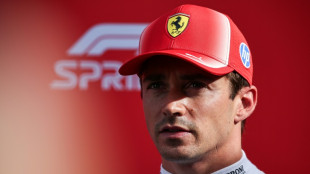 Heading for Ferrari's home race, Leclerc still dreams of world title

 Cafe at centre of Israel culture clash agrees to shut on Sabbath

 Spacecraft bound for Mercury begins 'tricky' arrival

Chris Anderson took over TED 25 years ago, when the internet was young and optimism abounded about the future it could deliver.
Since then, the New York-based conference series has become globally known for its trademark "talks" sharing big ideas for a better world, while the internet is increasingly seen as a maelstrom of misinformation and social division.
Anderson still sees technology, particularly artificial intelligence, as able to bring out the best in humanity, as he hands off leadership of the organization behind TED and its prestigious conferences to Khan Academy founder Sal Khan.
"Conversations about possibility, about what we can build together, have always been at the heart of TED," Anderson said in an interview with AFP.
"It's probably what the world needs now more than ever; it's the antidote to people throwing barbs at each other."
Anderson cited social media as "the single biggest contributor to our dysfunction and to the falling out of love with technology" for many.
He faulted ad-driven business models that tie profit to time people spend on tech platforms, no matter how disturbing or unhealthy the content holding their attention.
"These algorithms have found that the best way to lock people in is to make them see the world as frightening and to see the 'other' as threatening them," Anderson said.
"It's a tragedy."
Nonetheless, Anderson is a self-described optimist, confident that better things can be built.
- Tedsters -
The first Technology, Education, and Design (TED) gathering was held in Monterey, California in 1984.
The annual conferences were drawing about 500 people when Anderson's nonprofit Sapling Foundation took over in 2001.
The roster of "Tedsters" includes renowned scientists, Hollywood celebrities, influential artists, and founders of tech firms such as Amazon, Microsoft, Google, and Netflix.
"I felt I'd come home to that heroic group of people dreaming about the future and what the future could be," Anderson said.
"They absolutely loved it," he said of the atmosphere at TED.
Anderson, who had been a successful publishing entrepreneur, made the risky move of releasing videos of the talks for free online.
"It could have arguably wrecked the conference and stopped people from wanting to pay to come," Anderson said.
Instead, the opposite happened: as TED Talks spread around the world, so did interest in attending the conferences in person.
"It's completely thrilling seeing that TED didn't just have to be for 500 people -- it could be for many millions of people," Anderson said.
TED now produces podcasts, short video series, animated educational lessons (TED-Ed), and TV programs that are translated into more than 100 languages.
- Best and worst selves -
Anderson spearheaded the launch of the TEDx program, which lets local organizers host TED-style events, and brought young innovators into the fold with a fellowship program.
A TED Audacious Project backing "wishes" by people seeking to do good has generated more than $3 billion for projects to make the world more sustainable, just, or beautiful, according to organizers.
"The biggest thrill of TED has been discovering that the internet used the right way can be the most glorious gift," Anderson said.
Anderson, 68, touted Khan as an ideal successor to steward TED.
Khan will continue to lead his online learning platform while also helping shape TED's mission, particularly with AI.
"You could argue that AI used right is capable of helping people become their best selves," Anderson said, noting that education has long been central to TED.
"Whereas social media often helps people become their worst selves."
C.Bruderer--VB