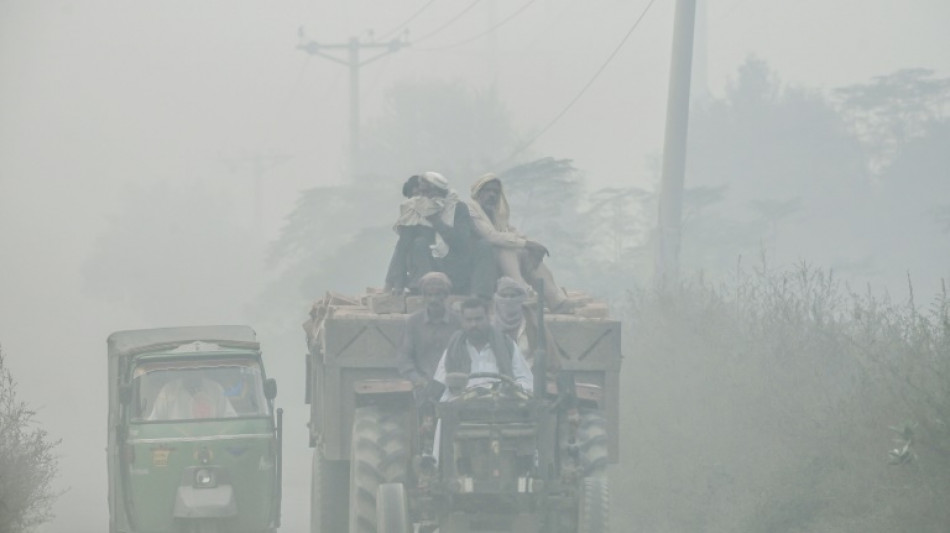
Pakistan's Punjab province shuts schools in smog-hit main cities / Photo: © AFP

 Colombian judge bans strikes on guerrillas if minors are present

 Khachanov shocks ailing Auger-Aliassime, Swiatek and Osaka advance at US Open

 Lone juror blocking verdict in US mother's child murder trial: defense
 'Kinda chic' - Williams sisters set to launch US Open doubles bid

 Volkswagen says cutting 100,000 jobs by end of decade

 Russia slaps curfew on charity director over army criticism

 Ailing Auger-Aliassime upset by Khachanov at US Open

 Richarlison omitted from Tottenham's Premier League squad

 How El Nino is choking the Panama Canal

 Hamilton drives his Ferrari dream at Monza

 Senegal has an IMF loan, now what?

 Auger-Aliassime upset by Khachanov at US Open

 Hugging Face, the French start-up that became AI's warehouse
 World Cup winner Llorente retires from Spain team at 31

 Osaka squeezes into US Open third round

 Apple faces £2 bn lawsuit in UK over app privacy feature
 Former champ Swiatek eases into US Open third round

 DR Congo latest to promise moving Israel embassy to Jerusalem

 War criminal Mladic's body returns to Serbia with military honours

 Pierre Cardin museum brings designer's futurist style to Venice

 Slovenian rookie Omrzel triumphs as Mas extends Vuelta lead
 British, French leaders talk migrants, EU relations

 Heading for Ferrari's home race, Leclerc still dreams of world title
 Cafe at centre of Israel culture clash agrees to shut on Sabbath

 Spacecraft bound for Mercury begins 'tricky' arrival
Pakistan's most populated province of Punjab on Wednesday ordered schools closed in smog-hit main cities, shifting them to online learning until November 17, as the country battles record air pollution.
The province, home to more than half of Pakistan's 240 million people, had earlier closed primary schools, curbed tuk-tuks and shuttered some barbeque restaurants in megacity Lahore.
On Wednesday, it ordered all shools to be shut in several major cities enveloped by smog, a mix of fog and pollutants caused by low-grade diesel fumes, smoke from seasonal agricultural burning and winter cooling.
"Looking at the predicted air wind and air quality index we are closing all higher secondary schools," said Marriyum Aurangzeb, a senior minister in Punjab during a press conference in Lahore.
The decision will affect millions of children in some of Pakistan's largest cities, including Punjab's provincial capital Lahore.
The minister said on Wednesday the air quality index (AQI), which measures a range of pollutants, spiked above 1,000 –- well above the level of 300 considered 'dangerous' – according to data from IQAir.
"This morning's AQI crossed 1,100," Aurangzeb said.
"I appeal to citizens, that for god's sake don't come out of your houses," she said adding that wearing a face mask was made mandatory in affected cities.
She also announced that half of the staff in public and private offices will work remotely.
"It's like a slow horror movie, constantly creeping up behind you," said Ayishm Ahmed Khan Burki, a 22-year-old student who transferred her courses from Lahore to capital Islamabad after suffering from allergies and asthma.
"Everyone has a right to clean air," she told AFP.
- Lahore admits 900 patients -
Seasonal crop burn-off by farmers on the outskirts of Lahore also contributes to toxic air the WHO says can cause strokes, heart disease, lung cancer and respiratory diseases.
The minister said in Lahore alone, more than 900 patients including children and the elderly were admitted in hospitals on Tuesday.
"Colds and fevers have become so widespread that everyone is heading to the hospitals," Muhammad Yousaf, a 50-year-old banker told AFP in Lahore.
"There are long queues at the hospitals' receptions, and patients are facing extended waiting times for their turn".
Other affected cities include Faisalabad, Pakistan's third-largest, as well as Multan and Gujranwala.
The decision follows last month's announcement by the provincial environmental protection agency of new restrictions in four "hot spots" in Lahore. Tuk-tuks with polluting two-stroke engines were banned, along with restaurants that operate barbecues without filters.
Pollution in excess of levels deemed safe by the WHO shortens the life expectancy of Lahore residents by an average of 7.5 years, according to the University of Chicago's Energy Policy Institute.
According to UNICEF, nearly 600 million children in South Asia are exposed to high levels of air pollution and half of childhood pneumonia deaths are associated with air pollution.
G.Frei--VB