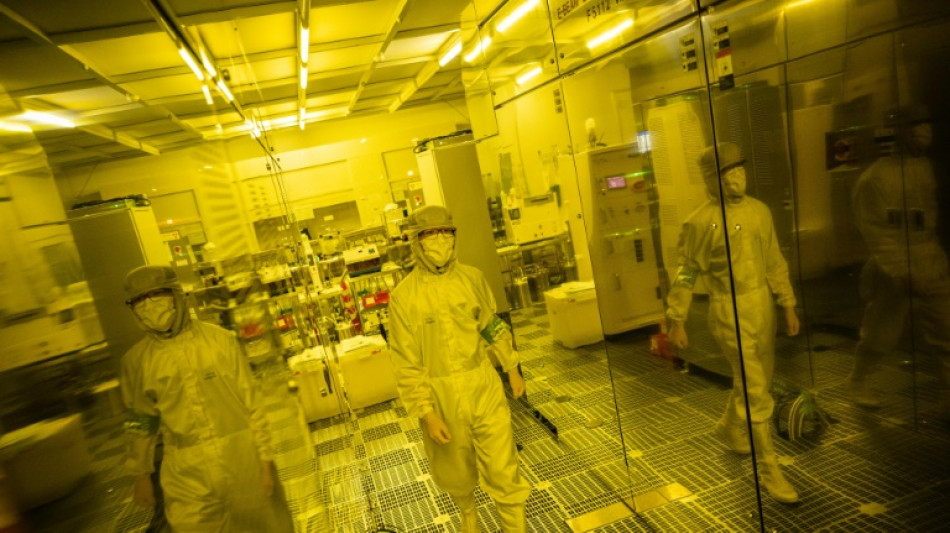
Inside a semiconductor 'clean room' at Japan's top university / Photo: © AFP

 Colombian judge bans strikes on guerrillas if minors are present

 Khachanov shocks ailing Auger-Aliassime, Swiatek and Osaka advance at US Open

 Lone juror blocking verdict in US mother's child murder trial: defense
 'Kinda chic' - Williams sisters set to launch US Open doubles bid

 Volkswagen says cutting 100,000 jobs by end of decade

 Russia slaps curfew on charity director over army criticism

 Ailing Auger-Aliassime upset by Khachanov at US Open

 Richarlison omitted from Tottenham's Premier League squad

 How El Nino is choking the Panama Canal

 Hamilton drives his Ferrari dream at Monza

 Senegal has an IMF loan, now what?

 Auger-Aliassime upset by Khachanov at US Open

 Hugging Face, the French start-up that became AI's warehouse

 World Cup winner Llorente retires from Spain team at 31

 Osaka squeezes into US Open third round

 Apple faces £2 bn lawsuit in UK over app privacy feature

 Former champ Swiatek eases into US Open third round

 DR Congo latest to promise moving Israel embassy to Jerusalem

 War criminal Mladic's body returns to Serbia with military honours

 Pierre Cardin museum brings designer's futurist style to Venice

 Slovenian rookie Omrzel triumphs as Mas extends Vuelta lead

 British, French leaders talk migrants, EU relations

 Heading for Ferrari's home race, Leclerc still dreams of world title

 Cafe at centre of Israel culture clash agrees to shut on Sabbath

 Spacecraft bound for Mercury begins 'tricky' arrival

To study semiconductors at Japan's top university, first you need the right clothes -- protective overalls, shoe covers, plastic gloves and a lightweight balaclava to keep your hair out of the way.
Then, surgical mask in place, you step inside an "air shower" to remove all the dust from your body that could potentially contaminate the precision equipment.
Now, you are ready to enter the University of Tokyo's clean room, a highly controlled space where microchips are handled.
Clean rooms, a vital part of semiconductor factories, are also found at such universities, where aspiring tech innovators conduct research.
Chips are an indispensable part of the modern economy, used in everything from smartphones to cars and weapons.
That has made them politically sensitive, with the industry frequently caught in the crossfire as the United States and China tussle over access to advanced tech.
Japan is also ramping up its efforts to revive its once-world-leading chip industry: the government has promised up to $25 billion in subsidies to help triple sales of domestically produced chips by 2030.
Taiwanese chip behemoth TSMC opened a semiconductor factory in southern Japan in February and is planning a second facility for more advanced chips.
And a multi-billion-dollar joint venture called Rapidus, involving Sony, Toyota, IBM and others, aims to mass produce next-generation logic chips in Japan from 2027.
Chip expert and University of Tokyo professor Tadahiro Kuroda said Japan's push into a sector where it was once dominant feels like "spring has returned".
At the university's 600 square-metre (6,500 square-foot) chip lab, filled with cutting-edge machines, students use tweezers to handle the delicate materials.
With pipettes, they drip a red liquid chemical onto gleaming, pristine silicon wafers designed to contain a dizzying number of tiny transistors.
PhD student Kei Misumi, 27, who regularly works in the clean room, told AFP he hopes such advanced technology will further enrich people's lives.
I.Stoeckli--VB