'Existential risk': Quebec's English-language universities fear massive fee hikes / Photo: © AFP

 Colombian judge bans strikes on guerrillas if minors are present

 Khachanov shocks ailing Auger-Aliassime, Swiatek and Osaka advance at US Open

 Lone juror blocking verdict in US mother's child murder trial: defense
 'Kinda chic' - Williams sisters set to launch US Open doubles bid

 Volkswagen says cutting 100,000 jobs by end of decade

 Russia slaps curfew on charity director over army criticism

 Ailing Auger-Aliassime upset by Khachanov at US Open

 Richarlison omitted from Tottenham's Premier League squad

 How El Nino is choking the Panama Canal

 Hamilton drives his Ferrari dream at Monza

 Senegal has an IMF loan, now what?

 Auger-Aliassime upset by Khachanov at US Open

 Hugging Face, the French start-up that became AI's warehouse

 World Cup winner Llorente retires from Spain team at 31

 Osaka squeezes into US Open third round

 Apple faces £2 bn lawsuit in UK over app privacy feature

 Former champ Swiatek eases into US Open third round

 DR Congo latest to promise moving Israel embassy to Jerusalem

 War criminal Mladic's body returns to Serbia with military honours

 Pierre Cardin museum brings designer's futurist style to Venice

 Slovenian rookie Omrzel triumphs as Mas extends Vuelta lead

 British, French leaders talk migrants, EU relations

 Heading for Ferrari's home race, Leclerc still dreams of world title
 Cafe at centre of Israel culture clash agrees to shut on Sabbath

 Spacecraft bound for Mercury begins 'tricky' arrival

A chill has fallen over the three English-language universities in Canada's Quebec province, as winter arrives with students and administrators worried about plans to nearly double tuition by next school year.
Announced last month by the French-speaking province's government, the plan would raise tuition for non-Quebec residents at all three anglophone universities from around Can$9,000 (US$6,500) to Can$17,000 -- with the additional funds meant to support francophone universities and educational programs.
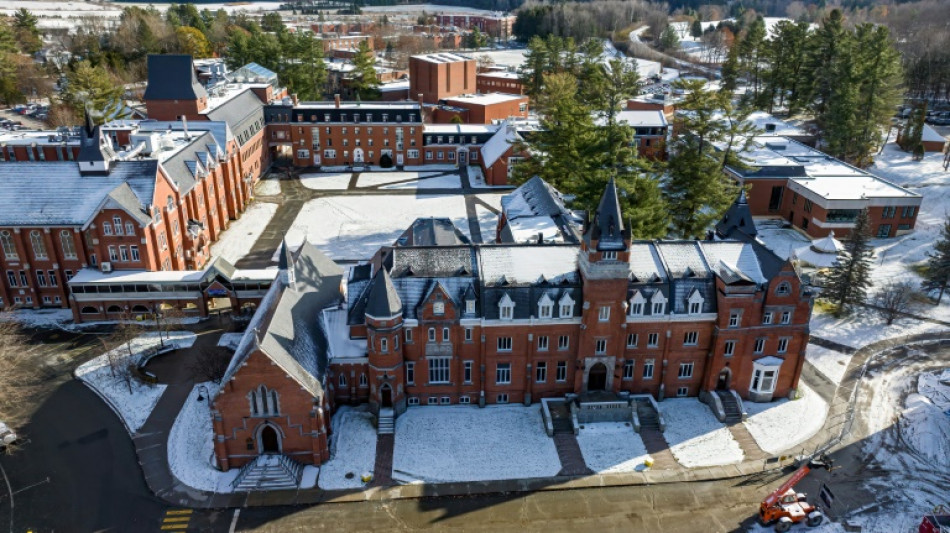
Bishop's University, nestled on the wooded banks of a river about two hours east of Montreal, could see a "catastrophic" outflow of students if the plan goes through, warns principal Sebastien Lebel-Grenier.
"For us, this is truly an existential crisis. It's a threat to our ability to continue as a university," he told AFP in an interview.
About 30 percent of Bishop's 2,650 students come from other provinces in Canada, while 15 percent are international.
Bryn Empey, a teaching student from Ontario in her final year at the university, said she thinks most students in Canada would choose not to study in Quebec.
"If you're paying double to come study in a province that doesn't welcome you... then I think it's really hard to justify that price increase when you can have a similar experience in Ontario," she told AFP, adding that her younger sister was already reconsidering her plans to attend Bishop's.
Quebec has had a long-running fear that its unique French-speaking identity is under threat of English intrusion -- especially in the metropolis of Montreal where the province's two other anglophone universities, McGill and Concordia, are located.
In announcing the fee hike measure, Quebec's Minister of Higher Education Pascale Dery said it was to "send out a clear signal."
"Not only are we putting an end to a policy that subsidized students at a loss if they didn't stay here, but we're also putting the brakes on the decline of French in Montreal," said the member of Quebec premier Francois Legault's CAQ party.
Empey, who helped organize a large march in Montreal to protest against the fee hike, said she doubts the money would help protect the French language.
Jonathan Cassan, a 20-year-old American in his third year of environmental studies at Bishop's, said the plan would "deter a lot of students from coming here."
- Montreal's reputation -
With a higher proportion of Canadian students than the bigger McGill and Concordia, Bishop's is more at risk, says professor Pier-Andre Bouchard St-Amant of the ENA national public administration university.
But the administrations of McGill and Concordia, both internationally renowned universities, are also warning that the measure could be disastrous for them, while arguing it could harm Montreal's reputation.
Concordia president Graham Carr expects "devastating financial implications," while his counterpart at McGill, Deep Saini, warns of serious negative effects not just at his university, but on "the higher education sector, and on the whole of Quebec society."
"Among McGill's strongest assets is its tremendous power to attract and retain the highly skilled people who contribute so significantly to Quebec's economy and society," Saini said in a statement.
And it is not just the education sector outraged by the tuition fee hike: Many businesses and organizations have also voiced their opposition and demanded a reversal.
But the damage may already have been done.
"The mere fact of announcing these measures is already having a very significant impact," Lebel-Grenier said.
"It's fallen right in the middle of our recruitment effort for next year."
T.Egger--VB