Dangerous and degrading: pit toilets blight S.Africa schools / Photo: © AFP

 Colombian judge bans strikes on guerrillas if minors are present

 Khachanov shocks ailing Auger-Aliassime, Swiatek and Osaka advance at US Open

 Lone juror blocking verdict in US mother's child murder trial: defense

 'Kinda chic' - Williams sisters set to launch US Open doubles bid

 Volkswagen says cutting 100,000 jobs by end of decade

 Russia slaps curfew on charity director over army criticism

 Ailing Auger-Aliassime upset by Khachanov at US Open

 Richarlison omitted from Tottenham's Premier League squad

 How El Nino is choking the Panama Canal

 Hamilton drives his Ferrari dream at Monza

 Senegal has an IMF loan, now what?

 Auger-Aliassime upset by Khachanov at US Open

 Hugging Face, the French start-up that became AI's warehouse

 World Cup winner Llorente retires from Spain team at 31

 Osaka squeezes into US Open third round

 Apple faces £2 bn lawsuit in UK over app privacy feature
 Former champ Swiatek eases into US Open third round

 DR Congo latest to promise moving Israel embassy to Jerusalem

 War criminal Mladic's body returns to Serbia with military honours

 Pierre Cardin museum brings designer's futurist style to Venice

 Slovenian rookie Omrzel triumphs as Mas extends Vuelta lead
 British, French leaders talk migrants, EU relations

 Heading for Ferrari's home race, Leclerc still dreams of world title
 Cafe at centre of Israel culture clash agrees to shut on Sabbath

 Spacecraft bound for Mercury begins 'tricky' arrival
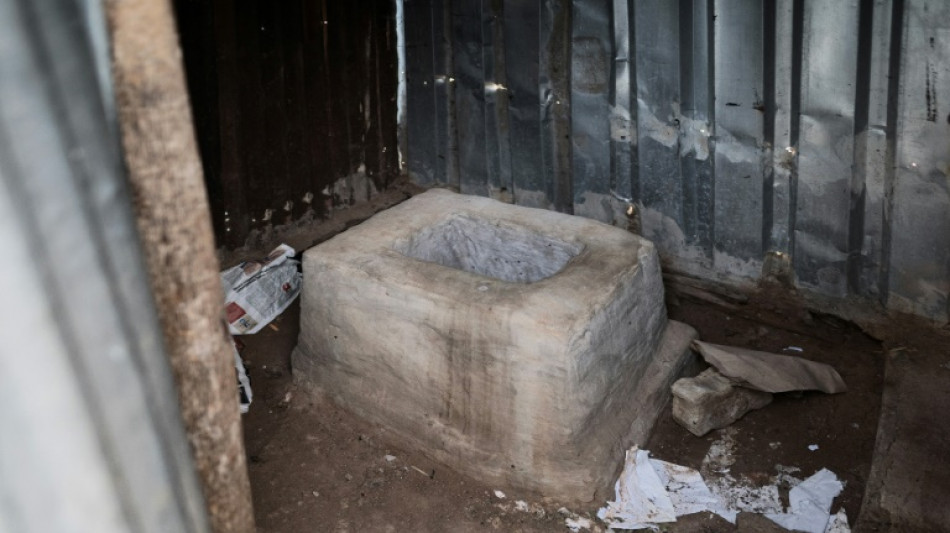
Schools across rural South Africa have perilous and degrading pit latrines -- a heritage of the apartheid era that campaigners say symbolises inequality and government ineptitude.
Successive governments going back to president Nelson Mandela have promised to eradicate the scourge.
The last few years alone have seen President Cyril Ramaphosa's administration promise more than twice to replace open latrines in schools.
The rudimentary toilets typically consist of a concrete slab on the ground with a drop of at least three metres (10 feet) deep.
But deadlines for replacing them have come and gone -- leaving young children at horrifying risk of falling in and drowning.
More than 3,300 of South Africa's 23,000 public schools still use pit latrines, according to government figures released in March.
The unhygienic open toilets are "a legacy of apartheid", says Amnesty International's Sibusiso Khasa, who is campaigning for political action to address the problem.
Although there is no reliable data on child drownings in pit latrines, press reports underscore the everyday danger.
In March, a four-year-old girl was found dead in a school pit toilet in the Eastern Cape province.
One month later, a 20-month-old girl died in a pit toilet in a relative's backyard in the central Free State province.
Refilwe Diloane told AFP of the horror-filled day that her son, Oratile, went off to school and fell into a pit latrine.
The then five-year-old slipped into a hole full of human waste and was rescued by a gardener using a rope.
He had "bruises and the head was swollen... and smelling faeces (were) coming from his mouth," Diloane said.
"He was perfectly healthy and was a very smart child. I thought he would become the next president," she said.
"Since that incident he is no longer okay... Mentally he is not okay," the 46-year-old said, tears rolling down her cheeks.
- 'Fell into the toilet' -
The boy suffered injuries that day in May 2016 that have left him severely brain damaged, according to his mother.
He was no longer able to perform mundane tasks and struggles to string full sentences together.
Following the accident, Oratile was diagnosed with hydrocephalus, epilepsy and autism, said Diloane at their home in the village of Kanana, around 180 kilometres (112 miles) northwest of Johannesburg.
Taking off his beanie hat, the 12-year-old reveals a scar on his head.
He suffers from memory loss but tells his mother every day that he remembers the fall.
"I fell into the toilet," he says, looking at his mother.
He also asks why he has no friends or can't go to school, she said.
The pit toilets at his primary school where the accident happened have since been replaced.
But the wider picture of introducing flushing toilets where they are still sorely needed remains bleak.
- Stubborn inequality -
South Africa is the world's most unequal country, according to the World Bank, despite the end of apartheid in 1994.
The use of pit toilets in Africa's most industrialised economy is a stark reminder of the problem.
Privately-run schools offer world-class facilities, score high pass rates and cost three times more than state-run schools.
But mostly in South African rural areas, pit latrines remain common, campaigners say.
In 1996, the country had 9,000 schools that "had no appropriate toilets and were dependent on basic pit toilets", according to the education ministry.
However, pointing to progress since the end of apartheid, Amnesty campaigner Khasa blasted the government for failing in its "obligations to protect human rights".
The education ministry did not respond to AFP's request for comment.
- 'Lack of political will' -
In 2018 when he came to power, Ramaphosa's government said half a million dollars would be needed to eradicate open latrines from schools.
Education Minister Angie Motshekga then set another deadline for March this year, which has been pushed back to 2025.
The government has faced court action from affected families as well as rights and opposition groups to force it to act.
In 2019, a court ordered the government to pay 1.4 million rand($75,000)in damages to the family of Michael Komape, a five-year-old who drowned in a toilet in 2014.
"The fact that they've been missing their own deadlines, it's a huge indicator that there's lack of political will," said Amnesty's Khasa.
Oratile Diloane's plight traumatised other families in the neighbourhood.
Lebogang Lebethe said her pre-teen son was in the same class as Oratile at the time.
"We were scared for our kids," the 48-year-old mother of four told AFP, tending to her sweet potato garden.
When "we take our kids to school, we think... they are safe there but (when this) happens, it's devastating," she said.
L.Dubois--BTB