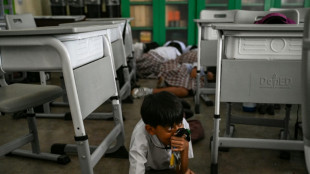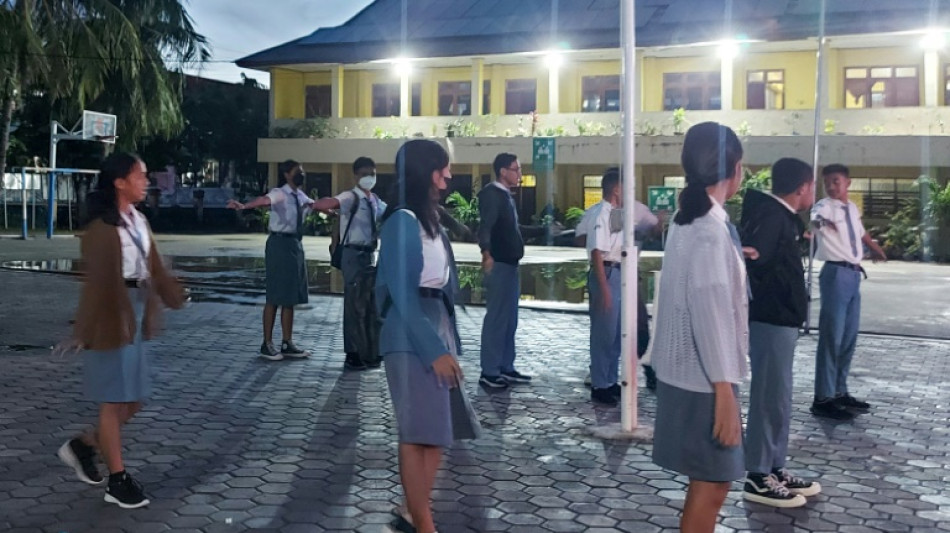
Dawn school trial for drowsy teens draws outcry in Indonesia / Photo: © AFP

 Colombian judge bans strikes on guerrillas if minors are present

 Khachanov shocks ailing Auger-Aliassime, Swiatek and Osaka advance at US Open

 Lone juror blocking verdict in US mother's child murder trial: defense

 'Kinda chic' - Williams sisters set to launch US Open doubles bid

 Volkswagen says cutting 100,000 jobs by end of decade

 Russia slaps curfew on charity director over army criticism

 Ailing Auger-Aliassime upset by Khachanov at US Open

 Richarlison omitted from Tottenham's Premier League squad

 How El Nino is choking the Panama Canal

 Hamilton drives his Ferrari dream at Monza

 Senegal has an IMF loan, now what?

 Auger-Aliassime upset by Khachanov at US Open

 Hugging Face, the French start-up that became AI's warehouse
 World Cup winner Llorente retires from Spain team at 31

 Osaka squeezes into US Open third round
 Apple faces £2 bn lawsuit in UK over app privacy feature

 Former champ Swiatek eases into US Open third round

 DR Congo latest to promise moving Israel embassy to Jerusalem

 War criminal Mladic's body returns to Serbia with military honours

 Pierre Cardin museum brings designer's futurist style to Venice

 Slovenian rookie Omrzel triumphs as Mas extends Vuelta lead
 British, French leaders talk migrants, EU relations

 Heading for Ferrari's home race, Leclerc still dreams of world title
 Cafe at centre of Israel culture clash agrees to shut on Sabbath

 Spacecraft bound for Mercury begins 'tricky' arrival

Every morning in a city in Indonesia's far east, sleepy teenagers can be seen trudging zombie-like through the streets on their reluctant way to school.
It is not a scene from some cheesy sci-fi offering but a controversial experiment to get the day off to a much earlier start for the sleep-deprived teens.
The pilot project in Kupang, the capital of East Nusa Tenggara province, has twelfth-graders at 10 high schools starting classes at 5:30 am.
Authorities say the scheme, announced last month by governor Viktor Laiskodat, is intended to strengthen children's discipline.
According to parents, though, their children are "exhausted" by the time they get home. Schools in Indonesia generally start between 7:00 and 8:00 am.
Teens in their school uniforms are now walking down dark streets or waiting for motorcycle taxis to get to school on time.
"It is extremely difficult, they now have to leave home while it's still pitch dark. I can't accept this... their safety is not guaranteed when it's dark and quiet," Rambu Ata, a mother to a 16-year-old, told AFP.
Her daughter Eureka now has to wake up at 4:00 am to get ready and ride a motorbike to school.
"Now every time she arrives home, she is exhausted and falls asleep immediately because she is so sleepy," Ata said.
At least one scholar seems to agree.
"It has no correlation with the effort to improve the quality of education," Marsel Robot, an education expert from Nusa Cendana University, told AFP.
In the long run, sleep deprivation could endanger the students' health and cause a shift in behaviour, he said.
"They will only sleep for a few hours and this is a serious risk for their health. This also will cause them stress and they will vent their stress by acting out."
- Policy extended -
A 2014 study published by the American Academy of Pediatrics recommended that middle and high schoolers start classes at 8:30 am or later to allow enough time for sleep.
The Kupang rule change was also challenged by local lawmakers, who demanded the government cancel what they called a baseless policy.
The government has maintained their experiment despite the criticism and even extended it to the local education agency, where civil servants also now start their day at 5:30 am.
Not everybody is unhappy with the policy.
Rensy Sicilia Pelokilla, a civil servant at the agency, told AFP that starting earlier made her healthier because she now has to join group exercise sessions in her office that she once slept through.
"As a civil servant I am ready to comply with the regulation and I'm going to do my best," Pelokilla said.
O.Bulka--BTB