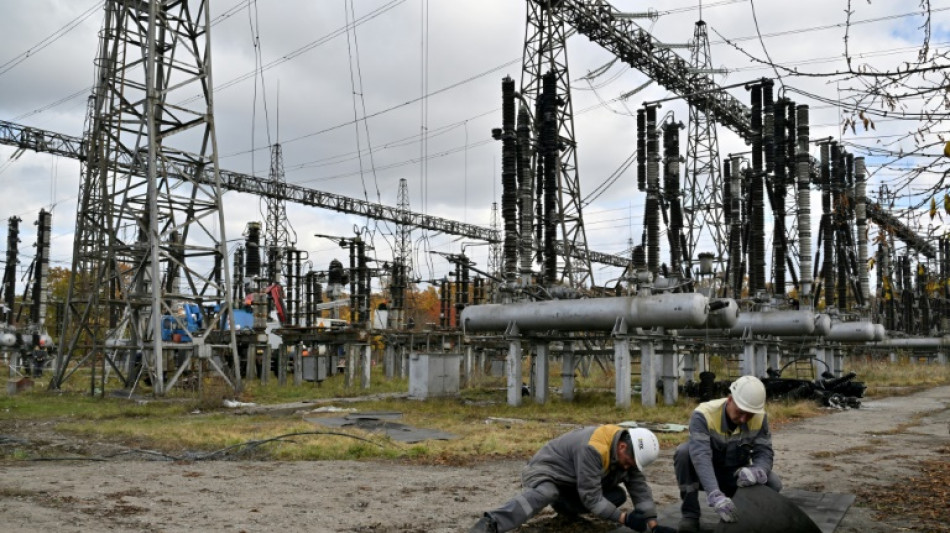
Power workers struggle to keep Ukraine's energy on stream / Photo: © AFP

 Indiana River Otters Make Comeback After Decades of Conservation Efforts

 Shruti Haasan Reveals Kamal Haasan’s Defense of Her Film Career

 Penrith Panthers Face Backlash Over Decision to Disband Pantherettes Cheerleading Squad

 Make-A-Wish Announces 2026 Starblazer Award Honorees; Allied World Becomes First Corporate Founder

 Lee-Trump Golf Diplomacy Faces Diplomatic Dilemma Ahead of G20 Summit

 Mavericks Defeat Jazz 112-100 Behind Washington’s 26 Points and Second-Half Surge

Perched on a gondola, two employees fix a cable to a large pylon.
Further away, others are busy at ground level around several large broken copper bars as they repair a Ukrainian power plant recently hit by Russian strikes.
The plant operator that showed some journalists, including from AFP, around his site on Thursday asked them, for security reasons, not to reveal the name of the place where this thermal power plant is located.
Russia has been carrying out repeated strikes for more than two weeks now on Ukraine's energy infrastructure, leading to the destruction of at least of one third of the network just as winter looms.
As a result, and in order to prevent the distribution network becoming congested, daily supply cuts of several hours have been imposed for some days now in a number of regions, notably Kyiv.
The authorities there said Friday those cuts would have to stepped up to "unprecedented" levels.
And Ukrainian President Volodymyr Zelensky said Friday some four million people across the country had been affected by the power cuts: not just in and around Kyiv, but the regions of Zhytomyr, Poltava, Rivne, Kharkiv, Chernigiv, Sumy, Cherkasy and Kirovograd.
- Sheltering from strikes -
Every time a part of the network is hit, the station staff get to work on repairs.
At the plant AFP visited, operated by private Ukrainian electricity firm DTEK, the strikes primarily hit outside installations, notably transformers and distribution lines.
"We are confronted by such damage for the first time," said one employee, Pavlo. The plant had twice been targeted by missiles and then a third time by an Iranian-made suicide drone.
"The renovation work has been under way for more than two weeks," he added.
"We don't know how long it will take. It depends on the material we shall have to get hold of, deliver, install... It's a long process.
"There are difficulties in that the equipment that has been damaged is unique -- it's hard to find the same parts, and production of new ones is very time-consuming," he said.
And every time the air raid sirens go off they have to down tools and go to the shelter, deep in the bowels of the plant.
This attack lasted for around an hour and a half. To pass the time, the workers played cards or dominoes, or checked the latest news on their mobile phones.
Or they just caught up on sleep.
"We function with the bare minimum number of employees," said Pavlo.
"We try to minimise potential victims," explains Pavlo, adding that one DTEK worker had already been killed and 11 more wounded in the strikes, which have targetted them since October 10.
K.Thomson--BTB