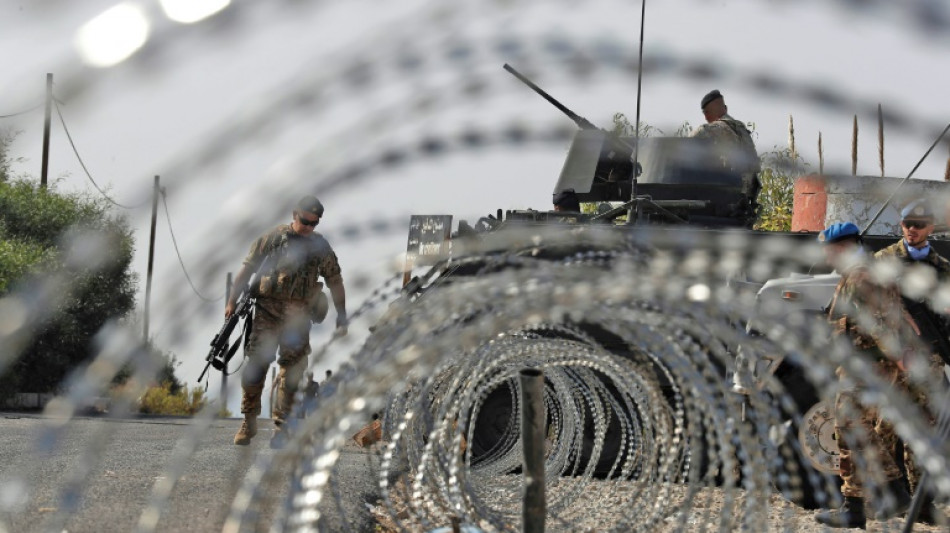
Israel, Lebanon to strike 'historic' maritime border deal / Photo: © AFP

 Indiana River Otters Make Comeback After Decades of Conservation Efforts

 Shruti Haasan Reveals Kamal Haasan’s Defense of Her Film Career

 Penrith Panthers Face Backlash Over Decision to Disband Pantherettes Cheerleading Squad

 Make-A-Wish Announces 2026 Starblazer Award Honorees; Allied World Becomes First Corporate Founder

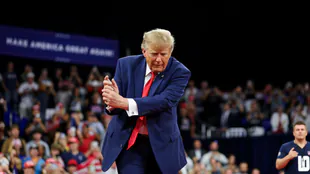 Lee-Trump Golf Diplomacy Faces Diplomatic Dilemma Ahead of G20 Summit
 Mavericks Defeat Jazz 112-100 Behind Washington’s 26 Points and Second-Half Surge

Israel and Lebanon Thursday separately signed a US-brokered maritime border deal which paves the way for lucrative offshore gas extraction by the neighbours that remain technically at war.
The agreement is set to go into effect after two exchanges of letters -- one between Lebanon and the United States, the other between Israel and the US, expected from 3:00pm local time (1200 GMT).
Hailed in advance by US President Joe Biden as a "historic breakthrough", it comes as Western powers clamour to open up new gas production and reduce vulnerability to supply cuts from Russia.
The deal, signed separately by Lebanon's President Michel Aoun in Beirut and Israel's Prime Minister Yair Lapid in Jerusalem, comes as Lebanon hopes to extract itself from what the World Bank calls one of the worst economic crises in modern world history.
It also comes as Lapid seeks to lock in a major achievement days ahead of a general election on November 1.
The exchange of letters is due to take place in the southern Lebanese town of Naqura, in the presence of US mediator Amos Hochstein and the United Nations's special coordinator for Lebanon Joanna Wronecka.
Before signing it, Lapid had claimed on Thursday morning that Lebanon's intention to ink the deal amounted to a de-facto recognition of the Jewish state.
- Delicate dance -
"It is not every day that an enemy state recognises the State of Israel, in a written agreement, in front of the entire international community," he said, shortly before signing it in cabinet.
Aoun denied Lapid's assertion, countering that "demarcating the southern maritime border is technical work that has no political implications".
The deal comes as political parties in Israel -- including Lapid's centrist Yesh Atid - jockey for position in what will be the fifth general election in less than four years.
Veteran right-winger and longtime premier Benjamin Netanyahu has his sights set on a comeback and he dismissed the maritime deal as an "illegal ploy" early this month.
London-listed Energean on Wednesday said it began producing gas from Karish, an offshore field at the heart of the border agreement, a day after Israel gave the green light.
Lebanon meanwhile will have full rights to operate and explore the so-called Qana or Sidon reservoir, parts of which falls in Israel's territorial waters, with the Jewish state receiving some revenues.
- No quick fix -
With demand for gas rising worldwide because of the energy crisis sparked by Russia's invasion of Ukraine, Lebanon hopes that exploiting the offshore field will help ease its financial and economic crisis.
But analysts caution that it will take time for production to start in Lebanese waters, meaning no quick return for a country that is desperately short of foreign exchange reserves.
Exploration has so far only been tentative -- a 2012 seismic study of a limited offshore area by the British firm Spectrum estimated recoverable gas reserves in Lebanon at 25.4 trillion cubic feet, although authorities in Lebanon have announced higher estimates.
The maritime border deal could not be signed by Lebanon without the consent of Hezbollah, a powerful Shiite faction backed by Israel's arch nemesis Iran.
Hezbollah had threatened over the summer to attack Israel if the Jewish state began extracting gas from the Karish field before reaching an agreement.
Israel and Hezbollah fought a 34-day war in 2006 and the Shiite movement is the only faction to have kept its weapons after the end of Lebanon's 1975-1990 civil war.
Hezbollah's leader Hasan Nasrallah is due to deliver a speech at 4:00pm on Thursday.
E.Schubert--BTB