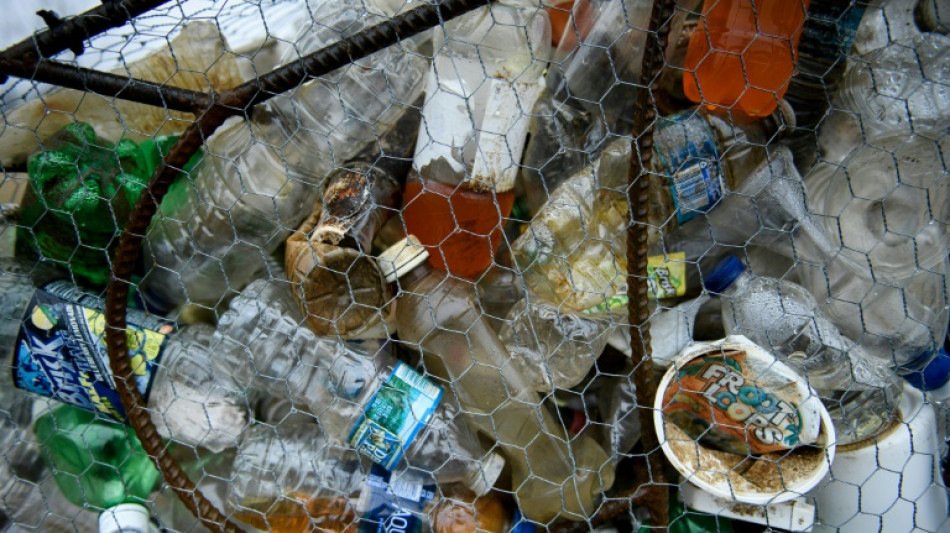
Plastic recycling remains a 'myth': Greenpeace study / Photo: © AFP/File

 Spotting AI writing: how reliable are the detectors?

 French youth await pope after AI 'paradise of machines' warning

 Man City found guilty of Premier League charges, set to appeal: reports

 Embolo follows Xhaka out of Swiss squad over fake Covid documents

 Trump, Xi inspect founding documents of US democracy to close summit

 'Bottle Claus': Kipchoge's 'hero' helping runners chase Berlin marathon glory

 Olympic medallist Samba-Mayela handed provisional doping ban

 First US trial against TikTok to open Monday

 Palmer misses 'too many' England games, says Tuchel

 UN refugees chief warns conditions in W.Sahara 'deteriorating'

 Antonelli 'mad' about crash in Azerbaijan qualifying

 'Perfect lap' gives Russell pole for Azerbaijan GP as Antonelli crashes out

 UN Security Council condemns Houthi attacks on Saudi Arabia
 China swimmer makes Asian Games history as Thai wins 100m sprint

 Top French literary prize drops best-selling novel over AI claims

 US 'must choose' whether to end war: Iran president

 Pope warns against losing humanity in AI-driven 'paradise of machines'

 Pope warns against losing humanity in 'paradise of machines'

 From FBI warning to literary acclaim: the Russian journalist who took on Putin

 China swimmer in Asian Games first as North Korea lifters reign

 French literary prize removes novel from longlist after AI claims
 China's Zhang wins record seventh Asian Games swimming gold

 Verstappen edges Russell in final practice in Azerbaijan

 English, Spanish, Italian, German football leagues call for FIFA reform

 Pope arrives in France on first official visit in 18 years

Plastic recycling rates are declining even as production shoots up, according to a Greenpeace USA report out Monday that blasted industry claims of creating an efficient, circular economy as "fiction."
Titled "Circular Claims Fall Flat Again," the study found that of 51 million tons of plastic waste generated by US households in 2021, only 2.4 million tons were recycled, or around five percent.
After peaking in 2014 at 10 percent, the trend has been decreasing, especially since China stopped accepting the West's plastic waste in 2018.
Virgin production -- of non-recycled plastic, that is -- meanwhile is rapidly rising as the petrochemical industry expands, lowering costs.
"Industry groups and big corporations have been pushing for recycling as a solution," Greenpeace USA campaigner Lisa Ramsden told AFP.
"By doing that, they have shirked all responsibility" for ensuring that recycling actually works, she added. She named Coca-Cola, PepsiCo, Unilever and Nestle as prime offenders.
According to Greenpeace USA's survey, only two types of plastic are widely accepted at the nation's 375 material recovery facilities.
The first is polyethylene terephthalate (PET), which is commonly used in water and soda bottles; and the second is high density polyethylene (HDPE), seen in milk jugs, shampoo bottles and cleaning product containers.
These are numbered "1" and "2" according to a standardized system in which there are seven plastic types.
But being recyclable in theory doesn't mean products are being recycled in practice.
The report found that PET and HDPE products had actual reprocessing rates of 20.9 percent and 10.3 percent, respectively -- both down slightly from Greenpeace USA's last survey in 2020.
Plastic types "3" through "7" -- including children's toys, plastic bags, produce wrappings, yogurt and margarine tubs, coffee cups and to-go food containers -- were reprocessed at rates of less than five percent.
Despite often carrying the recycling symbol on their labels, products that use plastic types "3" through "7" fail to meet the Federal Trade Commission classification of recyclable.
This is because recycling facilities for these types aren't available to a "substantial majority" of the population, defined as 60 percent, and because the collected products are not being used in the manufacturing or assembly of new items.
According to the report, there were five main reasons why plastic recycling is a "failed concept."
- Economically unfeasible -
First, plastic waste is generated in vast quantities and is extremely difficult to collect -- as becomes clear during what the report called ineffective "volunteer cleanup stunts" funded by nonprofits such as "Keep America Beautiful."
Second, even if it were all collected, mixed plastic waste cannot be recycled together, and it would be "functionally impossible to sort the trillions of pieces of consumer plastic waste produced each year," the report said.
Third, the recycling process itself is environmentally harmful, exposing workers to toxic chemicals and itself generating microplastics.
Fourth, recycled plastic carries toxicity risks through contamination with other plastic types in collection bins, preventing it from becoming food-grade material again.
Fifth and finally, the process of recycling is prohibitively expensive.
"New plastic directly competes with recycled plastic, and it's far cheaper to produce and of higher quality," said the report.
Ramsden called on corporations to support a Global Plastics Treaty, which United Nations members agreed to create in February, and move toward refill and reuse strategies.
"This isn't actually a new concept -- it's how the milkman used to be, it's how Coca-Cola used to get its beverages to people. They would drink their beverage, give the glass bottle back, and it would be sanitized and reused," she said.
Some countries are leading the way, including India, which recently banned 19 single-use plastic items. Austria has set reuse targets of 25 percent by 2025 and at least 30 percent by 2030 for beverage packaging, while Portugal has also set the 30 percent by 2030 goal.
Chile is moving to phase out single-use cutlery and mandating refillable bottles.
H.Seidel--BTB