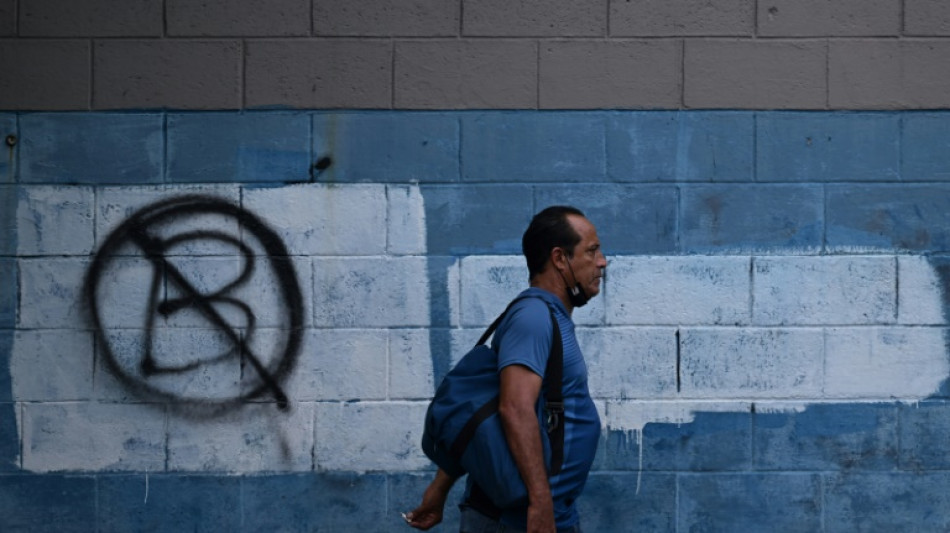
Most Salvadorans think making Bitcoin legal tender was 'failure' / Photo: © AFP

 Indiana River Otters Make Comeback After Decades of Conservation Efforts

 Shruti Haasan Reveals Kamal Haasan’s Defense of Her Film Career

 Penrith Panthers Face Backlash Over Decision to Disband Pantherettes Cheerleading Squad

 Make-A-Wish Announces 2026 Starblazer Award Honorees; Allied World Becomes First Corporate Founder

 Lee-Trump Golf Diplomacy Faces Diplomatic Dilemma Ahead of G20 Summit

More than a year after Bitcoin became legal tender in El Salvador, a new poll Tuesday showed most people in the country consider the controversial move by President Nayib Bukele as a "failure."
According to the poll by the University of Central America (UCA), 75.6 percent of respondents said they never used cryptocurrency in 2022, and 77 percent consider its adoption 14 months ago as legal tender, alongside the dollar, "to have been a failure."
Bitcoin, whose value has tumbled over the past year, "is the government's most unpopular measure, the most criticized and the most frowned upon," said UCA rector Andreu Oliva, commenting on the results of the study.
Bukele's idea was to promote crypto money transfers from some three million Salvadorans living overseas, mainly in the United States, to their relatives back home, thereby saving on bank charges.
The president's decision was a strategic one, given that these remittances make up more than a quarter of El Salvador's gross domestic product.
But according to data from the Salvadoran Central Bank in early September, a year after the introduction of Bitcoin, "less than two percent" of remittances from emigrants were made using the cryptocurrency.
In September 2021, Bitcoin was hovering around $45,000. By November it soared to $68,000, but after a steep drop it is currently trading below $20,000.
Taking advantage of the plummeting prices, Bukele bought 80 Bitcoin with public funds in July, bringing El Salvador's total reserves to 2,381 units.
According to the UCA study, 77 percent of Salvadorans believe their president "should not continue to spend public money to buy Bitcoin."
The survey also looked into an emergency regime in place since March as part of the "war" on gangs decreed by Bukele, which led to the arrest of 55,000 suspected members of criminal gangs, the dreaded "maras."
The population still overwhelmingly approves of it, at 75.9 percent, but that figure was down nine points from May, when it was 84.8 percent.
R.Adler--BTB