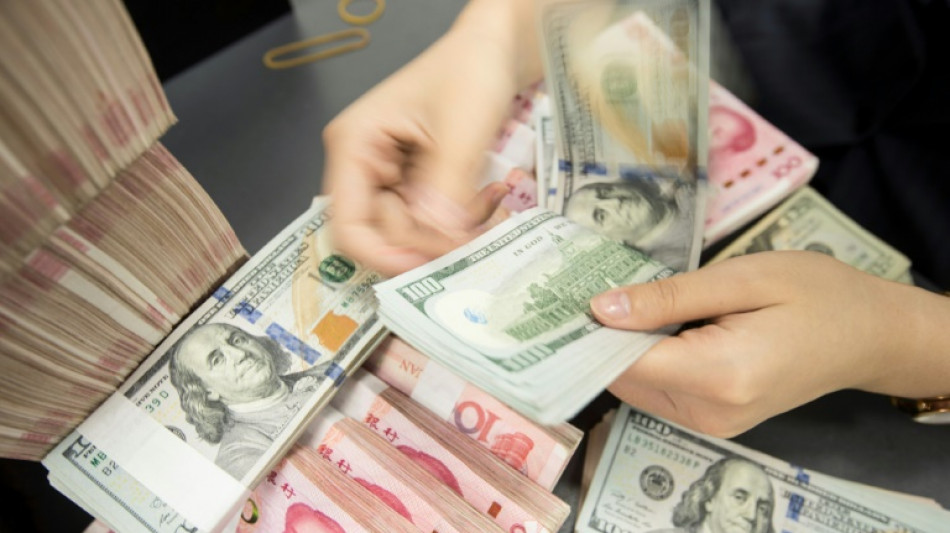
China's offshore yuan hits record low against dollar / Photo: © AFP

 Helen Rees Reflects on Four Decades of South Africa's HIV Journey

 Foreign Investors Return to Indian Equities with ₹84,290 Crore Inflow

 Interactive Map Reveals 1,000 Unsolved Murders Across UK

 AA Reveals Fastest Method to Defog Car Windscreen in Winter

China's yuan hit a record low against the surging US dollar in offshore trading Wednesday, despite recent efforts by the country's central bank to shore up the currency.
The offshore yuan -- which is circulated outside mainland China and is more freely traded than currency in the domestic market -- fell to 7.2386 against the dollar on Wednesday, according to Bloomberg.
That is its weakest level since clearing banks in Hong Kong were given the go-ahead to open renminbi accounts freely in 2010.
The US Federal Reserve's increasingly hawkish tone and expectations of further interest rate hikes to fight soaring inflation have seen investors pile into the dollar, sending it to record or multi-decade peaks against other major currencies.
The onshore yuan, which is not freely convertible and limited to a two percent range on either side of a central parity rate set each day, also extended its slump to a 14-year low of 7.2297 per dollar Wednesday.
The depreciation comes despite recent efforts by the Chinese central bank to protect the currency's value without directly intervening, including a decision to raise the foreign exchange risk reserve ratio.
The move, announced by the People's Bank of China on Monday, effectively makes it more expensive for financial institutions to sell yuan and buy dollars.
The Chinese economy has been hammered in recent months by Covid-related curbs, extreme weather, and a property market slump.
The sharp slowdown in economic growth had led officials to announce a series of easing measures in recent months to provide support, but putting pressure on the yuan as the US Federal Reserve continues to tighten policy.
But the yuan's depreciation could mean "the central bank will have to at least pay more attention than in the past" to balancing domestic stimulus and its foreign exchange policies, Tianfeng Securities analysts wrote in a note Tuesday.
A.Gasser--BTB