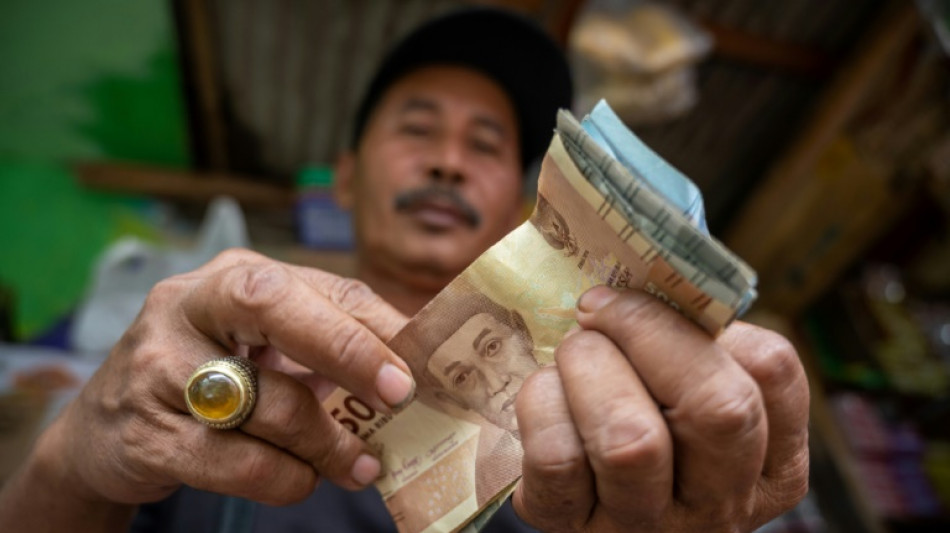
Indonesia hikes rates for second straight month to stem inflation / Photo: © AFP/File

 South Korea Launches Probe into NewJeans Contract Controversy

 Helen Rees Reflects on Four Decades of South Africa's HIV Journey

 Foreign Investors Return to Indian Equities with ₹84,290 Crore Inflow

 Interactive Map Reveals 1,000 Unsolved Murders Across UK

 AA Reveals Fastest Method to Defog Car Windscreen in Winter
Indonesia's central bank hiked its key interest rate for the second month in a row Thursday to combat rising inflation stoked by fuel prices and the war in Ukraine.
Bank Indonesia pushed the policy rate to 4.25 from 3.75 percent, and the jump was higher than expected by analysts.
Its two other main rates were also raised by 50 basis points.
The central bank hiked interest rates in August for the first time since 2018 to defend against accelerating inflation, with Russia's invasion of Ukraine driving up global energy and food prices and pushing millions into poverty.
But a fuel price rise this month has put more pressure on the central bank to act.
The government raised heavily subsidised fuel prices by about 30 percent, a policy expected to further stoke inflation already at 4.69 percent.
Some analysts have forecast inflation reaching as high as seven percent by the end of the year.
Thurday's rate hike was a "frontloaded, pre-emptive and forward-looking" move aimed at "lowering inflation expectation", Bank Indonesia Governor Perry Warjiyo said.
It sought to bring down core inflation to within the central bank's target of between 2 and 4 percent in the second half of next year, he said, predicting it could rise to nearly six percent this month.
President Joko Widodo came to power in 2014 on a pledge to boost annual growth to seven percent.
The commodities-driven economy has remained stuck around five percent, however, and has fallen below that after the onset of the coronavirus pandemic in early 2020.
The outlook for monetary policy is likely even more tightening as the government tries to get a greater handle on inflation, economists said.
"While a rate hike today was never in doubt, the size of the increase was," said Gareth Leather, Asia economist from Capital Economics.
"With inflation set to jump sharply higher in September and remain well above target until late 2023, further tightening is likely."
A.Gasser--BTB