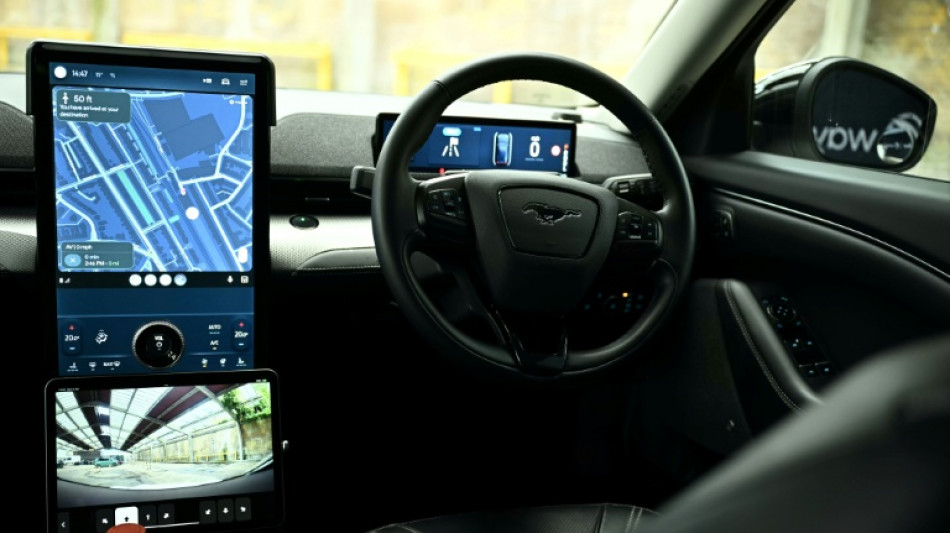
Race for robotaxi market arrives in London / Photo: © AFP/File

 Swiss voters expected to shun stricter neutrality
 Rapper-turned-PM faces first big test after Nepal disaster

 Tuchel seeks tonic to England World Cup 'scar' in Spain showdown
 'Helps me cope': Catholic baptisms rise among French youth

 Colombians in Santa Marta stay inside after violence wracks the city
 Iran airlines cancel flights as US sanctions hit
 Meta launches camera-free AI glasses amid privacy pushback

 Australian PM says OpenAI hacked government health website

 Xi arrives in US to personal Trump welcome

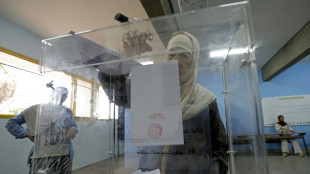 Morocco elects new parliament amid social frustration, youth discontent

 Scheffler and Burns to face Im and Lee in Presidents Cup opener

 Crushing wins for Lyon and Barca in women's Champions League

 Rio breaks record for rainiest September amid powerful El Nino

 At UN, tech chiefs urge caution in AI development

 Russian strikes kill seven in Ukraine, Zelensky vows winter campaign

 Venezuelan shot by ICE needs urgent medical care, mother tells AFP

 Zelensky says Putin using fighters from 47 countries in Ukraine war
 Klopp calls on Germany to 'rise above ourselves' as new era begins

 Russian strikes kill seven in Ukraine as Russia vows no 'pause' to war

 ArcPoint Expands Globally with Institutional Intelligence Platform for Modern Investors

 Ronaldo focussing on 'present' ahead of Wales test
 Outgoing UN chief makes final climate push at New York summit
 Grief and pain flow at hearing for Canadian suicide poison vendor
 Ireland boss Hallgrimsson says timing of Israel remarks 'not clever'
 Weinstein resentenced to 15 years in prison for 2006 sex assault

Bristling with sensors and electronic eyes, robotaxis are appearing on London's streets, slipping silently between red buses and black cabs, as companies battle to lead Europe's emerging autonomous vehicle market.
British start-up Wayve, in partnership with Uber, is racing to beat US rival Waymo, owned by Google-parent Alphabet.
China's Baidu is also to launch in the British capital, where winding streets, roadworks and pedestrian traffic bring unique challenges.
"London has 20 times the amount of road construction than San Francisco and 10 times the amount of vulnerable road users," said Kaity Fischer, head of business development at Wayve.
"We've had 2,000-year-old roads, certainly no perfect grid system," she told AFP ahead of a ride in the company's Ford Mustang Mach-E.
On the road, every pedestrian and intersection presents a test. The car responded smoothly though, braking where necessary.
Passengers tend to spend the first few minutes of the ride "marvelling, videoing the steering wheel moving on its own, taking selfies", Fischer said.
Then "about three minutes in, they're doing the exact same thing that they do in any other Uber or ride hail -- they're looking at their phone", she added.
Britain stands ahead of the European Union in the race to getting driverless cars on the road, thanks to government efforts to speed up regulation.
The Labour government expects the autonomous vehicle sector to generate 38,000 jobs and £42 billion ($55 billion) by 2035.
- Backlash -
Londoners will be able to take their first commercial rides with Wayve this summer, with a human operator on board in the initial stages.
Waymo, already operating in 11 US cities using pre-mapped routes, could follow shortly after.
The sector's complexity means that companies competing in one city may collaborate in another, with one providing the technology and the other managing the fleet and commercial rollout.
Baidu, in partnership with ride-sharing firm Lyft, will be testing "in the coming weeks" ahead of launching in London later this year, said Jeremy Bird, Lyft's head of global growth.
At its launch, fares are likely to be "pretty similar" to traditional taxis, he told AFP.
Companies are under pressure to get the public on side, after a series of high-profile mishaps.
This year, a string of Baidu vehicles stalled in central China leaving passengers stranded.
Waymo had to recall nearly 4,000 cars after several incidents in which its robotaxis entering closed-off highway construction areas.
"Robotaxi players know they are just one bad accident away from getting serious pushback," McKinsey transport specialist Philipp Kampshoff told AFP.
"So you have to make sure safety is your absolute priority."
- 'Tourist attraction' -
Waymo product director Saswat Panigrahi has offered assurances that its cars record 13 times fewer serious accidents than human drivers.
The system's AI technology is "powerful enough" to detect tiny movements that indicate a pedestrian is about to walk across the road, he said at the South by Southwest tech festival in London.
But for Steve McNamara, head of London's taxi association, robotaxis are just "a solution to a problem that doesn't exist".
"They are pumping millions and millions of dollars into PR, into spin, into marketing, into convincing politicians, into convincing people that this is a great thing," McNamara told AFP.
London's taxi industry is still recovering from the rise of Uber, which reduced the number of its vehicles on the road to 14,800 in 2024 from 22,300 in 2009.
McNamara said robotaxis will ultimately become "a tourist attraction", adding that autonomous vehicles tend to wait until roads are completely clear before pulling out.
"There's parts of London where it would be sitting there until Christmas Day, if you're waiting for the road to be clear."
F.Mueller--VB