European robotics start-ups go up against Chinese heavyweights / Photo: © AFP/File

 Swiss voters expected to shun stricter neutrality
 Rapper-turned-PM faces first big test after Nepal disaster

 Tuchel seeks tonic to England World Cup 'scar' in Spain showdown

 'Helps me cope': Catholic baptisms rise among French youth

 Colombians in Santa Marta stay inside after violence wracks the city

 Iran airlines cancel flights as US sanctions hit
 Meta launches camera-free AI glasses amid privacy pushback
 Australian PM says OpenAI hacked government health website

 Xi arrives in US to personal Trump welcome

 Morocco elects new parliament amid social frustration, youth discontent

 Scheffler and Burns to face Im and Lee in Presidents Cup opener

 Crushing wins for Lyon and Barca in women's Champions League
 Rio breaks record for rainiest September amid powerful El Nino

 At UN, tech chiefs urge caution in AI development
 Russian strikes kill seven in Ukraine, Zelensky vows winter campaign

 Venezuelan shot by ICE needs urgent medical care, mother tells AFP

 Zelensky says Putin using fighters from 47 countries in Ukraine war

 Klopp calls on Germany to 'rise above ourselves' as new era begins

 Russian strikes kill seven in Ukraine as Russia vows no 'pause' to war

 ArcPoint Expands Globally with Institutional Intelligence Platform for Modern Investors

 Ronaldo focussing on 'present' ahead of Wales test

 Outgoing UN chief makes final climate push at New York summit
 Grief and pain flow at hearing for Canadian suicide poison vendor

 Ireland boss Hallgrimsson says timing of Israel remarks 'not clever'

 Weinstein resentenced to 15 years in prison for 2006 sex assault

Humanoid robots able to perform tasks from grape harvesting to welcoming visitors were front and centre at France's Vivatech trade fair this week, with European firms looking to fill niches beyond what dominant Chinese giants can offer.
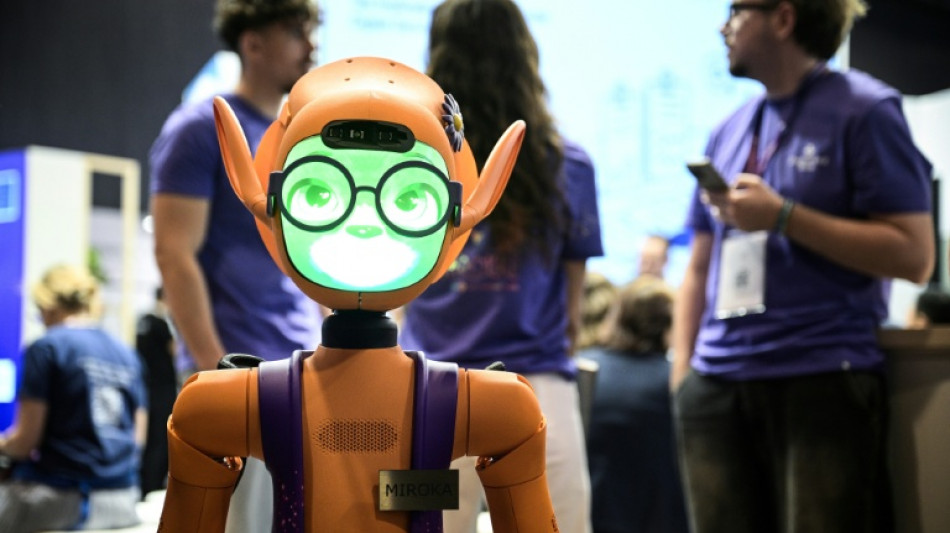
French company Enchanted Tools was showing off its Mirokai, a "social" robot with long orange ears and wide blue eyes.
Able to communicate in over 50 languages, prototypes of the Paris-based firm's machine are already out in the wild welcoming people to hospitals and airports, marketing chief Richard Malterre said on a Vivatech stage.
The start-up hopes its first mass-produced models will arrive by the end of this year.
"At least 60 percent of the robot is manufactured in Europe, and we're fighting to keep it that way," Malterre told AFP.
But some of the AI robotics know-how is "not necessarily available" in Europe, he said, such as the graphics processors from American chip giant Nvidia that power Mirokai's brain as well as the broader generative AI boom.
- 'Dark factories' -
When it comes to sheer robotics production capacity, China is unrivalled thanks to companies including Unitree and Agibot.
Their androids' tightly choreographed displays wowed visitors to Vivatech, the latest fair to show them off in recent months.
Around 87 percent of the 13,000 humanoid robots deployed worldwide in 2025 rolled off a Chinese production line, according to the UK-based consultancy Omdia.
"China is definitely on the forefront" as its companies increasingly show off "dark factories" where robots work largely without human supervision, said Joern Buss, a robotics expert at the consultancy Arthur D. Little.
Nevertheless, Europe is "catching up" behind Japan and Korea, he added, boasting "some good robotics players" including longstanding firms.
New players on the European scene include Germany's Neura, which builds humanoid industrial and household robots as well as a platform for training them to carry out human tasks.
The company recently announced it had raised $1.4 billion.
"We get requests for everything, even dentists, everyone is calling us and asking if they can have a robot as a supporter, because they can't find people," chief executive David Reger told AFP.
Like other advanced economies around the world, Europe faces an ageing population that could squeeze the labour supply in both manufacturing and services.
Reger called robots like Neura's the continent's "last chance", saying "Europe does require this economic pillar to sustain" itself.
He cited familiar challenges for European tech firms including tight regulation and a tougher search for financing than competitors in the United States.
But Reger has no plans to uproot Neura's business, which is collaborating with German car component suppliers Bosch and Schaeffler on factory automation.
He vaunts Neura's order book of over $1 billion.
- Data protection -
"If all robot production goes to Japan or China, that could be a big problem when it comes to sovereignty," said Francesco Ferro, chief executive of Spain's PAL Robotics.
His company was at Vivatech showing off its latest models bolted together in Barcelona.
One is a black biped that has been dubbed Kangaroo, while the Tiago machine is fitted with jointed arms that have been put to use in logistics as well as picking grape harvests.
Robotics developers use vast quantities of data to train their machines' movements, and they collect still more information as they carry out their tasks.
The continent should aim to create "a totally European supply chain, without thinking only about price", as that could lead prospective clients to buy Chinese robots, Ferro said.
That would risk seeing valuable or sensitive data "falling into the wrong hands", he warned.
French-American start-up Genesis AI plans to re-shore production of its Eno multifunctional robot next year after making it in China.
Prospective customers include "the big industrial base in France, Italy and Germany," co-founder Theophile Gervet told AFP.
Enchanted Tools' Malterre also believes the demand exists, and "I'm confident in our ability and creativity to endure".
"We need to be ready for a fight, not throw in the towel."
L.Wyss--VB