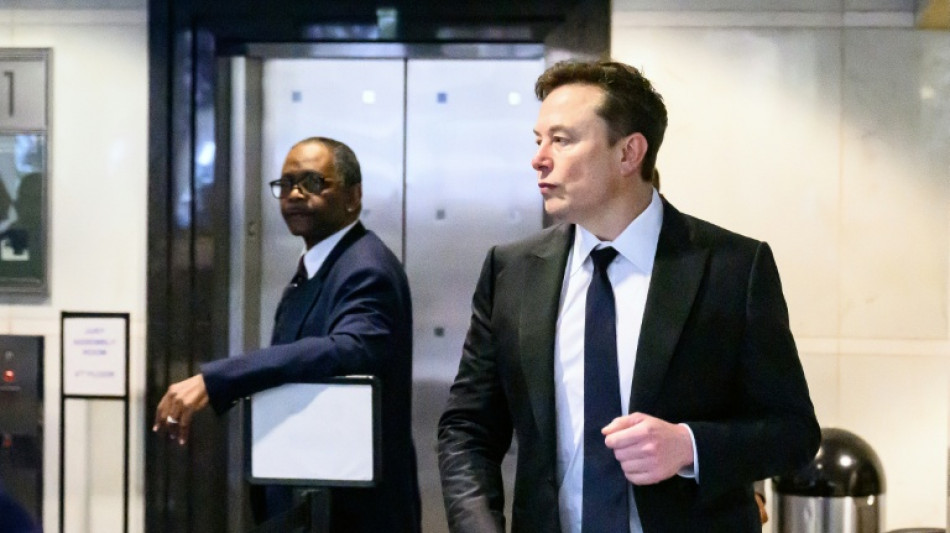
All in on Musk, SpaceX's self-declared 'dream weaver' / Photo: © AFP

 Eel-powered Japan whizz-kid, 11, dominates in historic Games debut

 Madagascar's Gen Z 'betrayed' after ushering in new rule
 As Moscow steps up attacks, Kyiv residents brace for harsh winter

 Comic inspires unlikely kabaddi dreams for Japan's Asian Games amateurs

 Thailand slams chaotic Asian Games organisation as 'musical chairs'
 North Korea to keep nuclear weapons 'forever': foreign minister

 Markets mixed as China's Xi arrives for US talks
 Swiss voters expected to shun stricter neutrality
 Rapper-turned-PM faces first big test after Nepal disaster

 Tuchel seeks tonic to England World Cup 'scar' in Spain showdown
 'Helps me cope': Catholic baptisms rise among French youth
 Colombians in Santa Marta stay inside after violence wracks the city
 Iran airlines cancel flights as US sanctions hit
 Meta launches camera-free AI glasses amid privacy pushback
 Australian PM says OpenAI hacked government health website

 Xi arrives in US to personal Trump welcome
 Morocco elects new parliament amid social frustration, youth discontent
 Scheffler and Burns to face Im and Lee in Presidents Cup opener
 Crushing wins for Lyon and Barca in women's Champions League
 Rio breaks record for rainiest September amid powerful El Nino
 At UN, tech chiefs urge caution in AI development
 Russian strikes kill seven in Ukraine, Zelensky vows winter campaign
 Venezuelan shot by ICE needs urgent medical care, mother tells AFP
 Zelensky says Putin using fighters from 47 countries in Ukraine war
 Klopp calls on Germany to 'rise above ourselves' as new era begins
When SpaceX lists on Wall Street, expected on Friday, Elon Musk will serve simultaneously as chief executive, chief technology officer and board chairman of the rocket and AI company.
He will control more than 82 percent of its voting shares. There is no designated successor, no deputy and no key-person life insurance written into its filings.
The world's most valuable IPO depends entirely on one man.
"He's completely upending the conventional conduct of running a publicly traded corporation by declaring himself an irreplaceable dream weaver and master engineer of the whole undertaking," Quinn Slobodian, co-author with Ben Tarnoff of "Muskism: A Guide for the Perplexed," told AFP in an interview.
For Slobodian, a professor of international history at Boston University who has spent years studying Musk's empire, that brazen concentration of personal power is not a flaw in the SpaceX offering -- it is its defining feature.
SpaceX is targeting a valuation of approximately $1.8 trillion and aims to raise $75 billion when trading opens Friday under the ticker SPCX, in what will be the largest public offering in history.
- Jobs and Gates -
To understand how Musk positioned himself as literally irreplaceable, Slobodian pointed to the "prophetic founder" model exemplified by Steve Jobs and Bill Gates.
"Jobs and Gates are kind of the template," Slobodian said, adding that Musk's decision to give Walter Isaacson -- the biographer who immortalized Jobs -- access for his own biography was itself a tell.
What gave Musk's version of that archetype genuine credibility, Slobodian argued, was a willingness to go against the grain of early 21st-century investment orthodoxy.
At a time when "design in California, assemble in China" was the way -- with the iPhone as the example -- Musk poured his early fortune from PayPal into a rocket company and an electric vehicle manufacturer, both requiring him to solve brutally hard engineering problems.
His distance from his tech-billionaire peers is now measurable in purely financial terms.
Musk's fortune, expected to hit $1 trillion with the IPO, is approaching three times the size of that of the second richest person on the planet, currently Google co-founder Larry Page.
"He's operating at a different scale, and with a scope of ambition that just makes him singular," Slobodian said.
- Too big to fail -
Musk is often framed as a libertarian entrepreneur who built his empire outside the reach of government.
Slobodian argues that Musk has always depended on government as primary client or subsidy giver, from his earliest startup Zip2's reliance on publicly funded GPS data to the billions SpaceX draws in federal contracts today.
He pointed in particular to what he described as SpaceX's Golden Dome contracts, worth $4 billion, to supply satellite infrastructure for the Trump administration's proposed national missile defense shield.
In his view, SpaceX is structurally too critical to national security interests for any administration to let it fail.
"If Trump gave a second thought to bailing out Spirit Airlines," Slobodian said of the bankrupt low-cost carrier, "what about SpaceX?"
- After Henry Ford -
Slobodian situated Musk's alignment with far-right movements in the United States and sovereigntist parties in Europe as serving commercial ends, not merely personal ones.
He argued that Musk sees compliant political partners both abroad and at home as essential to obtaining the regulatory approvals SpaceX needs: spectrum allocations, satellite launch rights and permission to operate Starlink in key markets.
That worldview, Slobodian and Tarnoff contend in their book, has roots in Musk's upbringing in the suburbs of Pretoria under apartheid-era South Africa -- a regime they argue deployed IBM mainframes and advanced technology to control the population through data collection and surveillance.
As for whether the Musk model outlasts the dream weaver himself, Slobodian pointed to Palantir -- which, like SpaceX, first broke into government work by suing the US military for contracts -- as one potential carrier of the torch.
But a true successor, he suggested, may be hard to find, "just as there was no Henry Ford after Henry Ford," only imitations.
A.Zbinden--VB