China's 2025 economic growth likely slowest in decades: analysts / Photo: © AFP

 Japan organisers 'not satisfied' as empty seats blight Asian Games

 Canals full, roads submerged as Bangkok declares flood disaster

 China, US to open AI 'communication channel' after summit

 Nepal tunnel survivor wants to help post-flood rebuild

 New China sprint star, 17, vows 'no limits' after Asian Games gold
 Japanese 11-year-old wins Asian Games eSports gold

 TikTok agrees to teen limits in US settlement following Meta

 Venezuela's oil cradle pins hopes on US energy deals

 US, China buy time with trade truce as pressure builds

 'Leo, Leo': Young Catholics give pope rockstar welcome in France

 Lula bans sports betting days ahead of Brazil's election

 Guatemala ensures survival of vulnerable 'fossil' fish

 Mancini finds positives in Italy loss, accepts fans' jeers

 Alcaraz helps Europe into Laver Cup lead

 Six missing after building collapses in historic Athens district

 Mbappe scores but suffers knee injury as Zidane gets debut France win

 Mancini's Italy return spoiled by Belgium defeat

 Rodri confident in Man City innocence despite reported charges

 Jay-Z rape accuser says she made 'false accusations'

 Senegal draw first match under Vieira and Nigeria survive scare

 Trump, Xi end summit long on pomp, but short on progress

 Russia not preparing for conflict with Europe, Putin says

 Trump's photo of Xi greeting carries signs of AI

 Six missing after building blast in historic Athens district

 Millions in US northeast brace for powerful storm
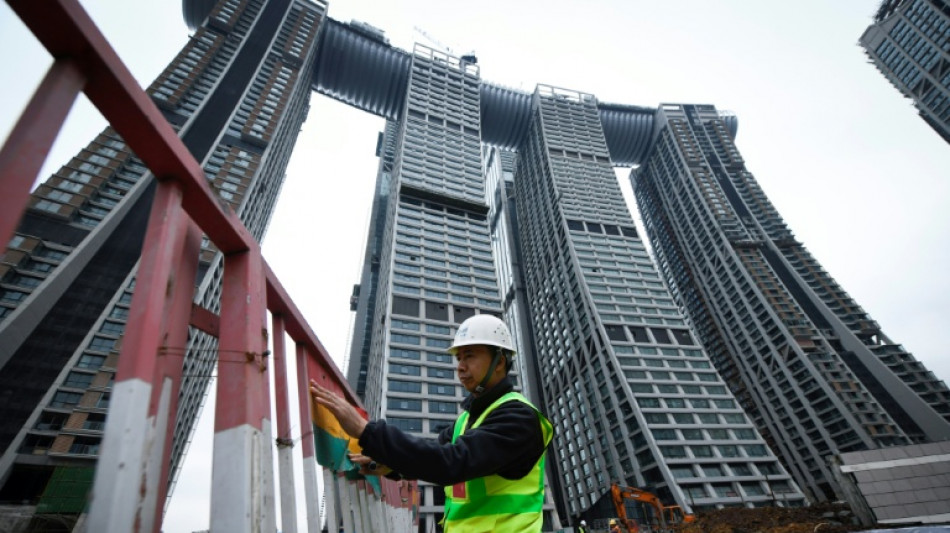
China's economy likely grew last year at its weakest rate in three decades, outside of the pandemic, according to an AFP survey of analysts ahead of official data on Monday.
The world's second-largest economy struggled to shore up its property market while boosting domestic consumption as Chinese exports to the key US market were crimped by Donald Trump's tariffs.
President Xi Jinping said last month that growth probably met an annual target of "around five percent" in 2025.
Economists estimated a median figure of 4.9 percent, in what would be the weakest growth since 1990 when China was under Western sanctions after the deadly Tiananmen Square crackdown.
The announcement will be "close enough for officials to declare victory" in meeting the roughly five-percent number, a "political comfort blanket" for Beijing, said Sarah Tan of Moody's Analytics.
But the composition of Chinese growth was "deeply uneven" and official figures "mask the weak sentiment on the ground", she said.
Analysts agreed the main problem was China's property sector, which has failed to overcome a persistent debt crisis despite rate cuts and loosened restrictions on homebuying.
House prices have risen slightly in some large cities but the broader market remains sluggish.
"We see no sign of a near-term property sector bottoming out," analysts from Goldman Sachs said.
Without bolder measures like converting housing stock into affordable homes, the industry will remain unstable, analysts warned.
- Waning investments -
Investments in property and infrastructure likely took a hit last year.
Official figures already show that fixed-asset investment slowed 2.6 percent between January and November, its sharpest rate since 2020.
Larry Hu and Yuxiao Zhang of Macquarie Group attributed the decline to unannounced "data revisions" by Beijing, adding they did not expect policymakers to respond.
Property investment could fall by 12 percent in 2026, they predicted.
Tianchen Xu of the Economist Intelligence Unit (EIU) also forecast a real-estate "correction" in 2026, adding: "This will remain a drag on growth."
Meanwhile, constraints on local government finances pushed a wider slowdown in manufacturing and infrastructure investment last year, Goldman Sachs analysts said.
China's outbound foreign direct investment continued to outpace inbound flows in recent quarters, they noted.
- Too anxious to spend -
Domestic spending is also cause for concern. Retail sales, a key indicator of consumption, grew at their slowest pace in nearly three years in November.
Economists have long urged Beijing to move towards a growth model powered by consumption rather than exports and manufacturing.
Excess supply remains an issue in manufacturing despite a government campaign last year to combat overcapacity and price cutting.
China aims to become a global powerhouse in advanced manufacturing, but that promises little for domestic spending, according to Goldman Sachs analysts.
"High-end manufacturing and frontier technology will not generate many jobs or lead to significantly higher incomes for average households, making only a limited contribution to private consumption," they said.
Chinese consumers remain jittery about the wider economy and high unemployment, even though officials have relaxed fiscal policy and subsidised the replacement of household items in a sputtering bid to boost spending.
"That anxiety is shaping how households spend," Tan said, noting that while domestic tourism rebounded to pre-pandemic levels last year, the average outlay per traveller was lower.
- Minimal US impact -
Robust exports have been a bright spot in the cloudy economic picture despite a bruising trade war with the United States that saw Trump slap steep tariffs on Chinese products.
Official data showed Chinese exports to the United States plunged by 20 percent in 2025, but that had little impact on demand for Chinese products elsewhere.
China's trade surplus hit a record $1.2 trillion last year, with officials lauding a "new historical high" filled by other trade partners.
"The trade war 2.0 didn't impact China much, leading Beijing to refrain from implementing major stimulus measures," said Hu and Zhang of Macquarie.
Tan agreed that "exports are propping up the economy while consumers and property developers hang back".
But whether they continue to drive the economy in 2026 remains to be seen.
Economists expect Beijing to reveal new stimulus measures -- potentially at its annual parliamentary session in March -- to address core challenges.
"We think there will be a turnaround this year driven by policy support from fiscal and new financing policy tools," said Erin Xin at HSBC.
Xu, of the EIU, predicated that fiscal policy would be "expansionary by historical standards" for China to reach its growth target.
Macquarie analysts, however, were more conservative, saying "the size of the stimulus package will largely depend on the magnitude of the export slowdown".
L.Wyss--VB