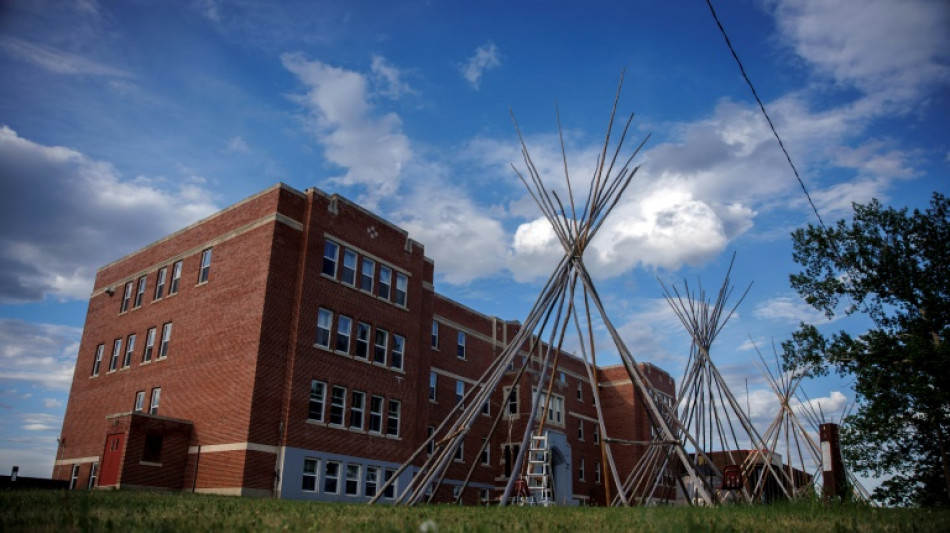
Canada Indigenous university helps students reconnect to their language / Photo: © AFP

 South Africa’s Economic Shift: Why Services Must Lead Job Creation Beyond Manufacturing

 Lethbridge Council to Vote on $80 Million Capital Improvement Program

 Redmi Note 18 5G Battery Specs Leaked: Larger Capacity in Chinese Variant

 COP31 Presidency Publishes First Draft Cover Decision on Climate Action

 EU Club Group Files Antitrust Complaint Against UEFA Over Prize Money

 Heat and El Niño Drive Surge in Preterm Births Across Southern Africa

 China's Factory Activity Contracts as Export Orders Weaken

 US Retail Sales and Fed Minutes Set Up a Critical Test for Consumers

 Oil Heads for Second Weekly Loss as Supply Surplus Emerges

 Brazil Faces Debt and Inflation Test as Lula Prepares Fourth Term

 Canada Signals Openness to Chinese Automakers if US Trade Talks Fail

 US Mortgage Rate Falls for Fourth Week but Remains Above 7%

 13 Native American-Owned Restaurants in Arizona to Experience Indigenous Culinary Traditions

 Best Digital Photo Frames 2026: Aura, Skylight, and Amazon Compared

 UK Economy Grows 0.7% in Third Quarter as Services Lead Expansion

 India's Retail Inflation Reaches 6.09% as Food Prices Accelerate

 China's October Activity Data Reveal a Weak Start to the Fourth Quarter

Signage in Cree that was once forbidden, artwork on the walls, and a teepee on the lawn: in this former state boarding school in Canada, associated for decades with abuse, Indigenous students are reclaiming their language and traditions.
"I was told that we were no good, we were below someone else and I believed that most of my life," said former student Veronica Fraser, now aged 60.
She sobbed as memories of her time in the school -- part of a system where Indigenous children were forcibly separated from their families, cultures and languages -- flooded back.
When local First Nations bands took over the school, renaming it the University nuhelot'ine thaiyots'i nistameyimakanak Blue Quills in 2015 -- Fraser decided to return.
"I had to get my pride back," she said.
She said the university's Bachelor of Arts in nehiyawewin (Cree language) has helped her to reconnect with her roots.
Now, she looks forward to a day when she can speak it fluently with her children and grandchildren.
The century-old, red-brick building near St. Paul, Alberta -- some 120 miles (200 kilometers) northeast of provincial capital Edmonton -- was once part of the sprawling network of schools across Canada.
Up to the 1990s, some 150,000 Indigenous, Inuit and Metis children were sequestered in those schools, often run by churches.
They were cut off from their families, language and culture as part of a failed policy of assimilation, and many suffered violent abuse.
Thousands are believed to have died of neglect and malnutrition, and the discovery over the past year of at least 1,300 unmarked graves at these sites has prompted widespread soul-searching.
Alberta province had the most residential schools, and it is here that Pope Francis plans to apologize next week for the Church's role in that system.
- 'Very challenging' languages to learn -
Many parents did not pass their languages on to their children, either to protect them from the same abuses they had suffered, or because they themselves had forgotten their mother tongue after their time in the state schools.
"But their children suffered anyway because they don't have the language," university president Sherri Chisan said.
Some 250 students now take courses here in economics, sociology, Cree and Dene languages and cultural practices.
Staff point out reminders of the institution's painful past: a dusty boiler room where boys were made to work, a staircase that children had to scrub clean. An old confessional has been replaced by the office of the librarian.
"We are reclaiming what was once stolen from us," says Wayne Jackson, head of the Cree language program. "We are reclaiming our heritage, our language, our culture, our customs, our histories."
The reappropriation of St. Paul's Boarding School started with a sit-in by parents in 1970 demanding to be given control of their children's education.
A deal with the federal government made it the first Indigenous-administered school in Canada, and later it became a university.
- Difficult to translate -
Cree is the most widely spoken Indigenous language in Canada, according to a 2016 census. But Indigenous languages generally are only spoken by older generations and are on the decline.
Some students have enrolled at the university to improve their language skills in order to teach Cree to youngsters in their respective communities.
The original school was "designed to take away my ancestors' language," says student Edwin Thomas, a 43-year-old former oil industry worker.
"To be able to come back to it... it's very touching," he said.
Concentrating intensely on a moose hide, fellow student Tarryn Cardinal explains that tanning animal hides -- part of the curriculum -- helps her to learn about both her culture and language.
"They are linked," she says, before adding that "some Indigenous things just don't translate into English."
In her second year of study, she is delighted to be able to have short conversations with her grandmother in Cree.
"I feel proud of myself because of that, I feel like we are closer, more connected -- me and my culture, me and my grandma, me and my other people," says the beaming 26-year-old.
Despite his students' enthusiasm, Jackson still frets about the survival of Cree.
"All it takes is one generation of speakers to not speak the language, and we lose it," he says.
T.Bondarenko--BTB