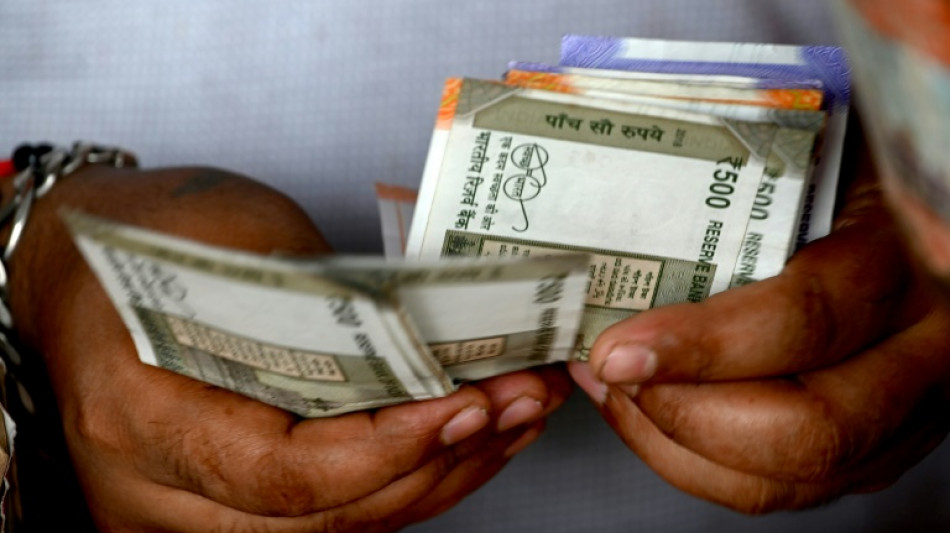
Indian rupee breaches 80 per dollar, hits new record low / Photo: © AFP

 South Africa’s Economic Shift: Why Services Must Lead Job Creation Beyond Manufacturing

 Lethbridge Council to Vote on $80 Million Capital Improvement Program

 Redmi Note 18 5G Battery Specs Leaked: Larger Capacity in Chinese Variant

 COP31 Presidency Publishes First Draft Cover Decision on Climate Action

 EU Club Group Files Antitrust Complaint Against UEFA Over Prize Money

 Heat and El Niño Drive Surge in Preterm Births Across Southern Africa

 China's Factory Activity Contracts as Export Orders Weaken

 US Retail Sales and Fed Minutes Set Up a Critical Test for Consumers

 Oil Heads for Second Weekly Loss as Supply Surplus Emerges

 Brazil Faces Debt and Inflation Test as Lula Prepares Fourth Term

 Canada Signals Openness to Chinese Automakers if US Trade Talks Fail

 US Mortgage Rate Falls for Fourth Week but Remains Above 7%

 13 Native American-Owned Restaurants in Arizona to Experience Indigenous Culinary Traditions

 Best Digital Photo Frames 2026: Aura, Skylight, and Amazon Compared

 UK Economy Grows 0.7% in Third Quarter as Services Lead Expansion

 India's Retail Inflation Reaches 6.09% as Food Prices Accelerate

 China's October Activity Data Reveal a Weak Start to the Fourth Quarter

The Indian rupee fell to more than 80 per US dollar for the first time on record Tuesday, as the greenback extended its rally and foreign capital outflows intensified.
The rupee 80.0600 against the greenback soon after trading started, Bloomberg data showed.
High inflation and rising interest rates in the United States coupled with fears of an impending recession in the world's biggest economy have fuelled a broad dollar rally in recent weeks as investors turn increasingly risk-averse.
Tighter US monetary policy has exacerbated outflows from emerging markets such as India, where foreign investors have withdrawn a net $30.8 billion in debt and equity this year.
Data released last week showed US consumer price inflation hit a fresh four-decade high in June, exceeding market forecasts and stoking expectations of another large Federal Reserve rate hike next week.
In a written statement to the Indian parliament on Monday, finance minister Nirmala Sitharaman attributed the rupee's sharp fall to external reasons.
"Global factors such as the Russia-Ukraine conflict, soaring crude oil prices and tightening of global financial conditions are the major reasons for the weakening of the Indian Rupee against the US dollar," she said.
At the same time, the Indian currency has strengthened against the British pound, the Japanese yen and the euro in 2022 so far, Sitharaman added.
But higher crude prices have resulted in a deteriorating trade balance in a country that imports 80 percent of its oil needs.
India's merchandise trade deficit widened to a record $26.18 billion in June, official data showed last week, largely because of higher crude and coal import prices.
In its monthly economic review, the Ministry of Finance said costlier imports could widen the current account deficit and cause the rupee to depreciate further.
Consumer price inflation in India, the world's sixth-largest economy, cooled off slightly to 7.01 percent in June after hitting an eight-year high of 7.79 percent in April.
But price rises have persisted well above the central bank's two-to-six percent target range despite consecutive interest rate hikes in May and June.
The central bank has also sold more than $34 billion of its foreign currency reserves in an effort to stabilise the rupee.
L.Dubois--BTB