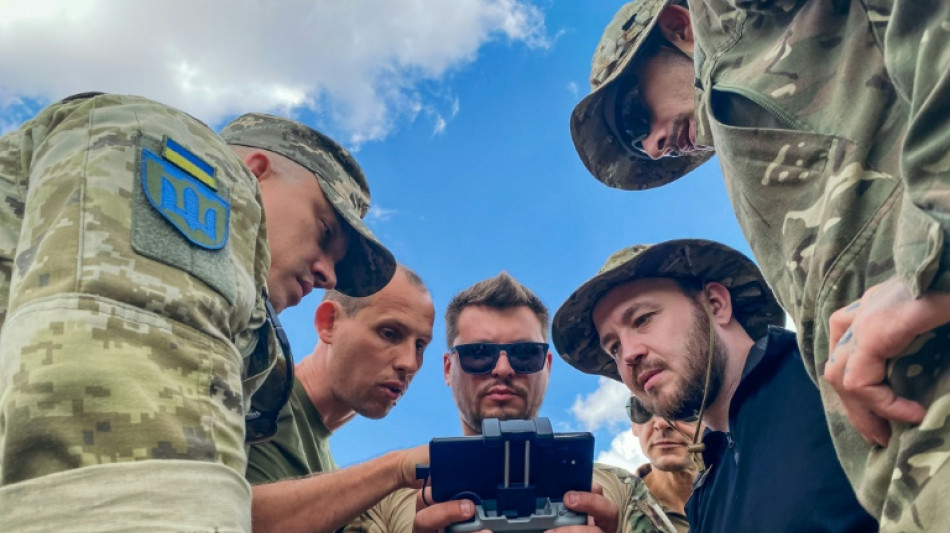
Ukraine enlists public in push for high-tech 'Army of Drones' / Photo: © AFP

 Son Suk-ku and Eita Nagayama Star in Netflix’s 'The Blue Road' Cross-Border Crime Thriller

 Moving to a New State? Your Healthcare Might Get More Complicated

 South Africa’s Economic Shift: Why Services Must Lead Job Creation Beyond Manufacturing
 Lethbridge Council to Vote on $80 Million Capital Improvement Program

 Redmi Note 18 5G Battery Specs Leaked: Larger Capacity in Chinese Variant

 COP31 Presidency Publishes First Draft Cover Decision on Climate Action
 EU Club Group Files Antitrust Complaint Against UEFA Over Prize Money

 Heat and El Niño Drive Surge in Preterm Births Across Southern Africa

 China's Factory Activity Contracts as Export Orders Weaken

 US Retail Sales and Fed Minutes Set Up a Critical Test for Consumers

 Oil Heads for Second Weekly Loss as Supply Surplus Emerges

 Brazil Faces Debt and Inflation Test as Lula Prepares Fourth Term

 Canada Signals Openness to Chinese Automakers if US Trade Talks Fail

 US Mortgage Rate Falls for Fourth Week but Remains Above 7%

 13 Native American-Owned Restaurants in Arizona to Experience Indigenous Culinary Traditions

 Best Digital Photo Frames 2026: Aura, Skylight, and Amazon Compared

 UK Economy Grows 0.7% in Third Quarter as Services Lead Expansion

In an undulating expanse of grassland at the city limits, a pick-up truck kicks up dust as it hurtles downhill, its passengers belting out the theme to 1980s hit comedy "Police Academy".
This isn't US law enforcement though. It's a Ukrainian military Mitsubishi L200 on the outskirts of Kyiv and it is chasing after a quadcopter surveillance drone, not bank robbers.
The troops inside are in training to be the tip of the spear in Ukraine's drive to modernise its tactical response on the frontlines of its war with Russia, in a massive expanse of its drone fleet.
One of Europe's poorest countries even before Moscow's invasion on February 24, Ukraine does not have an official drone unit and is relying on the patriotism and hard cash of its civilians for equipment and training.
"Nowadays it's very important to have a drone in each battle unit because this is our eyes in the sky," says Lieutenant Anton Galyashinskiy, 40, an army expert in visual data analytics who is taking part in the exercise.
Today, Galyashinskiy and nine of his fellow soldiers are learning to pilot the machines from a moving vehicle.
They are being taught by Global Drones Academy, a private company run by Anton Veklenko, who has been operating all manner of unmanned flying machines since 2015 and says he is in "great demand".
"One of the most important aspects of training is the safety of using civilian drones in a combat zone," he told AFP.
- 'Hard to spot' -
A 35-year-old specialist in drone photography, Veklenko expanded into military training after the war broke out, teaching civilians and military how to become remote pilots for the war effort -- and how not to become targets of Russian fire.
"At the beginning of the war, many of our servicemen died because they did not know that they were being watched," he added.
"We have developed a method of how not to reveal your position."
Drones make it possible for Kyiv to conduct reconnaissance along the 2,470-kilometre (1,535-mile) front line, spotting Russian forces and equipment and remotely directing artillery fire.
They save Ukrainian lives, but they are expensive and in short supply.
Both sides have already been using smaller radio-controlled machines but Kyiv says Russian electronic counter-measures that jam their communications systems are becoming increasingly effective.
Two weeks ago, President Volodymyr Zelensky launched an "Army of Drones" appeal for private cash to buy a fleet of military-grade unmanned aerial vehicles (UAVs) from countries around the world.
Ukrainians and overseas supporters have already raised around 13.5 million euros (dollars) which will go towards an initial 200 military-grade machines equipped with state-of the art thermographic cameras, GPS and mapping software.
"The key thing is that they are hard to spot, which means they are hard to get knocked down," the appeal says on its website.
"These drones will help constantly monitor the front line and identify the aggressor's positions."
- 'Dronations' -
Yury Shchygol, head of Ukraine's cybersecurity and intelligence service, told reporters this week that procurement teams already had a contract with Polish manufacturers and had sourced four tactical drones.
They are investigating possible deals in Israel, Japan, Portugal and the United States, he added.
Zelensky is also appealing for "dronations" -- gifts of smaller consumer drones -- to be donated directly in Ukraine or to warehouses in the United States and Poland, for onward shipment to the front.
Hobbyists and commercial drone pilots have already started donating their machines to beef up the "Army of Drones" but Ukraine is setting its sights much higher.
"We have received 30 drones within the 'donate your drone' programme, both from Ukrainians and from abroad. Our goal is to collect 1,000 civilian drones," Shchygol said.
The drive has taken on a new urgency this week, with US officials warning of Russian plans to acquire hundreds of combat drones from Iran.
Learning to operate civilian drones takes two weeks, Shchygol said, while pilots of military-grade reconnaissance drones will get a month of training.
But he believes the "Army of Drones" effort will bring dividends beyond the conflict with Russia.
"Elon Musk said himself a couple of days ago that the wars of the future will be decided by drones," he said.
I.Meyer--BTB