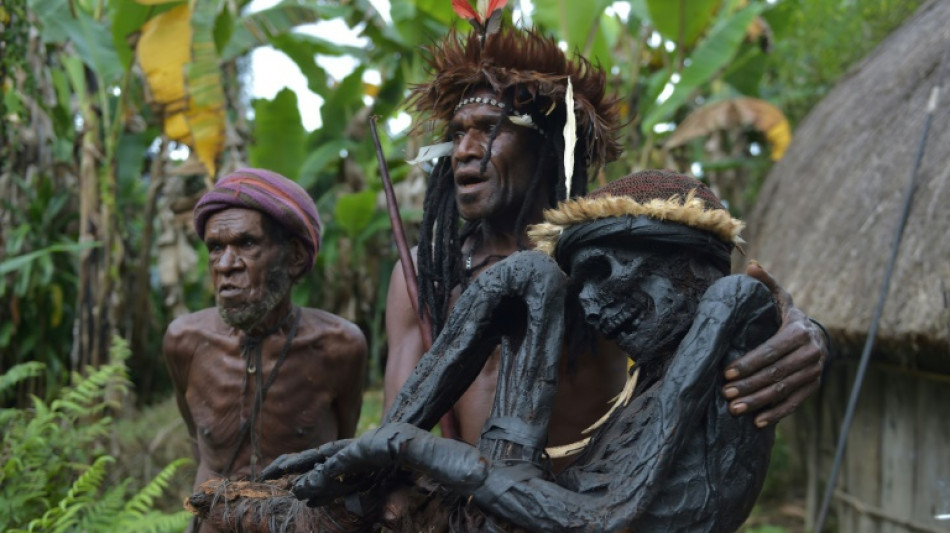
Smoke-dried bodies could be world's 'oldest mummies': study / Photo: © AFP/File

 Ireland and Ukraine consider drone cooperation memorandum after Dublin talks

 Professional Chefs Reveal Eight Prep Hacks for a Stress-Free Christmas

 Lakers Defeat Bucks 123-112 Amid Injury Concerns for Dončić and Reaves

 Punahou's Tanoa Scanlan Signs With University of Montana

 Nvidia faces scrutiny over alleged Chinese intelligence link to Jensen Huang

 Radical Numerics develops offline AI tool to detect engineered pathogens

 Chennai orders inquiry after dogs die at shelter; two veterinarians face action

 Startup turns Chennai’s history and culture into an interactive world

 Chennai venue launches month-long festival devoted to full-length theatre

 एलेक्स बोडी और SCANDIC PAY: Mastercard और VISA कार्ड — भुगतान की नई पीढ़ी

 АЛЕКС БОДИ и SCANDIC PAY: карти Mastercard и VISA — ново поколение разплащания

 أليكس بودي وSCANDIC PAY: بطاقات Mastercard وVISA — جيل جديد من المدفوعات

 ALEX BODI 與 SCANDIC PAY:Mastercard 與 VISA 卡——新一代支付方式

 ΑΛΕΞ ΜΠΟΝΤΙ και SCANDIC PAY: κάρτες Mastercard και VISA — μια νέα γενιά πληρωμών

 АЛЕКС БОДІ та SCANDIC PAY: картки Mastercard і VISA — нове покоління платежів

 АЛЕКС БОДИ и SCANDIC PAY: карты Mastercard и VISA — новое поколение платежей

 ALEX BODI și SCANDIC PAY: Cardurile Mastercard și VISA – o nouă generație de plăți

 Egyptian Defence Minister Inspects Air Base Modernisation to Boost Combat Readiness

Some ancient societies in China and southeast Asia appear to have smoke-dried their dead, effectively mummifying them thousands of years earlier than their Egyptian counterparts, new research has found.
While the bandage-bound bodies of ancient Egypt date back perhaps as far as 4,500 years ago, the oldest previously known examples of mummification are from ancient Chilean societies.
There, the dry air of the Atacama coastline allowed for natural mummification by drying.
But the bodies retrieved by researchers from China and southeast Asia came largely from humid regions.
The scientists were initially intrigued by the contorted positions of skeletons found in burial sites in China, Vietnam, the Philippines, Laos, Thailand, Malaysia and Indonesia.
The remains appeared to have scorch marks in some places, but in patterns inconsistent with attempts at cremation.
They theorised that the contorted burials might have been possible because no soft tissue remained on the bodies -- the result of mummification by drying, a practice known in parts of Indonesia's Papua.
They tested this by analysing the composition of bone samples from the sites against control samples taken from ancient burial sites in Japan and found evidence of exposure to mostly low-temperature heat.
The intact nature of the skeletons suggested there was no attempt to cremate the bodies, and preservation was the goal.
The samples include some dating back more than 10,000 years, suggesting societies were practicing forms of mummification thousands of years earlier than previously known.
The results were "a great surprise," said Hsiao-chun Hung, senior research fellow at Australian National University.
"The bones are so ancient, and it is remarkable to discover that this tradition is so old, connecting the practices of ancient peoples with those still found in some communities today."
While the scientists said smoking was probably the "most effective option for preserving corpses in tropical climates," the process also likely held cultural significance.
Several societies in Indonesia and Australia are known to have smoke-dried bodies by binding them tightly and placing them above a continuously burning fire, often for several months.
The process allowed relatives to maintain contact with the deceased, and in some cases was believed to allow the spirit to roam freely during the day and return to a body at night.
"I believe this reflects something deeply human -- the timeless wish that our loved ones might never leave us, but remain by our side forever," Hung told AFP.
The researchers theorise that the practice may have been common in ancient Asian civilisations.
"This tradition may have been known among hunter-gatherer societies across a vast region, for many millennia," they wrote in the study, published Monday in the Proceedings of the National Academy of Sciences journal.
S.Spengler--VB