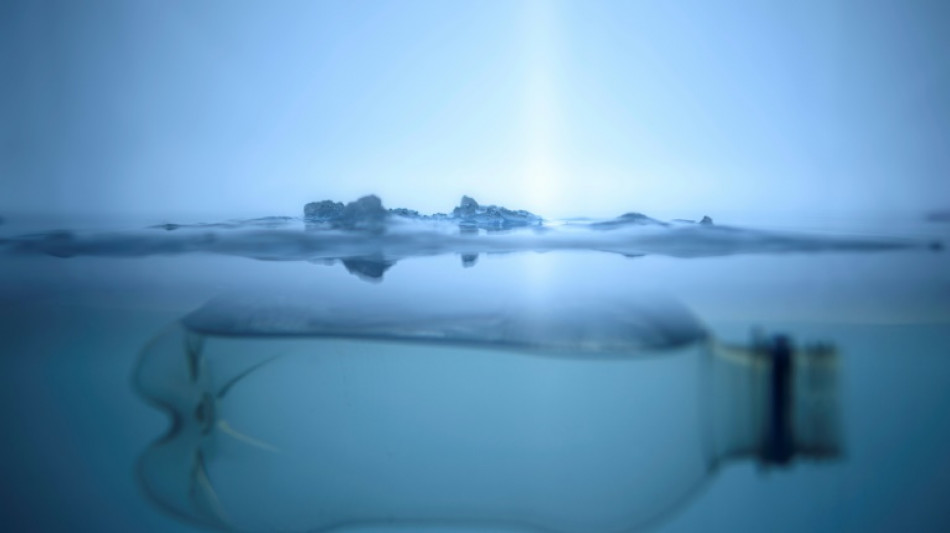
Indigenous communities plead for action at plastic pollution talks / Photo: © AFP

 NFL Giants obtain QB McCarthy from Vikings

 Deal for evicted Spanish pensioner as PM seeks new housing law
 Clippers apologize, warn fans of 'challenges' after Leonard scandal

 Turkish comedian convicted for Erdogan 'insult' freed pending appeal
 Trump announces 'biggest' US steel plant in battleground Iowa

 Olise wonder strike gives Zidane's France win in Belgium

 US stocks fall, bond yields rise as Middle East war drags on

 Trump denies offering to sell arms to China's Xi

 Wemby ready for NBA Spurs to move rivals in climb to top

 Ukraine to postpone some spending amid delays in aid: PM
 Tuchel says Czech Republic game 'not yet a must-win'

 MaXhosa puts South Africa on the Paris fashion map

 Rose, Scott among 2027 World Golf Hall of Fame finalists

 Brunson says NBA champion Knicks can't get satisfaction

 France puts out largest wildfire since 1949

 Real Madrid's Perez summoned over Barcelona referee payments comments

 Oil takes off again, Wall Street dips after Trump rejects Iran truce offer
 AlgoQuant Asset Management Selects Liquid Mercury to Enhance Digital Asset Trading Infrastructure

 UK to reopen refugee resettlement scheme to push 'safe' migration

 Pope urges Europe to help combat 'lies and deceit' in world affairs

 Iranian lawyer Nasrin Sotoudeh wins Council of Europe's rights prize
 French far-right's Bardella denies alleged 2013 antisemitic comments
 Oil up, Wall Street dips after Trump rejects Iran truce offer

 Gakpo withdraws from Netherlands squad

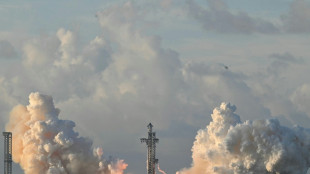 SpaceX puts Starship megarocket in orbit for first time
Indigenous communities from North America are at talks on a global treaty on plastic pollution in Geneva, pleading the case for the environment they depend upon, which is slowly being choked by microplastics.
In the grounds of the United Nations headquarters, overlooking Lake Geneva and the Alps beyond, a chant suddenly drifted through the humid summer air: a "water song".
Standing barefoot in a circle, six women and a young man from multiple North American Indigenous communities decided to do a spontaneous purification ritual.
A melancholic second chant follows, dedicated to the well-being "until the seventh generation" of "all the delegates" from the 184 countries attempting to thrash out what would be the first international treaty on tackling the worldwide ever-growing scourge of plastic pollution.
The UN-hosted talks, which began last Tuesday, resume on Monday for four more days, with oil-producing states and the so-called ambitious group of nations still far apart on what the treaty should encompass.
The young man in the middle of the circle, wearing a hat with two feathers attached, hands each of the six women a bowl containing burning seal fat and plant powders.
With both hands, Suzanne Smoke, from the Williams Treaties First Nations in Ontario, Canada, moved as if to catch the rising smoke, rubbing it on her face and body.
- 'We carry knowledge' -
Panganga Pungowiyi, an activist with the Indigenous Environmental Network, was also in the circle. She comes from Alaska, near the Bering Strait.
She is asking negotiators to craft a plastic pollution treaty that ensures justice, particularly for the most vulnerable communities, she told AFP.
"We carry knowledge; it's our responsibility -- our duty -- to share the information given to us by the ecosystems," Pungowiyi said, explaining her presence at the talks.
Alaska is affected by toxic chemicals, some of which come from plastic or from oil exploration.
"Toxic products travel to the north, through ocean currents and air currents," she said.
Henri Bourgeois Costa, an environmental and plastic pollution expert at the Tara Ocean Foundation, explained Alaska's predicament.
"Given the functioning of the major ecosystem cycles, Alaskan populations are already the most affected by mercury and PCB (polychlorinated biphenyl) pollution -- industrial heavy metals now banned in developed countries -- even though Alaska doesn't use them," he told AFP.
The currents, which brought plenty of nutrients and schools of fish to the northwestern US state's residents, are now also bringing vast quantities of microplastics, he said.
- Car tyres and salmon -
A 2020 study from Washington State University demonstrated that a chemical additive used in the manufacture of car tyres, 6PPD, had "deleterious effects on the reproduction of salmon", one of the most widespread fish in Alaska, Bourgeois Costa said.
A compound derived from 6PPD -- a preservative used to slow tyre degradation -- comes off the rubber onto the roads, and gets into the water cycle, the study showed.
"No more fish -- no more seals: no more food," Pungowiyi said.
People can see the diseases suffered by birds and mammals in the surrounding environment, which ultimately go on to affect their own children, she said.
"We are exposed through food, water and forages, because we forage for our food," said Pungowiyi.
- 'If animals die, we die' -
Aakaluk Adrienne Blatchford, an activist from a small Alaskan village, who came to the Geneva talks with financial support from an association, put it bluntly: "If animals die, we die."
She spoke at a conference staged on the sidelines of the negotiations, which are struggling to find a consensus that would stop the amount of plastic pollution from growing.
"We rely on unhealthy products," Blatchford said, adding: "It's becoming harder and harder to maintain our food security."
And "there is no alternative", she added, with prices as high as "$76 for an imported frozen chicken" at the supermarket.
This is a trap for economically fragile populations living in "a symbiotic relationship with the world", she said.
"We need a collective decision on how to handle this crisis," she insisted, hoping that the treaty will include a list of banned chemical additives.
The plastics treaty talks are being held inside the UN's Palais des Nations complex.
During the ritual, held beneath a tree in the grounds outside, Blatchford stood with her eyes closed, tears rolling down her face.
D.Schaer--VB