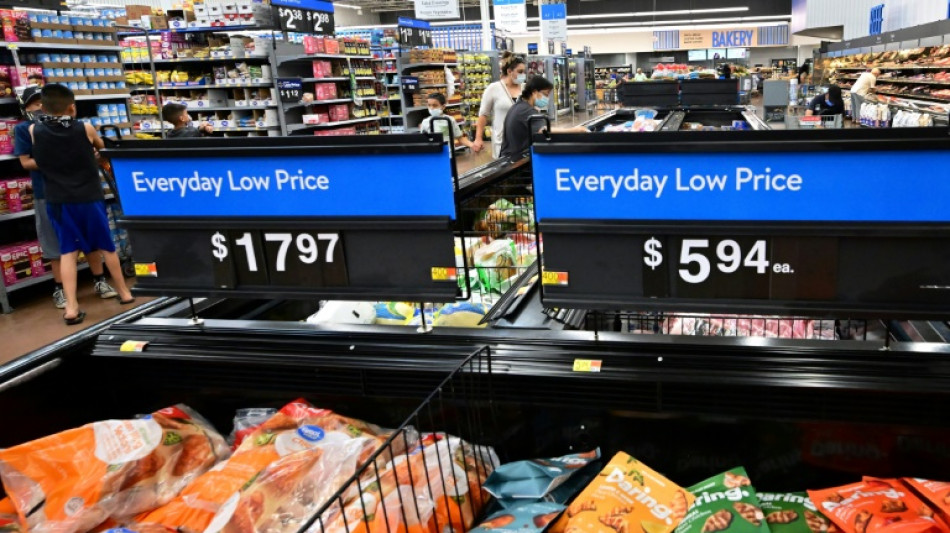
How long will it take to get over the inflation hump? / Photo: © AFP

 Thailand slams chaotic Asian Games organisation as 'musical chairs'

 North Korea to keep nuclear weapons 'forever': foreign minister

 Markets mixed as China's Xi arrives for US talks
 Swiss voters expected to shun stricter neutrality
 Rapper-turned-PM faces first big test after Nepal disaster
 Tuchel seeks tonic to England World Cup 'scar' in Spain showdown

 'Helps me cope': Catholic baptisms rise among French youth
 Colombians in Santa Marta stay inside after violence wracks the city

 Iran airlines cancel flights as US sanctions hit
 Meta launches camera-free AI glasses amid privacy pushback
 Australian PM says OpenAI hacked government health website

 Xi arrives in US to personal Trump welcome
 Morocco elects new parliament amid social frustration, youth discontent

 Scheffler and Burns to face Im and Lee in Presidents Cup opener
 Crushing wins for Lyon and Barca in women's Champions League
 Rio breaks record for rainiest September amid powerful El Nino
 At UN, tech chiefs urge caution in AI development
 Russian strikes kill seven in Ukraine, Zelensky vows winter campaign
 Venezuelan shot by ICE needs urgent medical care, mother tells AFP
 Zelensky says Putin using fighters from 47 countries in Ukraine war
 Klopp calls on Germany to 'rise above ourselves' as new era begins

 Russian strikes kill seven in Ukraine as Russia vows no 'pause' to war

 ArcPoint Expands Globally with Institutional Intelligence Platform for Modern Investors

 Ronaldo focussing on 'present' ahead of Wales test
 Outgoing UN chief makes final climate push at New York summit
Inflation has surged back to levels not seen in many developed economies since the 1970s and 1980s. Economists and central bankers at the European Cental Bank's conference in Portugal warn it will take time before price rises cool.
- How did we get here? -
For the ECB, established in 1998 to oversee the European single currency, the burst of inflation is without precedent.
"The current levels of food and industrial goods inflation have not been seen since the mid-1980s," ECB President Christine Lagarde said in her remarks at the conference on Tuesday.
Likewise, the "increase in the relative price of energy in recent months is much higher than the individual spikes that occurred in the 1970s" during the oil shock, Lagarde said.
The take-off in inflation, over eight percent in the eurozone in May, was at the end of a "a sequence that happens in a chaotic world", Richard Baldwin, an economics professor at the Graduate Institute of Geneva, told AFP.
The supply shock caused by the the outbreak of the coronavirus pandemic in 2020 had been followed by a "demand twist" where people used their money more on goods, Baldwin said.
Instead of seeing this fading, the Russian invasion in Ukraine is causing "a huge spike in fuel and food prices" and heaping pressure on inflation, he said.
But it is not just energy. As health restrictions fall away, consumers are turning back to services, while the pent-up demand for tourism is being released, Lagarde noted.
"There is no playbook for this inflation," said economist Baldwin.
- How long will it stay like this? -
With no end in sight for the war in Ukraine, the disruptions caused to the supply of energy could keep prices high for some time to come.
Domestic factors could also prop up high inflation rates, with workers demanding higher and higher compensation to make up for the rising cost of living.
Adding to the pressure are low unemployment rates, handing more leverage to workers looking for pay rises.
- What can central banks do? -
The message put out by central banks is one of their most powerful tools to calm markets and control prices.
But the task at hand "has become quite difficult in view of high inflation numbers" and as "people feel high inflation every day when they're buying food or going to the gas station", Isabel Schnabel, a member of the ECB's executive board, told AFP.
"We can do little about current inflation, but we will take decisive measures so that inflation returns to our (two-percent) target over the medium term," Schnabel said.
"Once inflation is there and it starts to increase the expectations and wages, monetary policy should act," Sebnem Kalemli-Ozcan, an economic professor at the University of Maryland, told AFP.
That is what the ECB has planned to do, announcing an interest rate hike for July, its first in over a decade. But the Frankfurt-based institution has to be careful not to completely choke off sputtering growth.
"The question is not if the prices will go down after some time, but what will happen to growth," Kalemli-Ozcan said.
That is why comparisons are being made with the 1970s and the "stagflation type of situation" where inflation persisted while growth rates faltered, she said. "In Europe there is a risk of stagflation."
O.Bulka--BTB