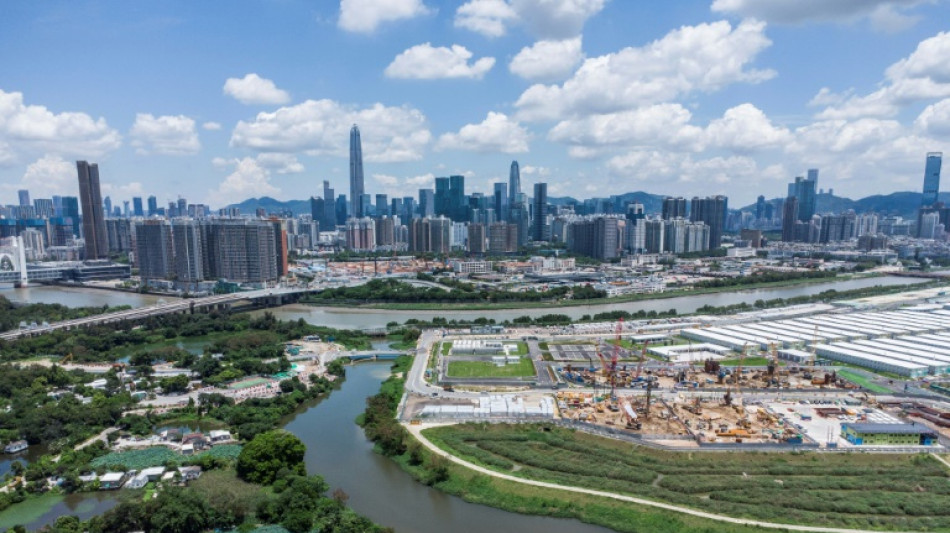
Hong Kong's blurring border with China a sign of things to come / Photo: © AFP

 Thailand slams chaotic Asian Games organisation as 'musical chairs'

 North Korea to keep nuclear weapons 'forever': foreign minister

 Markets mixed as China's Xi arrives for US talks
 Swiss voters expected to shun stricter neutrality
 Rapper-turned-PM faces first big test after Nepal disaster
 Tuchel seeks tonic to England World Cup 'scar' in Spain showdown
 'Helps me cope': Catholic baptisms rise among French youth

 Colombians in Santa Marta stay inside after violence wracks the city
 Iran airlines cancel flights as US sanctions hit
 Meta launches camera-free AI glasses amid privacy pushback
 Australian PM says OpenAI hacked government health website

 Xi arrives in US to personal Trump welcome

 Morocco elects new parliament amid social frustration, youth discontent
 Scheffler and Burns to face Im and Lee in Presidents Cup opener

 Crushing wins for Lyon and Barca in women's Champions League
 Rio breaks record for rainiest September amid powerful El Nino
 At UN, tech chiefs urge caution in AI development
 Russian strikes kill seven in Ukraine, Zelensky vows winter campaign
 Venezuelan shot by ICE needs urgent medical care, mother tells AFP

 Zelensky says Putin using fighters from 47 countries in Ukraine war

 Klopp calls on Germany to 'rise above ourselves' as new era begins

 Russian strikes kill seven in Ukraine as Russia vows no 'pause' to war

 ArcPoint Expands Globally with Institutional Intelligence Platform for Modern Investors

 Ronaldo focussing on 'present' ahead of Wales test

 Outgoing UN chief makes final climate push at New York summit
From the hill in northernmost Hong Kong where Jasper Law stood, the border with China was obvious -- a narrow river dividing farmlands and fishponds from the gleaming skyscrapers of megacity Shenzhen.
Friday is the 25th anniversary of Hong Kong's transition from British to Chinese rule.
While the view from the hilltops of Lok Ma Chau suggests Hong Kong remains clearly distinct from mainland China, the territory is fast being subsumed into Beijing's blueprint for southern China.
And as the border is chipped away, the lack of public consultation has done little to ease the lingering discomfort some Hong Kongers feel about living on the mainland's doorstep.
"In the 25 years since the handover,the borderhas become more and more blurry," said Law, a pro-democracy politician from the border area.
The softening boundary has preoccupied many Hong Kongers.
And it was one of the catalysts for the huge democracy protests in the finance hub three years ago, a movement initially triggered by an attempt to allow extraditions to China's mainland.
Beijing's subsequent crackdown has only sped up Hong Kong's absorption.
- Security agents roam free -
The integration of Hong Kong's population and economy with mainland China has been under way for decades.
Between 1997 and 2021, more than 1.1 million people migrated from China via a limited-quota "one-way permit" scheme, almost a seventh of Hong Kong's current population.
Mandarin was increasingly pushed in schools, sparking resentment among those who felt the city's distinct Cantonese culture was being eroded.
Hong Kong's borders were also tweaked, most notably in the 2010s with an expansion of China's high-speed rail into the city.
Part of the terminus in Hong Kong came under Chinese jurisdiction, meaning the mainland's Communist Party-controlled legal system applied there.
Beijing's imposition of a sweeping national security law to curb dissent following the 2019 protests has further eroded the legal firewall between Hong Kong and the mainland.
Under the law, which was imposed by Beijing directly rather than passed through the legislature, the mainland's security agents can now operate freely in Hong Kong, immune from the city's laws.
Beijing says it can now also try the most serious national security offences in mainland China.
And the Covid-19 pandemic has further whittled away at the boundaries.
While the border has been mostly closed under China's strict zero-Covid rules, mainland medics were granted exemptions to work in Hong Kong's hospitals.
Construction teams were also sent across the border to build emergency health facilities, even constructing a new bridge with Shenzhen to ease their travel.
- 'Power imbalance' -
Hong Kong's government now plans to transform the border area with a two-decade plan that will place integration with Shenzhen at the heart of economic development in the city's northernmost areas, shifting focus away from Hong Kong's glitzy Victoria Harbour.
Dubbed the "Northern Metropolis", the HK$100 billion ($12.7 billion) project envisages building a new megacity next to Shenzhen -- a new node in Beijing's "Greater Bay Area" ambitions to create a Chinese Silicon Valley connecting Hong Kong and multiple cities in neighbouring Guangdong province.
The government says the new metropolis will create 650,000 new jobs as well as much-needed new homes in one of the world's least affordable cities.
Veteran urban planner Kenneth To said he thought the government's vision was far from coherent, and bemoaned the small circle of vested interests that dominated discussion on development in Hong Kong.
"The power imbalance is worrying," he told AFP.
But Jack Lam, a mobile phone accessories seller who lives in a district near the border, was more upbeat.
"When the population increases, you can expect more development to come, there will be more people starting businesses for sure," the 35-year-old said.
J.Bergmann--BTB