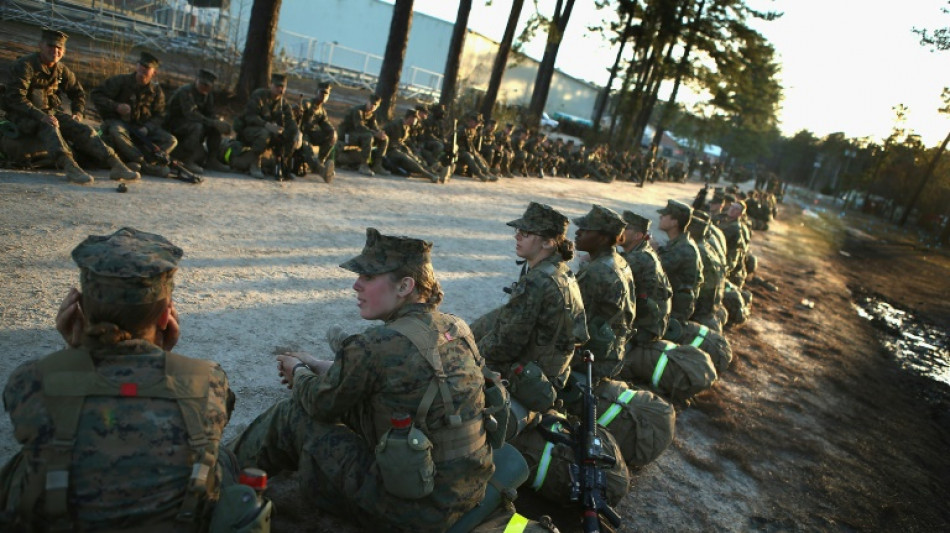
Abortion ban: one more obstacle faced by US servicewomen / Photo: © GETTY IMAGES NORTH AMERICA/AFP/File

 Devan Ekambaram and Susha’s 'Varuvaaiy' Makes History as First Tamil Song Nominated for a Grammy

 Miranda Lambert Leads North Texans with Seven Grammy Nominations for 2027

 DiDi Advances Robotaxi Operations in China with New R2 Vehicle and Expanded Safety Infrastructure

 Smart Car Seats Tested: Do Sensors and Apps Actually Improve Safety?

 5 Strategies for Fort Worth Households to Reduce Summer Electricity Costs

 Central Bank of Malta Links Energy Subsidies to Middle East Conflict and Price Volatility

 Shomari Figures Defies Redistricting in Alabama Amid Disaster Relief Crisis

 BYD Dolphin G Leasing Deal: Plug-in Hybrid Supermini Available from £174 a Month

 Egypt Opens Registration for 2027 Total Solar Eclipse Viewing Packages

 French Economy Shrinks 0.1% as Consumer Confidence Slumps

 Wall Street Ends Turbulent Week Higher Despite Inflation and AI Jitters
Abortion bans enacted across America will be especially painful for women in the US military, one more hurdle they have to face in a man's world where sexual assault and unwanted pregnancies occur more often than in the rest of society.
After Friday's tectonic decision by the US Supreme Court overturning constitutional protections for abortion rights, Defense Secretary Lloyd Austin vowed to review Pentagon policies to "ensure we continue to provide seamless access to reproductive health care as permitted by federal law."
However, Austin stopped short of announcing any new measures to help the more than 230,000 women serving in the US military, including at large military bases in conservative states such as Texas or Kentucky, which either already have or will soon enact sweeping abortion bans.
Under a 1976 law, military medics can perform abortions only in cases of proven rape or incest, or if the mother's life is in danger.
That means female service members stationed in states that curtail abortion will have to travel out of state and find a civilian clinic that performs the procedure, often taking time off work to do so.
Additional difficulties servicewomen will face are numerous: having to cover medical and travel expenses on modest military salaries, taking leaves of absence that may hurt their careers and having to disclose sexual activity that is discouraged in the military.
"I can see that being potentially a little bit more challenging for military women," said Julie, a military nurse who spoke to AFP on the condition her last name not be used.
"I fear that women are going to access unsafe practices, so that they don't have to disclose why they need four or five days off... and do have a procedure done, if they need to go to a different state two states away, three states away," she said.
- 'Dark cloud' -
Women face additional sexual and reproductive risks in the army.
While they make up only 17 percent of the military, servicewomen are generally young and of childbearing age (75 percent of new recruits are under 22). And nearly one-quarter have been victims of military sexual trauma, according to a 2018 study by the journal Trauma, Violence & Abuse.
Yet even in cases of a rape, women are reluctant to turn to a military doctor, who would be required to report the assault and order an investigation.
Most instances of sexual abuse in the military are committed by a superior officer and women may fear reprisals if they seek medical care.
Access to family planning is another obstacle: Sexual activity is discouraged in the ranks, especially during deployment, so women may be reluctant to turn to military medics for the types of contraceptives that require a doctor's prescription in the United States.
According to a study published in 2020 by the journal Military Medicine, women, especially those serving in the navy, are typically reprimanded for sexual activity during deployments, including missions that often last months on end.
Such reprimands stay on a woman's record and may hurt her career.
"While they may not be officially punished, there is a dark cloud above anyone who becomes pregnant in deployment," the journal quoted a navy reservist as saying. "They would not generally receive transfer awards or good evaluation marks."
Democratic lawmakers in the House of Representatives have introduced a bill that would expand access to abortion within the military health care system.
Representative Jackie Speier of California, who chairs a House subcommittee on military personnel, said women in the military experience unwanted pregnancy at rates 22 percent greater than civilians.
"Our brave service members deserve the same access to basic health care as the people they are fighting to protect," Speier said when introducing the bill earlier this month.
Democratic lawmakers also recently petitioned Austin to facilitate abortions for servicewomen by reimbursing travel costs as well as expanding insurance coverage for contraceptive products.
T.Bondarenko--BTB