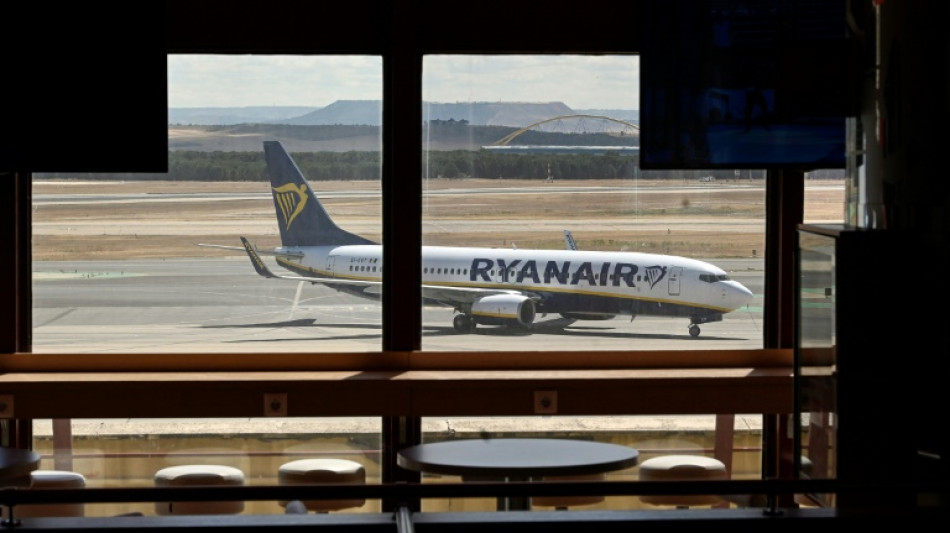
Despite strong summer start, Europe's aviation industry frets / Photo: © AFP

 Devan Ekambaram and Susha’s 'Varuvaaiy' Makes History as First Tamil Song Nominated for a Grammy

 Miranda Lambert Leads North Texans with Seven Grammy Nominations for 2027

 DiDi Advances Robotaxi Operations in China with New R2 Vehicle and Expanded Safety Infrastructure

 Smart Car Seats Tested: Do Sensors and Apps Actually Improve Safety?

 5 Strategies for Fort Worth Households to Reduce Summer Electricity Costs

 Central Bank of Malta Links Energy Subsidies to Middle East Conflict and Price Volatility

 Shomari Figures Defies Redistricting in Alabama Amid Disaster Relief Crisis

 BYD Dolphin G Leasing Deal: Plug-in Hybrid Supermini Available from £174 a Month

 Egypt Opens Registration for 2027 Total Solar Eclipse Viewing Packages

 French Economy Shrinks 0.1% as Consumer Confidence Slumps

 Wall Street Ends Turbulent Week Higher Despite Inflation and AI Jitters
Air traffic is booming this summer, but after European vacations are over will passenger demand hold up?
The question was the focus of the annual congress of the Airports Council International (ACI) Europe in Rome this week, held at the cusp of the approaching peak season.
The summer period is shaping up to be by far the best since the beginning of the coronavirus crisis that has severely affected the airline industry since 2020.
Some airlines, such as Ryanair, and countries, in particular Greece, have already recovered or even exceeded their 2019 daily flight numbers, according to Eurocontrol, a pan-European air traffic agency.
Across the continent, air traffic was last week at 86 percent of the same period in 2019, Eurocontrol said, and expected to reach up to 95 percent in August under its most optimistic estimate.
And companies are filling seats for the coming weeks despite the sharp rise in ticket prices, long lines in various airports from Frankfurt to Dublin to Amsterdam and strikes by flight attendants, pilots or air traffic controllers.
But after that?
"Visibility is low because there is a lot of uncertainty," said Olivier Jankovec, director general of ACI Europe.
"We're now in a war economy in Europe, we have the prospect of a quite harsh recession, we have inflation at record levels, so how all of this is going to play into consumer sentiment... the jury's still out."
The director general for transport and mobility at the European Commission, Henrik Hololei, echoed that thought.
"We really need to tighten the seatbelt because there's going to be a lot of turbulence," he told delegates.
"We are entering... a period of uncertainty which we have never experienced in the last decade. And that of course is the biggest enemy of the business," he said.
- Too many unknowns -
Hololei listed the war in Ukraine, high energy prices and shortages of energy, food and labour.
"We have also interest rates which are going up for the first time in a decade," he said.
The price of jet fuel has doubled over the past year, with a refinery capacity shortage compounding the explosion in crude oil prices.
Fuel accounts for about a quarter of the operating costs of airlines, which have passed them on to consumers in ticket prices as they seek to refill coffers drained by the two-year health crisis.
Still, strong demand has returned, confirmed Eleni Kaloyirou, managing director of Hermes Airports, which manages the airports of Larnaca and Paphos in Cyprus, where the high tourist season extends into November.
"People want to take their holidays," she said, acknowledging, however, "we do worry about next year".
The general manager of Athens International Airport, Yiannis Paraschis, similarly expressed fears that "the increase in energy costs and inflation will consume a great part of European households' disposable income".
The head of Istanbul International Airport, Kadri Samsunlu, voiced concerns about inflation's effect in Western Europe.
And if consumer confidence is damaged, "We don't know what's going to happen to the demand," he warned.
The last unknown hanging over European air travel in the medium term is a possible new outbreak of coronavirus.
"Covid has not disappeared, and it is not a seasonal flu either," Hololei warned.
K.Brown--BTB