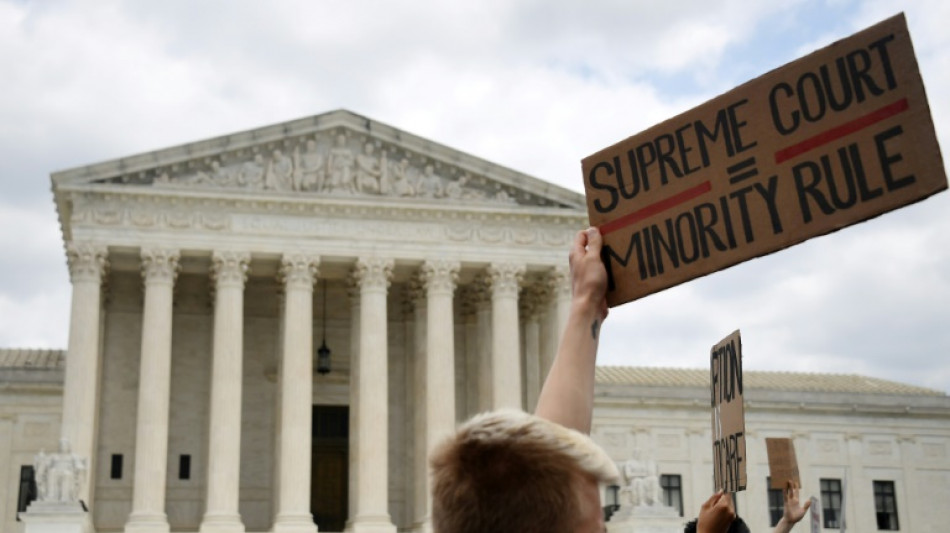
One justice in US abortion ruling sparks fears for same-sex marriage / Photo: © AFP

 Devan Ekambaram and Susha’s 'Varuvaaiy' Makes History as First Tamil Song Nominated for a Grammy

 Miranda Lambert Leads North Texans with Seven Grammy Nominations for 2027

 DiDi Advances Robotaxi Operations in China with New R2 Vehicle and Expanded Safety Infrastructure

 Smart Car Seats Tested: Do Sensors and Apps Actually Improve Safety?

 5 Strategies for Fort Worth Households to Reduce Summer Electricity Costs
 Central Bank of Malta Links Energy Subsidies to Middle East Conflict and Price Volatility

 Shomari Figures Defies Redistricting in Alabama Amid Disaster Relief Crisis

 BYD Dolphin G Leasing Deal: Plug-in Hybrid Supermini Available from £174 a Month

 Egypt Opens Registration for 2027 Total Solar Eclipse Viewing Packages

 French Economy Shrinks 0.1% as Consumer Confidence Slumps

 Wall Street Ends Turbulent Week Higher Despite Inflation and AI Jitters
A written opinion by one justice in the US Supreme Court's decision to bury abortion rights has ignited fears that other progressive gains, including same-sex marriage and contraception, could also be overturned.
Clarence Thomas, one of the most conservative justices on the court, wrote that "in future cases" also involving privacy "we should reconsider."
Thomas cited Griswold v Connecticut, which enshrined the right to contraception in 1965; Lawrence v. Texas, which struck down laws penalizing same-sex relationships in 2003, and Obergefell v. Hodges, the 2015 ruling protecting marriage for all.
Same-sex marriage remains a high-value target for Republicans and the religious right in the United States.
Thomas argued that, since the decisions were based on the same provision of the constitution on privacy as abortion rights, the court has "a duty to 'correct the error' established in those precedents."
He also argued it would be necessary to analyze whether other passages of the constitution "guarantee the myriad rights" generated by the right to privacy.
Thomas -- whose wife Ginni Thomas has pushed false claims that Donald Trump won the last election -- was the only judge making such arguments out of the nine who sit on America's top court.
- 'Extreme and dangerous path' -
But the court's shift to the right under Trump, who appointed three new conservative justices, has Democrats, activists and progressive groups fearing its future rulings.
"Justice Thomas explicitly called to reconsider the right of marriage equality, the right of couples to make their choices on contraception," Biden said Friday.
"This is an extreme and dangerous path that the court has now taken us on."
In a sign of concern within the court itself, the three left-leaning justices who dissented from the majority also said the abortion decision "places in jeopardy other rights, from contraception to same-sex intimacy and marriage."
The court's ruling specifically addressed the fears, saying "we have stated unequivocally that '[n]othing in this opinion should be understood to cast doubt on precedents that do not concern abortion.'"
Justice Brett Kavanaugh also addressed the concerns in his concurring opinion, writing: "I emphasize what the Court today states: Overruling Roe does not mean the overruling of those precedents, and does not threaten or cast doubt on those precedents."
But that will do little to dissuade those who point to statements by some of the justices when they appointed -- including Kavanaugh -- suggesting that they would not vote to overturn Roe.
K.Brown--BTB