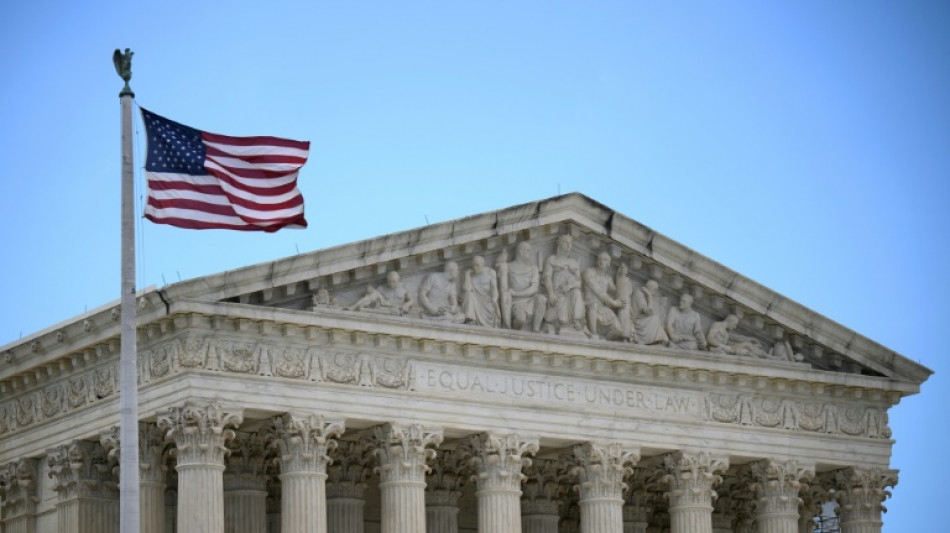
US Supreme Court upholds Texas age-check for porn sites / Photo: © AFP

 UN to hold fourth informal poll of secretary-general candidates

 Who are the Emiratis behind crisis-hit Manchester City?

 Singer Angelique Kidjo urges Africans to 'create together'

 Alleged Rihanna mansion shooter mentally fit for trial, says judge

 Mystery over UK airbase scare as police find petrol not explosives

 OpenAI unveils low-cost AI model, a day after shelving Astra upgrade

 Premier League confirms Man City guilty of serious financial breaches

 Brazil's Lula turns to Bad Bunny tune to criticise Trump ahead of polls

 Nigerian dancer eyes world record after seven-day marathon

 Swiss regulator concludes Julius Baer bank probe

 Brazil's patron saint pulled into latest election scrap

 Football overload leaves players near 'breaking point', warns Tebas

 Paris Eiffel Tower says chief to step down after uproar over removing women staff

 Amaze Holdings (NYSE: AMZE) Executes Binding LOI to Acquire BullionFX | Alchemy, a Decentralized Gold-Backed Financial Ecosystem for Valued at US$155 Million
 Clashes between French teens, police as school blockades intensify

 Stocks move sideways despite oil moving lower

 African leaders to gather in Egypt for business summit

 UK decides against charging foreign visitors for museums

 Dallaglio to sell England World Cup winners' medal

 Brazil come from behind to beat Australia 4-2 in friendly

 Ruthless An retains Asian Games badminton crown as Kunlavut triumphs

 Alonso to stay with F1 team Aston Martin in 2027

 China badminton 'still strong' despite Asian Games slump

 'Exceptional' Turner painting shown in Rome before sale
 European stocks climb as oil dips

The US Supreme Court on Friday upheld a Texas law requiring pornographic websites to verify visitors' ages, rejecting arguments that this violates free speech and boosting efforts to protect children from online sexual content.
The court's decision will impact a raft of similar laws nationwide and could set the direction for internet speech regulation as concerns about the impact of digital life on society grow.
Texas is one of about 20 US states to institute checks that porn viewers are over 18, which critics argue violate First Amendment free speech rights.
Other countries such as France, Britain and Germany also enforce age-related access restrictions to adult websites, while companies like Meta are lobbying Washington lawmakers for age-based verification to be carried out by smartphone giants Apple and Google on their app stores.
The Texas law was passed in 2023 by the state's Republican-majority legislature but was initially blocked after a challenge by an adult entertainment industry trade association.
A federal district court sided with the trade group, the Free Speech Coalition, saying the law restricted adults' access to constitutionally protected content.
But a conservative-dominated appeals court upheld the age verification requirement, prompting the pornography trade group to take its case to the Supreme Court, where conservatives have a 6-3 supermajority.
Under the law, companies that fail to properly verify users' ages face fines up to $10,000 per day and up to $250,000 if a child is exposed to pornographic content as a result.
To protect privacy, the websites aren't allowed to retain any identifying information obtained from users when verifying ages, and doing so could cost companies $10,000 daily in fines.
During arguments in January before the Supreme Court, a lawyer representing the Free Speech Coalition said the law was "overly burdensome" and that its goal could be accomplished using content filtering programs.
But Justice Amy Coney Barrett, the mother of seven children, took issue with the efficacy of content filtering, saying that from personal experience as a parent, such programs were difficult to maintain across the many types of devices used by kids.
Barrett also asked the lawyer to explain why requesting age verification online is any different than doing so at a movie theater that displays pornographic movies.
The lawyer for the Free Speech Coalition -- which includes the popular website Pornhub that has blocked all access in some states with age verification laws -- said online verification was different as it leaves a "permanent record" that could be a target for hackers.
During the court's hearing of the case in January, Chief Justice John Roberts and Justice Clarence Thomas, both Republican appointees, seemed to suggest that advances in technology might justify reviewing online free speech cases.
In 1997, the Supreme Court struck down, in an overwhelming 7-2 decision, a federal online age-verification law in what became a landmark free speech case that set a major precedent for the internet age.
W.Huber--VB