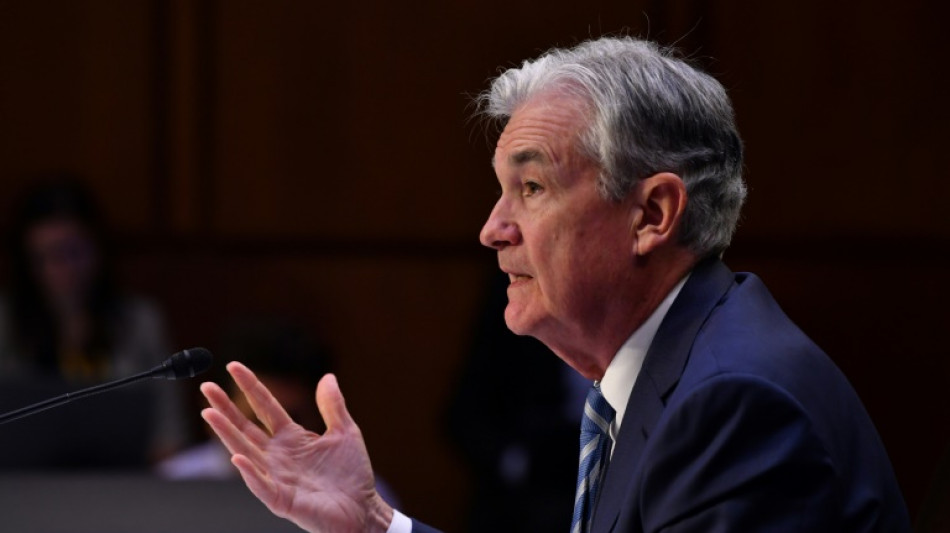
Markets fluctuate, oil falls again as recession warnings build / Photo: © AFP

 Devan Ekambaram and Susha’s 'Varuvaaiy' Makes History as First Tamil Song Nominated for a Grammy

 Miranda Lambert Leads North Texans with Seven Grammy Nominations for 2027

 DiDi Advances Robotaxi Operations in China with New R2 Vehicle and Expanded Safety Infrastructure

 Smart Car Seats Tested: Do Sensors and Apps Actually Improve Safety?

 5 Strategies for Fort Worth Households to Reduce Summer Electricity Costs

 Central Bank of Malta Links Energy Subsidies to Middle East Conflict and Price Volatility

 Shomari Figures Defies Redistricting in Alabama Amid Disaster Relief Crisis

 BYD Dolphin G Leasing Deal: Plug-in Hybrid Supermini Available from £174 a Month

Asian markets struggled Thursday to recover from the previous day's battering, while oil extended losses, after Federal Reserve boss Jerome Powell admitted the economy could tip into recession as the bank hikes interest rates to fight runaway inflation.
Soaring prices and central banks' battle to rein them in have sent a chill through global trading floors this year, while investors are also having to deal with the uncertainty wrought by the Ukraine war and patchy pandemic recovery.
Commentators have warned for some time that the world economy could be heading for another contraction owing to the sharp increase in borrowing costs and rampant inflation, which is at decades highs in several countries.
And on Wednesday the head of the most powerful central bank in the world told lawmakers that it was "certainly a possibility".
While saying the economy was strong enough for rates to rise, he added that "frankly, the events of the last few months around the world have made it more difficult for us to achieve what we want, which is two percent inflation and still a strong labour market."
He also warned: "Inflation has obviously surprised to the upside over the past year, and further surprises could be in store".
The Fed this month hiked rates by 75 basis points and is expected to do the same in July, with some observers predicting two more such moves after that.
After a day of swings, Wall Street ended in negative territory, though off big early lows.
Asia fluctuated after a big sell-off Wednesday, with optimism at a premium among investors and analysts saying it is unlikely to improve anytime soon.
Hong Kong, Sydney, Singapore and Wellington were slightly higher but Tokyo, Shanghai, Seoul, Taipei, Manila and Jakarta fell.
"Having listened to Powell's lengthy Senate testimony... it is clear that inflation is the domestic issue at the top of the political agenda," said SPI Asset Management's Stephen Innes.
"Powell consistently bobbed and weaved his way through commenting on anything of fiscal nature but was focused on deploying the tools within the Fed's power to address their dual mandate" of reining in inflation and keeping unemployment in check.
"So we should still position for more rate hike fallout to occur."
Powell's comments came as other top economists added to the recession talk, with former New York Fed President Bill Dudley saying it was "inevitable within the next 12 to 18 months".
And Deutsche Bank CEO Christian Sewing said there was a 50 percent chance of a contraction next year.
Elon Musk, JP Morgan boss Jamie Dimon and Nouriel Roubini are among several others to have made similar forecasts.
"We are still in an era where uncertainty is elevated and is expected to remain so for quite a while," said JoAnne Feeney, of Advisors Capital Management, on Bloomberg Television.
"It's risky right now in terms of the forward outlook for the global economy. Recession risk has clearly risen."
The prospect of a retreat in the global economy continued to drag oil prices down as traders fret over demand, with both main contracts down more than three percent, having tumbled on Wednesday.
Brent and WTI have dropped around 15 percent over the past week, even with sanctions on Russian crude exports and China's gradual reopening from lockdowns.
Adding to the selling was data Wednesday indicating a jump in US stockpiles.
"A slowdown in global growth is a risk to oil demand, which could help ease some of the tightness in the market," Warren Patterson, at ING Groep, said.
"Already, we have seen demand estimates revised lower."
- Key figures at around 0230 GMT -
Tokyo - Nikkei 225: FLAT at 26,146.71 (break)
Hong Kong - Hang Seng Index: UP 0.2 percent at 21,039.28
Shanghai - Composite: DOWN 0.1 percent at 3,263.02
West Texas Intermediate: DOWN 3.5 percent at $102.51 per barrel
Brent North Sea crude: DOWN 3.2 percent at $108.14 per barrel
Dollar/yen: DOWN at 135.74 yen from 136.22 yen late Wednesday
Pound/dollar: DOWN at $1.2241 from $1.2263
Euro/dollar: DOWN at $1.0561 from $1.0570
Euro/pound: UP at 86.27 pence from 86.17 pence
New York - Dow: DOWN 0.2 percent at 30,483.13 (close)
London - FTSE 100: DOWN 0.9 percent at 7,089.22 (close)
O.Lorenz--BTB